
These Saints Are Stones
Poems by Millie Tullis
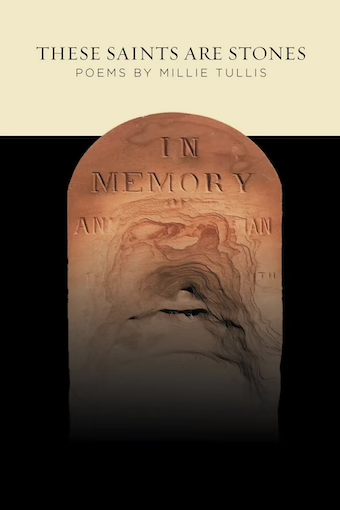
In American society today, we tend to think of family as small, nuclear, and, above all, living. Conversations rarely run to distant relatives and ancestors, to the funny stories and scandals of our dead. The poet Millie Tullis insists on a different concept of family, in which those who live commune with those who have gone before. Tullis’s new, full-length collection, These Saints Are Stones, abandons our superficial definitions of family for the rich, multigenerational evidence supplied by a family’s artifacts, papers, monuments, land, and lore. It’s a resonant book, and an important one, reminding us that love and respect can cross even the boundaries of death.
Tullis’s family and mine differ profoundly: she, raised Mormon in Utah; I, raised Italian-American Catholic in Connecticut. Still, our families share a reverence for the graveyards, the old stories, and the passed-down clothing that conjure memories of our relatives, even those relatives who died before we were born. Author’s notes at the end of the book express the connection of the poetry to long-departed ancestors who lived in that complex, polygamous 19th-century Mormon family. Tullis states that “[m]any of the poems imagine into the lives of my Mormon women ancestors, especially Martha Eccles Tullis, my great great great grandmother, and Alice Eccles Hardman Tullis, her mother and sisterwife.” In the first of two poems in the collection titled “Pinto Cemetery,” Tullis recalls both desolation and curiosity as she repeats her childhood visits to Alice’s grave. Here, she considers Alice’s marriages, first to Thomas, and then a second time, to the man (David Tullis) who would name the poet’s lineage over generations.
I do not know.
which graves
are graves.
Some markers
only branches
or iron
bars rising
from dirt.
Other headstones
are stones
but illegible. Sand
stone after water.
Wind. Years.
This time
I find Alice
and Thomas first.
Their large grey stone
gives no hint
that she remarried
after he died.
The stone is new.
Replaced maybe
forty years ago.
The cemetery is dilapidated. Many of its grave markers are worn or nonexistent. Yet the poet seeks the grave of her great great great great grandmother, just as forty years earlier, someone else in the family sought the grave to refurbish it. This series of images strikes me as a metaphor for the entirety of “These Saints Are Stones.” Tullis’s book tends the graves of her ancestors, revisiting the legacy, rescuing them from obscurity, and honoring them with new monuments.
Poems as monuments: I found this a useful way to reflect on the Tullis’s collection. For example, it helped my understanding to look at three poems entitled “Helpmeet” as monuments memorializing both complexity and simplicity in the lives of Alice, Martha, and indeed Mormon women in 19th century Utah. The first of these poems weaves back and forth in short, staggered stanzas, its form well-suited to the intricate relationship of Alice and Martha. Alice was Martha’s birth mother, by Alice’s first husband, Thomas. Martha, as a teenager, married (in polygamy) Alice’s second husband, David Tullis. Through alternating images, the poet considers the emotions and coping mechanisms of the women—Alice, resigned to David’s need for a wife not married before, Martha, focused on the everyday:
Doing what sixteen year old
pioneer girls did.
Sewing.
Milking.
Gathering eggs.
Holding the baby,
her half
brother.
In contrast, the second version of “Helpmeet” leaves behind the complications of polygamy. The poem is a monument to the simple fact that the family’s homes and marriages were practical necessities. “Some days,” Tullis writes, “it all reads/simple as money.” Finally, the third “Helpmeet” reconciles complexity and simplicity—Martha’s marriage to her own stepfather a simple solution to a complex problem.
Like “Helpmeet” and “Pinto Cemetery,” other poems offer manifold expressions, that is, they are different poems with the same title. This is a valuable technique, and one that befits the collection. Poems of the same name can present and sometimes resolve opposition or conflict in an area of family life; they allow for Hegelian dialectic, moving through thesis, antithesis, and synthesis. Tullis’s family vibrates with the tension of contraries—a mother is a sister; a dream is reality; the dead still live—captured and revisited in identically titled poems. In addition, spreading poems with the same name throughout the book creates a kind of tonal cemetery to evoke the actual cemetery of the poet’s ancestors. While reading, we come upon a repeated title as if reaching a new headstone with the same surname.
Familial memory is central to “These Saints are Stones,” but the timeline does not point only to the distant past. The poet also voices her present-day experience of living with the stones of memory. For instance, in one of the poems entitled “Dream,” Tullis links past, present, and future through images related to the mouth, a symbol for both nourishment and suffering:
Vomit even in my dreams.
Yellow vomit dresses potato beds.
There is no room inside my dress for this.
Mother works the dresses smaller. I feel
it’s working through my dreams.
This future is made of mouths.
Mouths closing on my body.
This poem is a window into Tullis’s craft. She never errs in metrics. I love free verse that carries the hint of traditional English meters. It lends modern poem the dignity and austerity of the past. Tullis does this: “There is no room inside my dress for this” is perfect iambic pentameter. Not only is her metric approach pleasing in its own right, it also works beautifully in a collection devoted to carrying the past into the present. Tullis also pays close attention to line breaks. The poet does not enjamb a line simply to follow fashion, and comfortably uses an end-stopped line when an end-stop makes sense. This aspect of Tullis’s craft is, like her metrics, a nod to tradition. It is another strong technique fitting for a book about family tradition.
Before reading “These Saints Are Stones,” I worried that I might not understand a book about a Mormon family in Utah. But as I noted at the start of this review, despite the differences between my Catholic and Tullis’s Mormon heritage, I identified completely with the poet’s project of honoring her ancestors.
I identified with much more: family conflict, the strivings of women to attain respect, and a family history that includes remarriage and blended families. So common were death, abandonment, separations, and new partnerships in my immigrant family, my (step-) great-grandfather finally declared: “There is no ‘step’ in this family.” We were all siblings, parents, and cousins without qualification. The generosity of my great-grandfather is the same generosity I found in “These Saints Are Stones.” Tullis’s book is a generous and loving remembrance of an imperfect family. I am grateful for these poems, and the mirror they hold to the past—mine and, I trust, that of others in search of their own legacies.
—Dana Delibovi
* * *