
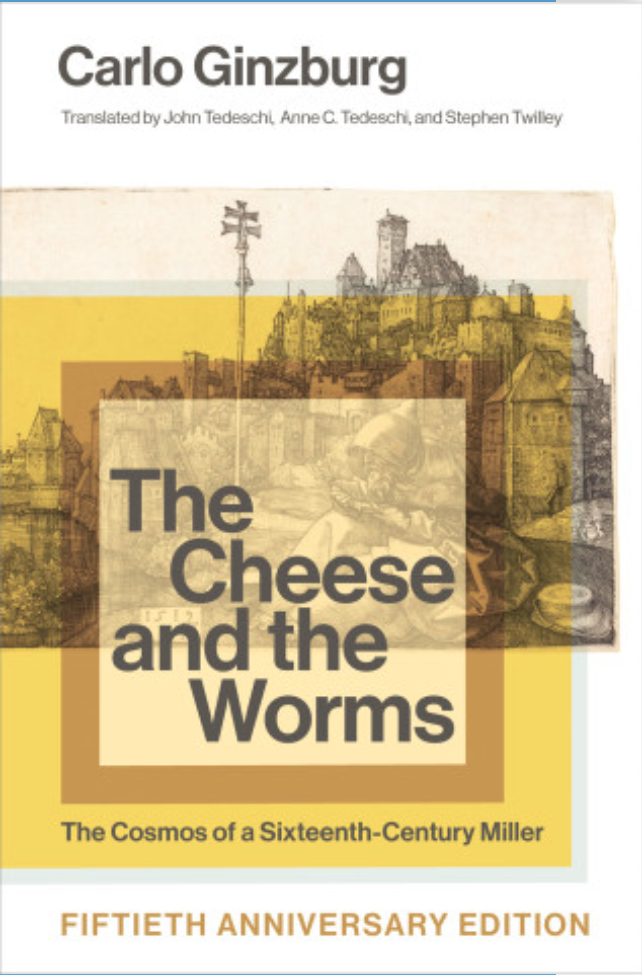
The inestimable Carlo Ginzburg has passed away, leaving behind a powerful literary legacy. Those who wish some background should at the least read his [in]famous The Cheese and the Worms; the Cosmos of a Sixteenth-Century Miller. The illustration at the if of the 50th anniversary edition, as noted, and put out by Johns Hopkins University Press.
If readers have not encountered this book and Ginzburg, this book is both foundational and hugely important (not to mention flat-out interesting.) This reviewer will write in more detail about Ginzburg, whose influence is and was so important for writers and scholars.
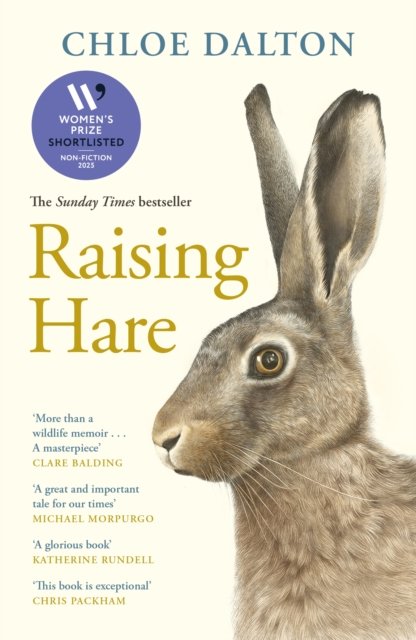
Along with the article, “A Little Lower than the Angels,” which looks at human understandings (and misunderstandings) about the relation between us and the rest of nature, comes this interesting book, winner of the Wainwright for nature writing, among several other kudos. The reviewers rather sloppily note that the book, about a woman who finds and raises a wild hare, explores, among other things, the “relationship between human and animal, as if we humans we not animals ourselves.
Be that as it may, it’s a worthy book and well worth the read.
Olga Tokarczuk won the Nobel for her work on The Books of Jacob, a fictionalized version of the true story of Jacob Frank, a young Jewish false Messiah who begins his journey in 18th century Poland, the era the Hapsburg and Ottoman Empires. Prior to Frank’s appearance and coming from Ottoman Smyrna—now Izmir—Rabbi Sabbetai Zevi made a similar claim, once even converting to Islam to save himself from the wrath of the Sultan, then moving his efforts to Salonika/Thessalonika. Zevi is alluded to several times in Tokarczuk’s novel; but the main focus is Jacob Frank and the world in which Jews found themselves in 18th century eastern Europe and along the borders of what would later become Turkiye.
I began this novel, almost 1000 pages, as an on screen read and found it disappointing. Why? The world Tokarczuk paints is so full, so potentially absorbing that reading on screen just doesn’t do it. Switching to a print copy proved my point—what a book! Without polemics and with clear vision (and obviously a tremendous amount of research on the part of the author,) it informs the reader about what, tragically, was lost to the world when eastern European Jewry was wiped out at the behest of the Nazis. At the same time, the novel is by no means a “woe is me/us” narrative.
Seamlessly translated by Jennifer Croft, I recommend this for a summer read particularly because the book is long, but so absorbing it deserves our particular attention.
I resisted this book several times before immersing myself in it, perhaps because of the spin on the title (‘Hamnet’ apparently is/was the same as ‘Hamlet’) or because it has become harder and harder to find interesting work these days. Yes, the book won several prizes; yes, it has been made into an apparently very successful film….
However, what is most compelling about the book, ostensibly about Anne and William Shakespeare’s son, whom O Farrell fictionalizes as having tragically died from the scourge of the plague that swept through 16th century England—what is most compelling is the veracity of the world which O’Farrell recreates. Categorized as a historical novel, the author not only refers us to the historical period of those times, but genuinely brings them alive. In this increasingly tech-contaminated world, we forget what the world was like without it: face to face interractions, the natural world as a wild, sometimes frightening, place, the lack of scientific cures, the persistence of human fears of difference… And I say this,not out of romanticizing some sort of ‘simpler life’ but facing the increasingly synthetic barriers between ourselves and others, ourselves and the transient, natural world….
— Bronwyn Mills
* * *