
Compiled and with an introduction by Lisa Bourbeau
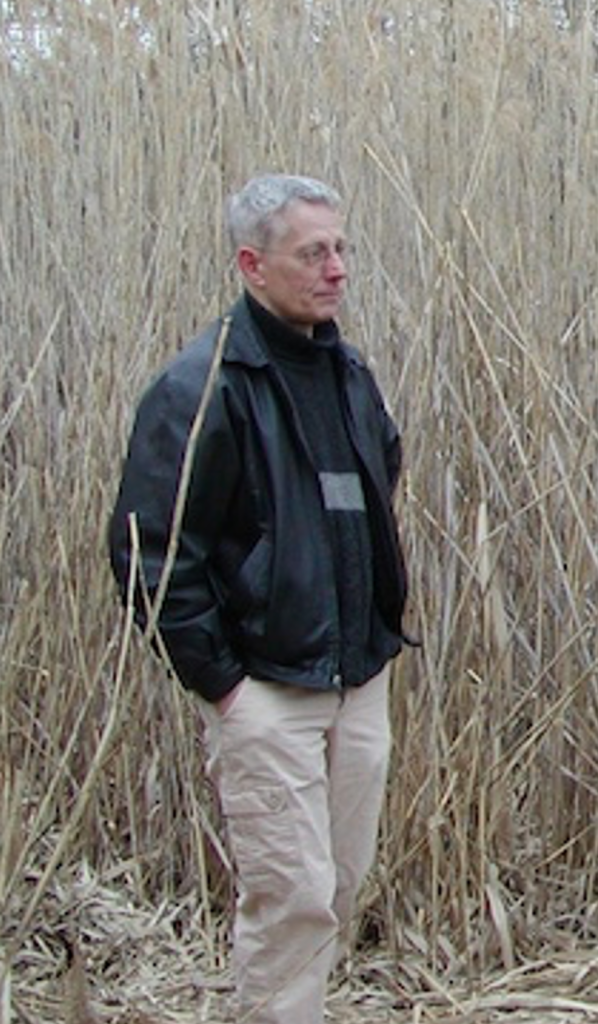
December 17, 1942 – January 12, 2026
Photo: Lisa Bourbeau
“And now/there’s nothing still/within the branches/in his garden/but the air.” Since the death of Edward Foster on January 12, 2026, these lines from his poem “Your Somewhat Symbolic Mind” keep haunting me, and not because they were among the best lines he has written, or favorite lines in a favorite poem among the multitude he has left for us. It took me awhile to realize that this was happening because I was having so much difficulty in accepting that he was gone, and I was in some way seeking recognition of his recognition that this would inevitably happen, that it was something he had found peace with in a way that I still could not.
Ed was possibly the most remarkable human being I have ever met, and I will forever cherish the friendship he so humbly offered. His accomplishments – a nearly endless list that includes his careful poetry (always written in deference to what would – or could – not be said, to anything that might disappear under the weight of the words placed upon it,) his interviews and essays, his teaching, his work through Talisman House to provide a focused exposure to an expansive world of new and worldwide poetry – all are well recognized. If I found this awesomeness incredibly intimidating when we first met nearly three decades ago, Ed’s generosity of spirit banished all intimidation. When I began thinking of him as the Patron Saint of Poetry and once voiced it, his response was “I’m just me.”
We shared that somber New England reticence which grounded many of our conversations in inference, but he was generous with his knowledge and exacting in historical fact. He freely shared with others his connections to, curiosity about, and roots into the international literary community, never imposing judgement or expectation. He left so much of himself here, in the “air within the branches.” So much more than air…
Any time he had guests, particularly those from other countries, he became a guide on road trips around Western Massachusetts – Alice’s Restaurant, the Bridge of Flowers, Melville’s home, the Poets Tower, the New England Peace Pagoda, Saint-Gaudens National Historical Park in Cornish, NH, MASS MoCA, Clark Art Institute… Information flowed with stunning accuracy. I remember being driven by Edith Wharton’s home (The Mount) in Lennox, MA, and Ed’s casual observation that it was built “let me think, sometime around 1902” which was, of course, the exact year it had been built.
There were so many unique experiences he shared with me beyond those that included the gatherings of fascinating guests in his beautiful, Eastlake grounded, turn of the century homes. In Istanbul, there was the dinner with eight or ten Turkish intellectuals and poets, several of whom recounted various imprisonments. This was where I first learned of the 1993 Sivas Massacre. Poets, intellectuals, musicians and artists had gathered to celebrate the life of 16th century Alevi poet Pir Sultan Abdal, and the hotel they had gathered in was set on fire, killing many. There was also the tour along the walls surrounding the city: the orderly vegetable plots, the farmers – mostly women wrapped in scarves, plying their hoes – the goats that climbed haphazardly up the walls… Ed was, in my eyes, an Olympic walker. I am a wanderer and he would kindly look back periodically to make sure that I was still in sight. And Ed was fearless – to this day I find it difficult to believe that, on another day in Istanbul, I followed him, led by three young gypsy children, up a narrow path of crumbling ledges in a long-abandoned castle in order to take in a magnificent and otherwise unobtainable view of the city.
In thinking about Ed, I am reminded that I cannot read the work of William Bronk without thinking of Ed, any more than I can read the work of Ed without thinking of William Bronk. In ”The Inclination of the Earth,” Bronk wrote: “All this unvesselled light:/Our untouched dissatisfactions/Flood from our hands/Held cupped to catch them in.” Ed, for me, is in many ways “all that unvesselled light,” uncontainable, his gifts to us flooding into his absence now: an ever-expanding world of place, of mind, of form and formlessness, poetry, conversation and friendship.
— Lisa Bourbeau