
by Hardy Griffin
In February, I took my daughter to Tokyo as an early high school graduation gift. Talya is applying to art schools to study animation, and she has been talking for at least the last five years about how she wants to see various anime sites in person.
On our third day there, we had just left the Tokyo National Museum, our brains overstimulated with all that we had tried to see at once. We walked for a time, aimlessly, away from Ueno Park and the train station we had come from. At some point, we looked up and saw:
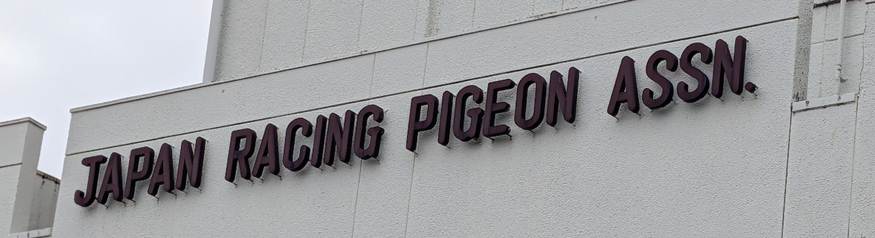
“Why’s the sign in English?” Talya asked. She’ll give you a sideways look filled with playful challenge.
“I don’t know. Let’s investigate.”
There was a plaque by the door:
Our association aims to improve the traits of racing pigeons, contribute to international goodwill through pigeons, and thereby contribute to the development and improvement of the Japanese pigeon world, while also fostering camaraderie among pigeon enthusiasts.
The four-story building was shut tight, however, so we continued on our way, over a pedestrian bridge. Below us lay twelve separate train lines, no doubt heading to all corners of this megacity of 41 million people and beyond.
The grey clouds threatened rain and a brisk wind came up the tracks. We hustled to the other side and down the stairs, into a warren of narrow streets.
“I’m hungry,” Talya said. “Let’s go in there and have some ramen.”
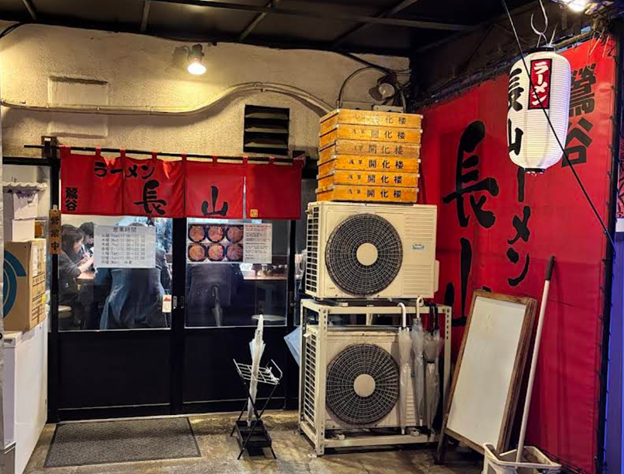
She was pointing at an open doorway with a sign in Japanese on the building above. Had she learned enough of the language to read ‘Ramen’? As we approached, I realized the kanji characters on the sign were noodles.
We stepped inside. The memory that hit me was so strong, it felt like I was in two times and places at once: There in the ramen restaurant in 2026, but also in the Flatirons Movie Theater in Boulder, Colorado forty years earlier, watching the first Japanese film I’d ever seen, タンポポ, Tampopo.
The movie opens with the truck driver Gorō and his assistant Gun walking into a tiny ramen shop where the customers sit at the counter, served directly by the chef—who, we later find out, is Tampopo (‘dandelion’), a widow trying to run her deceased husband’s restaurant.
Just like the film, the place we had walked into also had counter service only, the chef also a woman, serving a row of blue collar workers who were all slurping. I didn’t feel comfortable taking a picture, so here’s a photo with no one in it.
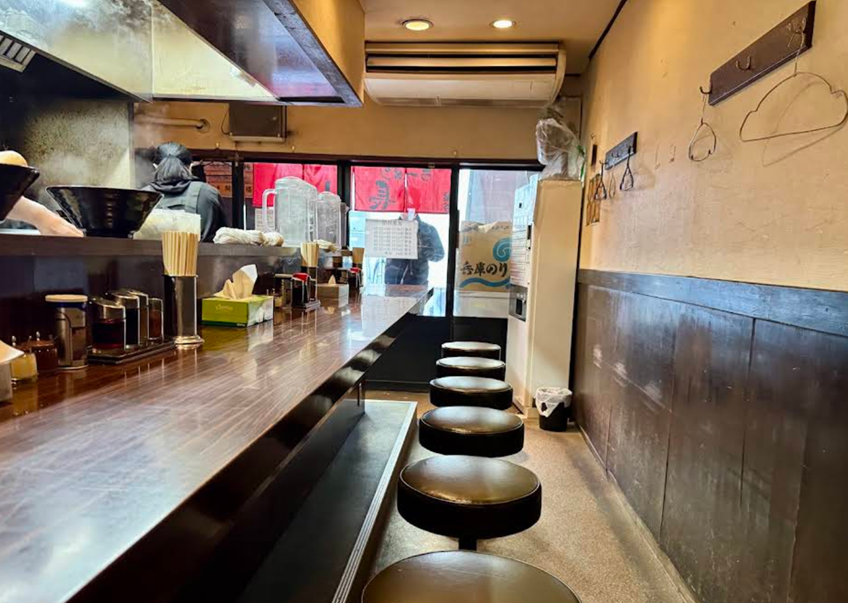
On the left when we entered was a vending machine where we placed our orders—we’d used so many machines for such things over the last few days that this no longer surprised us. We sat on the two stools in the foreground, hanging our coats on the wire hangers behind us.
And here’s a still from the movie to give you an idea how similar this restaurant is to the one in the film.
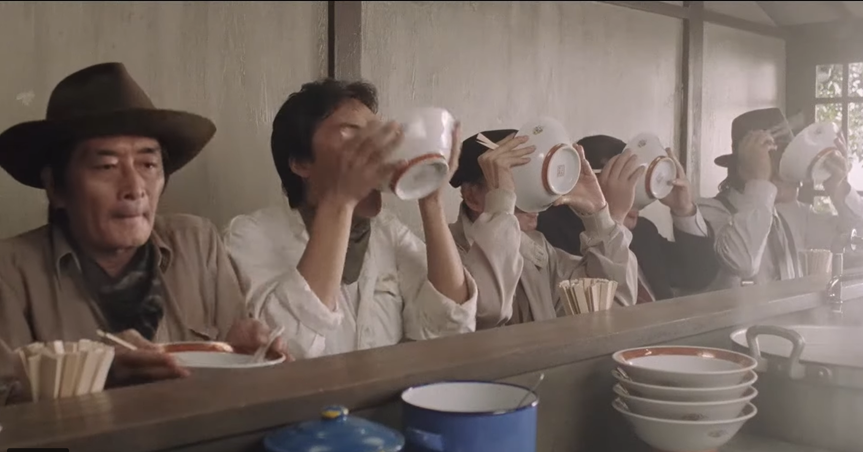
On the far left in this picture, Ken Watanabe is the truck driver Gorō, and Tsutomu Yamazaki as his assistant, Gun, is just about to put his bowl down.
Here is a nighttime shot of the restaurant with Tampopo, brilliantly played by Nobuko Miyamoto, praying that these men helping her find her ramen delicious.
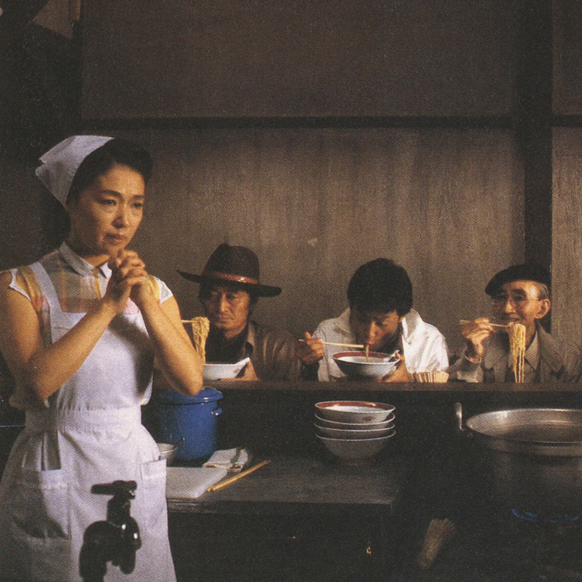
In this still, you can see the chiaroscuro with which Miyamoto’s character is often portrayed—an effect used throughout the film to turn Tampopo into an almost angelic figure. This makes sense, given that Miyamoto and the director, Jūzō Itami, were married from 1969 up until Itami’s passing in 1997.
“Dad, are you all right?”
“Sure, I…” How could I explain? “I saw this movie a long time ago that was described as ‘a ramen Western.’ In it, this chef, Tampopo, learns how to make the best ramen noodles and broth.”
Talya laughed. “That sounds like a nutty film!”
In one of the first scenes, Gun asks a great ramen expert the best way to begin eating when the bowl comes. The expert says first you appreciate it in its entirety. This sensei goes on to say:
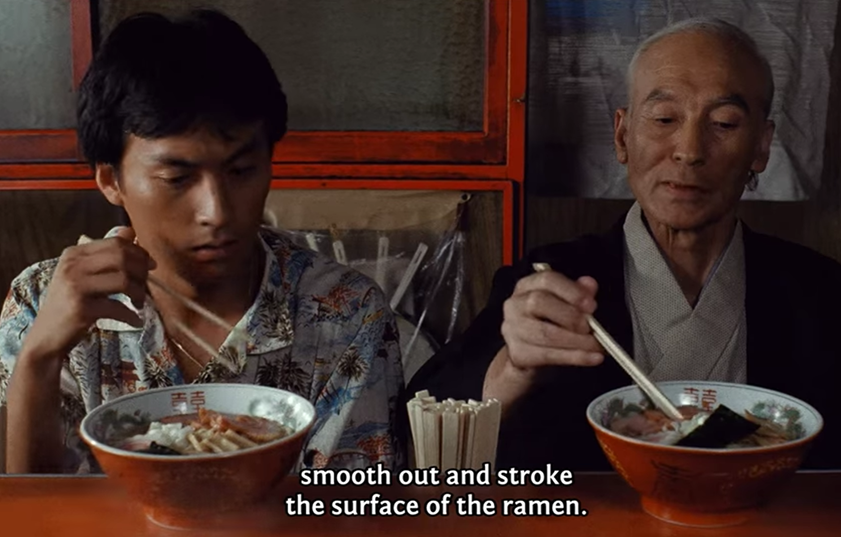
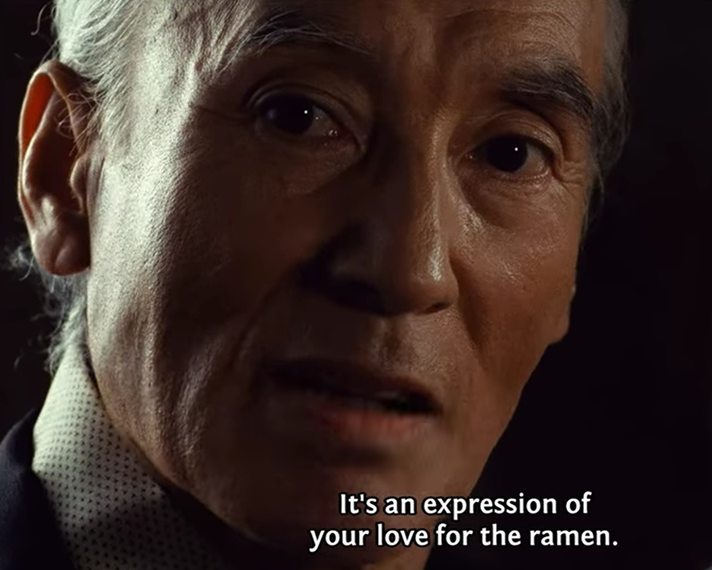
Talya broke apart a pair of chopsticks. The chef placed our food on the high counter. We’d learned in just a few days how this is an essential aspect of Japanese culture: Nothing should be done directly, always indirectly, like putting your money down on the tray so the other person can then pick it up from there.
We carefully took the trays down with a little bow.
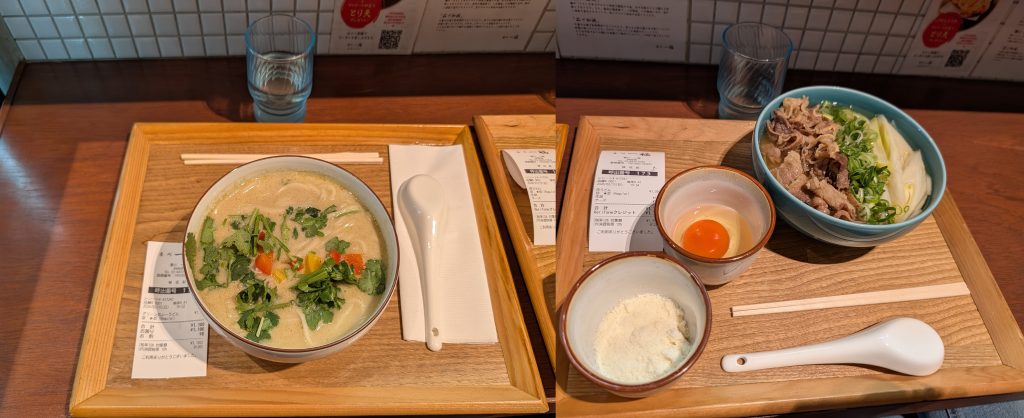
We started eating, making sure to slurp. The cilantro, curry, and peppers in mine made for a very different, wonderful bowl of light spice and green flavors. Talya’s was almost the opposite, with lots of mouth feel from the daikon and slowly-cooking egg.
As we were finishing up in the hot little shop with the delightful food, I flashed on yet another moment from the movie where Tampopo finally learns how to make incredible ramen — Gun drinks down the last of the broth and, putting his bowl on the counter, says, “Hai! Oishii desu.” Yes! It’s delicious.
I repeat the motion and say the words. Talya’s cheeks immediately turned a light red that matches her hair. The assistant chef smiled. He spoke to the chef in rapid-fire Japanese, indicating me with his head as he repeated, “oishii desu.”
We bowed on the way out and said, “Arigatou gozaimasu.”
We were halfway down the street when we heard someone calling out. We turned and there was the chef’s assistant with our coats in hand. For an instant, I thought of saying we didn’t need them, except I didn’t know enough Japanese to express this. But it was true—we were so warm from the ramen and the wonderful restaurant, we’d been walking along, talking about Tampopo without a care in the world. We took our coats and bowed.
* * *