
The New Italian Poetry
by Raphael Rubinstein
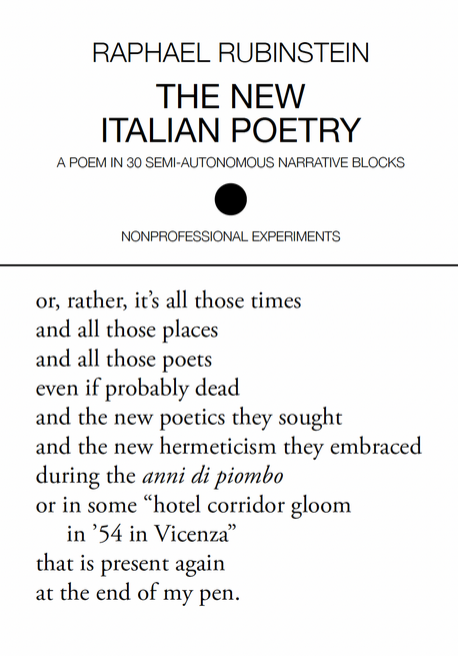
As COVID-19 raged, artists and philosophers found a strange solace. Shuttered commerce meant free days to create and reflect. Even as we confronted illness and death, we experienced something unknown for decades in many societies: time for contemplation. Raphael Rubinstein is one artist who found the pandemic productive. In 2020, the world shut down. Rubinstein opened his mind, and the result is the book length poem The New Italian Poetry.
Rubinstein’s work takes its title, and its creative spark, from Lawrence Smith’s 1981 anthology The New Italian Poetry, a bilingual volume of Italian poetry after 1945. Rubinstein has told me that “this book was the starting point. I’m not sure I can say exactly why, other than that I found myself reading it during the lockdown. Maybe it had something to do with how Italian poets responded to the political turmoil of postwar Italy, especially during the “anni di piombo” of the 1970s.” These “years of lead” were the time of extreme turmoil and violence in Italy, including terrorist bombings perpetrated by groups across the ideological spectrum
The initial pages of Rubinstein’s book acknowledge the debt to anthology—45 years old now and 39 years old when the pandemic hit. The poet picks up the book in the luxury of time the pandemic created for many—”because all museums and galleries have suspended their activities/and for the first time in 10 years I have no art-writing deadlines.” He laments “the curse of wishing to be easily understood” as a poet, but finds himself hopeful in those strange days of lockdown:
pen of hope, poem of hope
pen’s poem, poem’s pen
opening in hope
at staying open
unclosing, reapperaturing
like a dilating lens, an inhaling lung,
a café open for business
a poem open for business…
The poet experienced openness in the COVID-closed world. I felt that, too—I remember the homebound days, sad yet serene, when there was little to do but to think and to create. To be open as an artist while society closes down is the central theme of Rubinstein’s book. It’s a theme that resonates with me, as I think it does with many creative people.
Images of opening and closing operate on many levels in The New Italian Poetry. On the elevated level of Italian art and art criticism, openness is a dominant feature that Rubinstein catalogues. He mentions, for example, Roberto Rossellini’s film “The Open City” and Umberto Eco’s great treatise on aesthetics, “The Open Work,” which contrasts “open” modern art—art that invites and encourages interpretation—with closed and dictatorial classical art.
But intellectual reflections on openness are never detached from everyday openness in Rubinstein’s work. He frames citations of Rossellini and Eco with the practical and the personal effects opening up in a pandemic, which hit Italy particularly hard. The Italian authorities fear risk—“They warn against a rush to reopen (‘non dobbiamo avere fretta di reaprire’).” A truly open art—the “poor art (‘arte povera’)” coined in 1967 by Italian critic and curator Germano Celant—expressed the heavy grief of the pandemic, which numbered Celant as one of its victims.
The pages of The New Italian Poetry are imbued with another kind of opening: the opening of the human heart.
Early in the work, Rubinstein expresses love and gratitude for his wife and daughter on a rainy weekend in lockdown. In a lyrical series of images, he captures the transcendent in the mundane life of a family. As everyone goes about their Saturday business, the poet realizes his wife’s arms would open at any moment to embrace him, if he needed this.
By the end of the work, the poet’s heart opens to the sadness of his own nation, the United States, decimated by the virus and the government’s cruel response:
It can take on terrible associations, like any other word
like “tree”
like “breathe”
like “family”
the verb “to open” has become a weapon.
If I were to use my nation to point out human failings
I would barely know where to begin…
Within the frame of family and county, Rubinstein covers history, culture, and emotions, weaving a fabric of life in the pandemic with life in the aftermath of the second World War. George Floyd is murdered during the pandemic; post-WWII Italian artists experiment and Italian free radio thrives, while the Vietnam War rages; Roland Barthes and Cy Twombly appear as heralds of openness. The images parade, the mood is bittersweet. Everything moves, hope and sorrow alternate. It all holds together beautifully, because of Rubinstein’s craft in sectioning this book-length poem into 30 parts—“semi-autonomous narrative blocks,” a technique used by Pier Paolo Pasolini in his 1961 file, Accattone.
Like so much of Rubinstein’s writing, The New Italian Poetry is a rare combination of intellect and warmth. This combination infuses work Rubinstein has published in Cable Street, as well as in his many essays on art and culture. Intellect and warmth seem the perfect pairing with which to approach the pandemic, to face the problem with logic and caritas—qualities sorely lacking in the federal response to COVID-19. To read Rubinstein’s book to remember that, even in the depths of the shutdown, artists still chose the open mind, the open hand, and the open heart.
—Dana Delibovi
* * *