
Lines
by Sarah Riggs
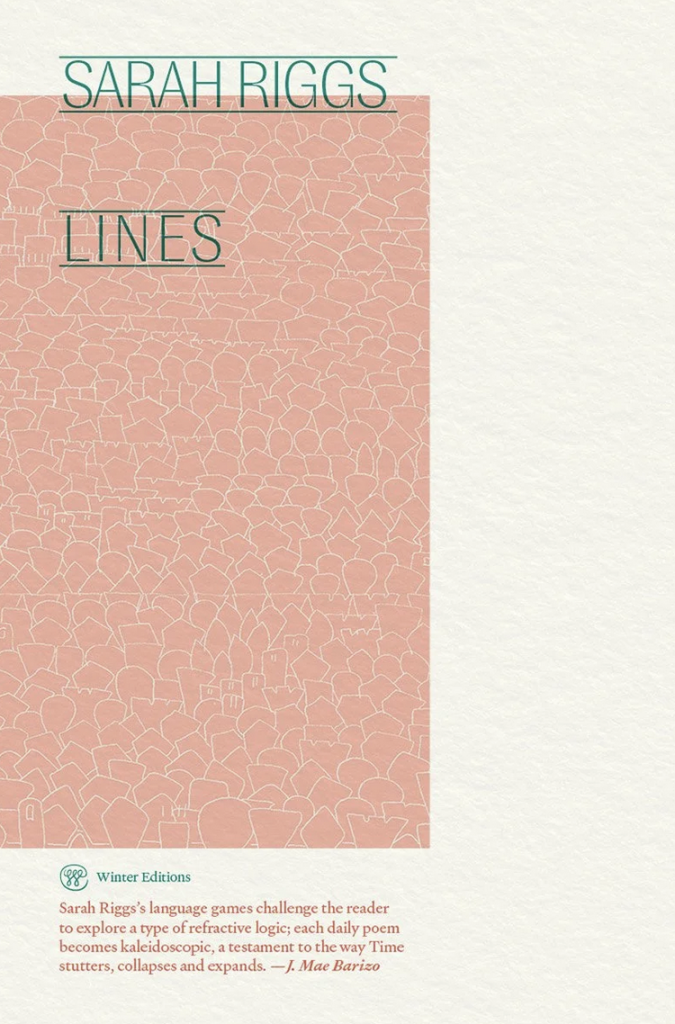
I can barely remember the first Trump presidency. The chaos is hard to recall: a maelstrom of family separations, dictator cuddle-ups, and the daily drumbeat of racism and sexism. COVID-19, occurring in the midst of it all, is a blur across my memory. Events don’t come easily to mind, but sensations do. I can re-imagine the sheer exhaustion Trump created and the silver-lining silence of the first few weeks of lockdown. Lines is a book infused with a sense of that time. It is also an augury for the future that came to be.
Riggs is a Brooklyn-based poet, essayist, and artist, who wrote daily poems from 2018 through 2020. Lines is a selection of those poems. The first poem in the book is dated October 15, 2018; the last, April 25, 2020, about a month after COVID lockdowns began. In an author’s note, Riggs acknowledges the influence of Lyn Hejinian and her book My Life, with its “frame of the number.” Riggs also cites the influence of Bernadette Mayer’s daily photo-poetic diary, Memory. The poetic journal Riggs has crafted in Lines is a worthy successor to these works, because the language of the poems reflects the poet’s interior state within a political environment. Lines is not a political work. It is a record of one poet’s inner space in a politically fraught time.
The structure of the poems closely mimics the way thoughts pass through the mind. Depending on the day and the emotions it provokes, the poet’s inner monologue can be more or less logical, more or less rational. As the title, Lines, suggests, the poems do not break into multi-line stanzas. Instead, each line seems to function as its own stanza, or perhaps more accurately, as a monostich, a poem unto itself. The effect is a replica of the way thoughts come when we are engaged in daily activities (other than the act of persuasive writing, of course). The flow is overwhelmingly associative, only rarely analytical, as in this example at the end of “October 17 [2018]”:
Many in a struggle toward breath
Seven-and-forty swans or how many at Coole
And some willingness to change
There were fourteen back there
Making the night an eye opener
Such that talking together: carrots
And if she can’t relate
Quickly to say to speak
All ears in the waiting room
Gently that nudge comes
To sit back and breathe
Millions of others just like him
In October of 2018, the journalist Jamal Khashoggi was murdered inside the Saudi consulate in Istanbul; there were also shipwrecks of migrants in the Mediterranean and a lethal earthquake and tsunami in Indonesia. Trump had begun to advocate against birthright citizenship and to oppose the civil rights of transgender people. So many struggling to breathe—physically and figuratively. Yet the poet was also 47 when she started writing, the number of swans she thinks might appear in William Butler Yeats’s poem “The Wild Swans at Coole” (it is actually 59). All occurring in the context of daily life’s waiting rooms and carrots. In the swirl of associations, Riggs text ends with a moment of logical coherence: a man in the waiting room receives a gentle nudge to relax, “to sit back and breathe”—advice that millions of stressed-out people could use, as well.
At times, the poems lapse into nonsense language. The nonsense ranges from lines that are somewhat off kilter, like “Trained to whale outwards,” to lines of gibberish, like “Frip tway trusilience.” Riggs, in the author’s note, describes these lines as moments of “language collapse,” functioning as “snapshots of uncomfortable confrontations and toxic situations, as well as utopian possibilities.” The mind under stress loses cogency and the interior voice disintegrates; the same thing occurs when the mind is seized with an irrational hope.
The technique Riggs uses—stacked-up monostiches—is a wise choice for the book. As mentioned, it replicates the unruly way one thought follows another as we go about our lives. The technique also gives the poetry immediacy—images occur in the moment, with no past memory or future prediction involved. I was struck by how accurate this immediacy is in the age of Trump. As the chaos rolls, it is impossible to remember what happened even the day before. As the chaos rolls, we find it impossible to predict anything but more chaos. This is the augury of Riggs’ book. The voice is not Cassandra foretelling future events in a world of coherence. The voice in Lines has given up prophesy for guesswork, bumping along each day, knowing nothing but the present moment. We live this way now, under Trump 2, and I am glad Riggs’ book challenged me to admit this.
By using language to reflect the uncensored, varying movement of thought, Riggs has created a fascinating book. For me, a fascination arose because I realized I could not read the book as I normally would a collection of poems. I could not rely on the poet to order and edit thoughts, so that the words would set me in a place or bring me into a scene. In approaching Lines, I had to read each phrase and try to sense where it pointed in my own interior life. As a result, reading Lines was a reflection on my own thoughts in their raw form, uncorrected by my urge to organize. The process made me, in the most literal way, mindful. I’m grateful that Riggs’ inner space has been a template for my own.
—Dana Delibovi
* * *