
Poetry for the New Millennium:
Bilingual Reading Via Zoom
edited by Marta López Luaces
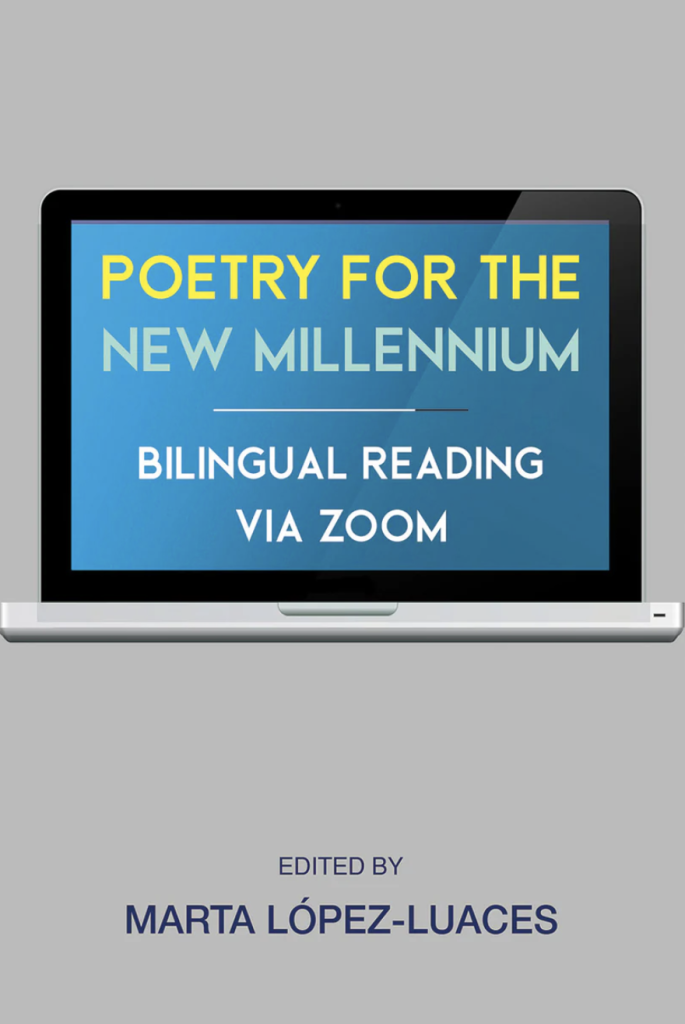
A powerhouse in Spanish and English poetry runs week upon week in Montclair, New Jersey. Responding to the COVID-19 pandemic, the Department of Creative Writing at Montclair State University began hosting the Bilingual Poetry Reading Series via Zoom. Since then, the series has grown into an important international forum for poets and translators. Now, the guiding light of the series, Marta López Luaces, has edited an anthology of participating artists, Poetry for the New Millennium. I believe this collection is a worthwhile addition to any library of poetry.
The Series
To launch the Bilingual Poetry Reading Series, López Luaces, poet, translator, and Professor of Creative Writing at Montclair State, collaborated with Nuria Morgado, Professor of Hispanic Studies at the College of Staten Island and the City University of New York. They procured additional support for the project from New York City’s Jefferson Market Library, la Universidad de Granada, and la Academia Norteamericana de la Lengua Española.
Work from the series has been featured in Cable Street—here and here—as has poetry by López Luaces translated by Tanya Huntington. I cannot even hope to write a review completely free of bias, because the Bilingual Poetry Reading Series has been instrumental in my literary journey as well as the journey of Cable Street’s beloved, late editor, Christopher Sawyer-Lauçanno. Bilingual students of translation in the New York area translated poems written by both Sawyer-Lauçanno and me. My recent translations of the work of Mexican poet, Rocío Cerón, are the direct result of our meeting at the Zoom readings of the series. Many legacies of collaboration have emerged from the Bilingual Poetry Reading Series.
The Anthology
The new anthology brings the literary legacies of the series together in one place. The works of fifty-eight poets, writing in their native languages of Spanish or English, are presented with in original and in translation. The book groups this abundance of poets into fifteen sections, each dated with the day they gave a Zoom reading in the series
The original poetry runs the gamut from traditional English free verse to experimental work, often with valuable regional inflections, in Spanish. Translators certainly get a work-out in this volume, to the delight of the reader. One example is the poetry of Galician writer Eva Veiga, which has been translated into English by Craig Patterson after being translated from Galician to Spanish Teresa Seara:
flor de nieve que cae
como descienden las horas más hermosas de la tristeza
dulces y lentas sobre la piel
se vuelve de silencio
se hace de noche y olvida
mientras dentro la sangre
fractal en la extrema quemadura
solo un instante
hasta que la flor se yergue
y queda la sombra invisible
el frio
snowdrop falling
as the most beautiful hours of sadness descend
sweet and slowly upon the skin
turns into silence
night falls and forgets
while inside the blood
fractal in the extreme scorch
just an instant
until the flower rises up
and the shadow remains invisible
the cold
Veiga’s poem and its translation shows the richness of the work selected for the anthology. The Zoom readings of the series have been consistently excellent, and the selections in the book reflect this.All participating poets attend closely to craft, often using techniques of construction and rhythm that are a lesson to every student of poetry. But beyond an expression of skill in the medium of language, the poems chosen for the anthology reliably address serious and important themes. A case in point is the poem “Caracas” by Venezuelan poet Sonía Chacrón, beautifully translated by López Luaces, that opens with these ominous lines:
La order es partir pronto
con las niñas de las ojos
con las flores astascadas en la garganta para no gritar…
The command is to leave soon
with the apple of our eyes
with the flowers stuck in the throat so as not to scream…
The History. The Present
Poetry for the New Millennium is an historical book, in two ways. First, it is a snapshot of Spanish and English bilingual literary life, at a time when, in the United States, languages other than English are ignored and even derided by my ever parochial compañeros. As such, the anthology is a chronicle of poetry across the English- and Spanish-speaking world that is both necessary and subversive. Many of the poets included are major literary figures in their home countries and cultures. Of special note: Ida Vitale, the great Uruguayan poet and winner of the Cervantes Prize in Spanish literature, participated in the reading of March 21, 2021 and has four poems in the anthology.
Second, Poetry for the New Millennium is part of the historical record of art during the COVID-19 pandemic. The text covers readings from 2020 through 2023, from the first pandemic summer through the conversion of COVID to an endemic disease. The first year of the pandemic was a fertile time of creativity for me—especially during lockdown. But it was also emotionally fraught, as my high-school–aged children grew sad and stressed out by the loss of the social life so precious at that age. To hold the volume is to remember those days—fondly, however strange that might seem. It is also to remember that poetry knows no season, and can emerge in both sun and shadow.
The pandemic turned out to be just the beginning for the Bilingual Poetry Reading Series. It continues in 2026, starting with a wonderful reading to celebrate the launch of the anthology. As I look forward to the next readings, I feel sustained by my print copy of Poetry for the New Millennium. It’s here to remind me of the abundant friendships, collaborations, and creative joys that the Bilingual Poetry Reading Series has given me.
This essay is dedicated to my editor, translation-mentor, and friend Christopher Sawyer-Lauçanno.
—Dana Delibovi
* * *