
The Elements
by Jean Day
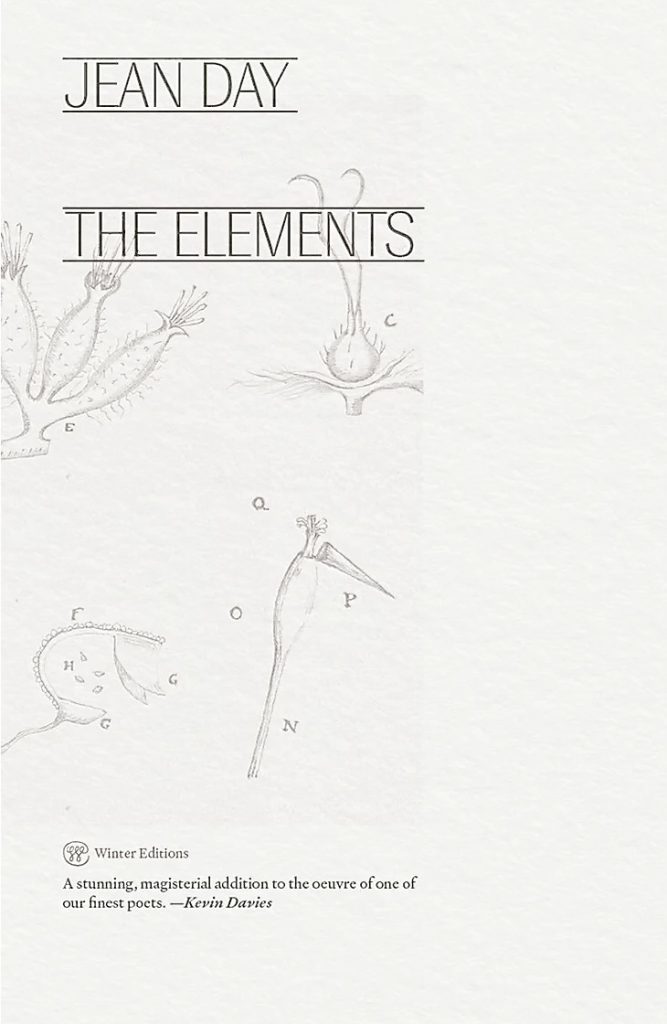
My partner and I are a geologist and a poet. We often discuss the deployment of the term “anthropocene” in both literary and scientific contexts. Its cousin, “ecopoetics,” has become something of a buzzword within university literature departments. It might best be described as poetry about humanity’s hand in the end of the world. The images that populate these poems are perhaps, at this late date, trite: burning forests, melting glaciers, bleached coral. The language reads as obviously portentous, ripped from the headlines of CNN or The New York Times. In their straightforward reflection of mass-media vocabulary, the poems miss something about complex earth systems and indeed the grief humans feel at their destruction. Their cultural cache seems to derive from making climatic destruction into a spectacle while the fundamental significance of these natural systems is disregarded.
Across five long poems, Jean Day’s newest collection, The Elements, documents the guttural abjection of ecological and societal collapse in a way that does not merely regurgitate talking points or paint a lurid allegorical picture of our future. The personal and the individual is almost completely erased in favor of that which is constitutive and, fittingly, elemental to the universe.
Out of water
fish flop.
The stars ignore you;
history balks
…
Still the oak is having acorns
and the squirrel’s mind
is blown.
In an interview with Jacob Kahn, Day described her poems as “counterpoints to the dull interiority many of us labor under.” The images and the speed with which they come certainly convey the intensity of being alive. Anyone who’s seen a salmon run will know what I mean. Anyone who has paused and listened to an oak drop thousands of acorns will know what I mean. The squirrels eat them and shit out new life. Amid the business of world, humans are another detail, rather than the central figure. “The stars ignore you” captures our relative and implies, in a very Stevens way, that the meanings we attribute to the material world—stars as markers of fate and destiny—are perhaps just strategies to appease our existential angst.
The collection’s standout poem is “Ex Ovo Omnia,” which takes its title from a term coined in 1651 by the doctor William Harvey, meaning all animals come from eggs. The idea and the attendant term “preformationism” were scientific explanations that dealt with the complexity of life and its origins by proposing straightforward formulas in which all beings came to be: we all came from eggs; we developed from miniature versions of ourselves; in one illustration from the period, homunculi are bunched inside a sperm cell, then let outside to play
The poem is composed of unnumbered sections and uses ellipses to demarcate sections. It does not propose that every animal comes from eggs inasmuch as it claims that everything comes from something and that the something was itself something that came from something else. In other words, there was never nothing. Inevitably, this leads to a psychedelic reading experience. Here are the poem’s opening seven lines:
Erased by the end is just the beginning of
pixels in the shape of fact
…
Jellyfish anyway (of all things)
swim back
to their premodern thoughts
true ectomorphs, however fat
or filamentous
The use of ellipses as section indicators augments the psychedelic reading experience, establishing a kind of equality and over-arching interconnectedness that a poem with, say, numbered stanzas, cannot. Day’s imagery furthers this reading experience. The contents of the first line suggests an ouroboros or Möbius strip, proposing that beginnings and endings exist in a continuous cycle. Any “end” is really just another “beginning.” Yet, given the context of the twenty-first century, “the end” as Day writes it, reads as a metonym for planetary collapse, for humanity’s doom. The second line reinforces this reading: “pixels in the shape of fact” gesture toward the rampant misinformation and AI slop that rules our age.
Within the sociocultural context Day outlines in the first two lines are the inevitable acts of the natural world that recur throughout the poem. Jellyfish “swim…/to their premodern thoughts” enacting ancient biological instincts. “A string / of cells / from which a membranous / frond will arise” is recalled. One elemental thing among others leads to a greater whole. Importantly, though, Day does not claim that these natural processes are implicitly good or bad. She rejects anthropomorphization; the jellyfish or the fronds are neither morally superior nor inferior to human culture. They simply are.
If there is a universal truth in Day’s collection it is that the power of a collective is more able to effect change than a bunch of individuals working separately. In Day’s poems a character who circumvents the interdependent web for individual glory fails: the couplets “you do / your ceremony / but the fates do not attend” and “dreams are out of the question / except for the greater good,” being two examples. Day’s poetics, however, is seemingly uninterested in assigning moral value to human failure; her focus, instead, is the documentation of it: “Meanwhile, all things conspire. Our portapaks are heavy; our medium decays (gerundial, like a headline).”
Day’s project forces readers to reckon with these “decays.” As readers we are forced to come to grips with humanity’s shallowness, the “fear there are no elements at all here, just bugs” (99). Nothing is worse than realizing we have placed our faith in the wrong thing:
Of a beautiful thing
we can say nothing
but nothing indeed is needed
where the weather suits our clothes
and clothes are what we are
in columns of fluted air.
When weather salts our cities then
who knows
where the forests will lead us
or what miserable minerals we’ll find there
to drive us all mad
with lust for life.
Compared with the airiness of “Ex Ovo Omnia,” the excerpted poem above, “Swing State,” is much denser, documenting the way human hubris has brought about our own demise and how, in facing that, “we can say nothing.” The phrase “miserable minerals” particularly conveys this failure: it brings to mind images of the rare earth mineral mines that provide the raw materials for the batteries powering life in the twenty-first century. The mining practice itself pollutes ground water and has a history of violent conflict attached to it. I’m sure there is a deadly history to the battery in the very laptop I am typing on. Part of Day’s project is documenting this truth, coming to grips with our “lust for life” which, from another point-of-view, constitute human violations of the planet. In the same stanza, Day continues with:
Van Gogh famously had an ear
he didn’t want. Kong was the saddest
of animals.
Here, Day engages with two exemplars of human culture and artistry: the painter Van Gogh and the iconic monster King Kong. However, instead of writing about the physical media associated with the two figures, Day describes their individual psyches, their senses of disaffection, which, for both, led to acts of destruction. The disaffection is characteristic of twenty-first century life, as the speaker goes on to say:
I don’t need a weatherman to tell me
which way a tower leans in the wind
or who’s about to fall
completely out of favor
Awareness of our complicity in earth’s destruction is totalizing and complete. The final lines of this stanza speak to this: “willows may weep / but only onto these pages.” Climatic disasters abound but but at least the earth has no consciousness. We who write the “pages” are saddled with the cultural and ethical meanings of systemic destruction. If the collection does have a moral, it is that we must live with our self-awareness, that whether we create or consume culture, we efface ourselves and the world.
—Review by Margaret Saigh
Works Consulted:
Haldane, J.B.S. Possible Worlds and Other Essays. London: Chatto and Windus, 1927.
Jean Day, interview by Jacob Kahn, Traffic Report, Small Press Traffic, 2022.
“Mapping the Impact and Conflicts of Rare-Earth Elements.” Institute for Policy Studies, July 17, 2024. http://ips-dc.org/mapping-the-impact-and-conflicts-of-rare-earth-elements/
“Preformationism.” Wikipedia, October 4, 2026. https://en.wikipedia.org/wiki/Preformationism
* * *