
Welcome Calm, Silence Tyrants: Adult Lullabies
by Melanie Weldon-Soiset
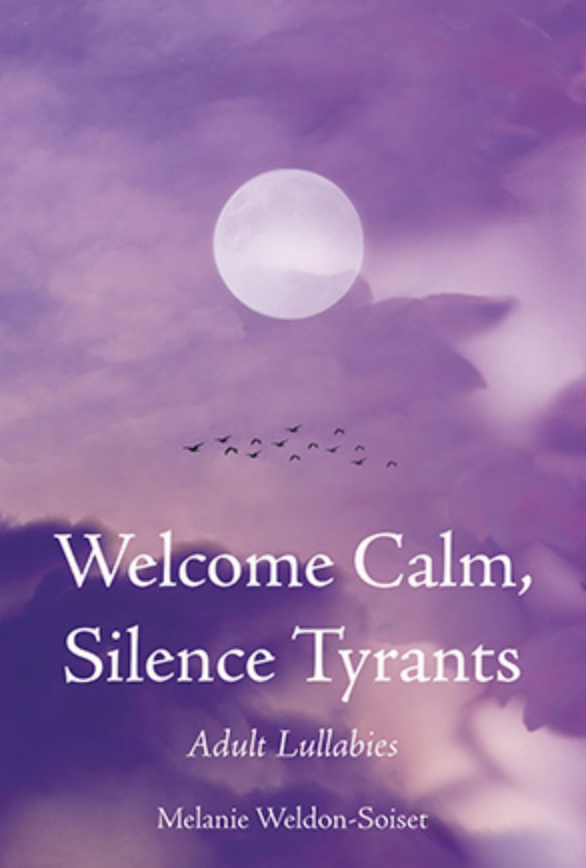
Rarely do I experience being calmed by contemporary poetry. The soothing bestowed by some older English poetry—poems like Dickinson’s “Hope” or Herbert’s “I cannot ope mine eyes”—has diminished in value. Nowadays, we tend to prize disruption, anxiety, and friction. I found a counterweight to my agitation is Melanie Weldon-Soiset’s debut collection, Welcome Calm, Silence Tyrants: Adult Lullabies. The poet’s stated purpose is to sate our hunger for peace, by offering poems as lullabies—two of which have appeared in the pages of Cable Street.
Although the word “lullaby” may conjure the precious or inconsequential, Weldon-Soiset debunks this myth in a well-researched introductory essay. Lullabies are mollifying cradle songs sung to infants and children. But this surface definition hides the fears, tensions, morbidity, and suffering of individual families and societies. “Babies often fight terror as they fall asleep,” so the lullaby is a complex totem of safety for the child. The content of many lullabies is as dark as any Grimm fairy tale—think of “the cradle will fall” (Rockabye Baby), “all yonge children to slay / lully, lullay” (Coventry Carol), or a poor, abused nanny’s lament, “naku to iwarete uramareru” (“I’m hated for letting the child cry”; Itsuki Lullaby). The point of Weldon-Soiset’s essay, and indeed her book, is that the genre of lullaby comforts without suppressing the pain of living. Lullaby connects us to lament, to adversity, to rage, and to injustice; then, it encourages us to take our necessary rest within these storms of life.
As a practice of peace, lullaby also partakes of the spiritual. Weldon-Soiset is both a writer and a minister—she holds an MFA and a master’s in divinity. Her take on the lullaby as a spiritual instrument harkens to the traditions of social-justice theology across the Americans. I was delighted to find, in the introductory essay, the poet’s clear stand on the brutality of the current American regime, “deploying soldiers and tanks” in her home streets of Washington, DC and “disappear[ing] other neighbors into concentration camps.” Even as we seek rest, we must name and know the sins of our society. Lullaby enables us to do just that.
Weldon-Soiset organizes the ample poetry in “Welcome Calm, Silence Tyrants” into clear, thematic sections. The first sections fit within the theme of “Welcome Calm”—they focus on relieving our individual woes, from sleeplessness to personal grief. Later sections embody the theme of “Silence Tyrants,” with lullaby poems for justice, compassion, and the value of labor.
The sectional structure of the book comforts the reader with order and balance. It is also an aspect of the poet’s craft, which is very accomplished in this debut book. Weldon-Soiset’s writing anchors in stanzaic poetry in the English-language tradition. With the creative constraint of regular stanzas, she writes both narrative and lyric poetry very well, as shown, respectively, in “A Game of Oware in Ghana” and “Jaspers Jumble in a Basket”:
The crowd banters and jokes,
their laughter infusing
the air. Chale wote!
Feathered neem tree branches
spread canopy and shade.
One hand has reaped twenty-
five seeds—a winsome crop
shared with everybody.
—”A Game of Oware in Ghana”
* * *
[H]is descendants discover these stones
sprouting by riverbeds across the globe
the crop and crust of magma
quartz and filth from ages past
each one a chrysalis of trash
now erupting butterflies
—”Jaspers Jumble in a Basket“
Despite her skill within the regular stanza, Weldon-Soiset never gets stuck there. She takes risks with poem structure throughout the collection: poems with scattered lines and caesuras, poems built of questions, poetry in dialogue, a sunburst-shaped poem, a poem with blanks for the reader to fill, and one of my favorite forms, Anglo-Saxon prosody, exemplified in “The Poet Responds to a Lullaby Album: Don’t Say a Word“:
curl my finch feet, toes swim in seaweed salad
point back toward temple self minor key sunrise, then
my uterus unfolds, moth wings a nocturne pastoral
coyotes also need to sleep beneath a boulder
When combining multiple forms of poetry in a collection, there is always a danger of the work as a whole feeling fragmented. This does not happen through most of the book, because Weldon-Soiset has carefully curated the placement of each poem in relation to each other. A possible exception is the section, “Lullabies for Social Justice,” that includes such a wide range of multiple different forms the switching is very noticeable. But even with this caveat, the overall effect of poems with multiple forms is a gentle sense of playfulness, which contributes to the comforting qualities of the work.
No matter what the form, Weldon-Soiset has an unusually sonorous way with the Latinate words of English. These words can pose problems in poetry: our stress-timed idiom makes the number and placement of Latinate words in a poem of great importance—and great difficulty. In Weldon-Soiset’s introductory essay, she notes that beat and stress in the English-language lullaby may mimic the human pulse, which is a distant manifestation of the four heart sounds. The poet intuits how the sparing use of the Latinate creates a soothing, literally heart-felt, set of lines, as shown in this use of serenade, metronome, circadian, and symphony from the poem, “Hymn for the Front Porch Rocking Chair”:
A rocking chair can serenade anyone,
not just the very young and old:
the calm of my torso keeping time,
a metronome marking a steady beat
Not just the very young and old
join this circadian symphony.
metronome marking a steady beat
pulses through us every day.
The subtitle to Weldon-Soiset’s book is “Adult Lullabies.” For me, one word sums up the phenomenological experience I had, as an adult reader of the collection: convalescence. When adults hear lullabies, we do so from a place of memory that soothes our present-day unease. Convalescence is one of my most treasured emotional states. I convalesce after physical illness, but also when I allow myself to surrender to my grief, stress, sadness, or anger. I feel the injury and loss, and I am finally willing to rest and recover. For me, the mood of convalescence is complex: open, self-accepting, delicate, wistful, and filled with nostalgia for the care my parents gave me as a child.
Welcome Calm, Silence Tyrants summoned convalescence, and I am grateful to Weldon-Soiset for a poetry capable of evoking this set of feelings and memories. Personally, I need the call of lullabies to convalesce—to rest and to heal—from the burnout I have refused to admit for nearly a year now. But everyone in our violent, ill-governed, over-digitized, money-mad society could use a break, a quiet evening in repose with this restorative collection of poems.
—Review by Dana Delibovi
* * *