
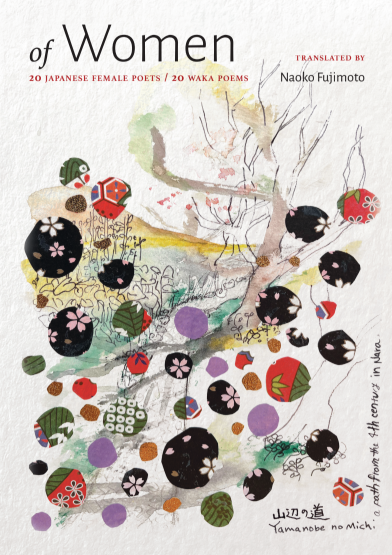
Of Women
20 Japanese Female Poets/20 Waka Poems
translated by Naoko Fujimoto
In Japan, the seventh to the twelfth centuries witnessed the dawn of literature within Japanese society, with ramifications in the wider world. Women shaped this epoch. Female writers of the period include three genre-defining authors: Murasaki Shikibu (b. 973 CE), author of what is likely the world’s first novel, The Tale of Genji; Sei Shōnagon (b. 966 CE), whose The Pillow Book captures observations in a genre we now call creative nonfiction; and the memoirist Fujiwara Michitsuna no Mother (936–995 CE). In Of Women, poet, translator, and graphic artist Naoko Fujimoto has collected, translated, and reimagined the poetry of Japanese women at this literary daybreak. I delighted in every page of this book. Fujimoto’s work enchanted me with its craft and elegance of form. It impressed me as a bridge between classical and contemporary poetics. And it made me sad and joyful and angry right along with these remarkable poets.
Of Women includes translated work by 20 female poets whose lives spanned approximately 645 to 1175 CE. Some I knew— Murasaki Shikibu, Sei Shōnagon, and the great diarist and writer of verse, Izumi Shikibu—but most I encountered for the first time in this book. Each poem in the collection is a waka, a 31-syllable lyric poem in the pattern 5-7-5-7-7—described in the Translator’s Note as “small enough to fit in the palm, vast enough to hold grief, longing, weather, memory, politics, and desire.” Fujimoto accompanies each translated poem with elements she has created: introductory prose on the model of haibun, the form established by Matsuo Bashō in his masterwork, Oku no Hosomichi (The Narrow Road to the Deep North); a charming biography of the poet; and visual expressions of each poem rendered in collage, ink, and paint. Two of the word-image groupings from the book were published in Cable Street, here and here.
Fujimoto treats each of the 20 poets with delicacy and reverence. She does not treat the poets as historical figures whose work is to be purified or otherwise tidied up to honor them. These translations and their prose and visual auxiliaries are alive, complex, and human. The English is that of 20 real women with distinctive tones of voice, engaged in conversation with the reader. That’s true, even when the woman happens to be royalty—as in this waka by Empress Shoshi (988–1074 CE), who outlived her husband and children and asks the cuckoo (hototogisu) to convey a message in the early summer (samidare) rain:
Hototogisu—tonight
if you fly toward death mountain, tell my son,
I am rudderless in this samidare-rain.
I
miss him
Three techniques that Fujimoto brings to this poem—and to all the others as well—capture both the aesthetics and the powerful emotions of the women who wrote waka.
First, Fujimoto does not limit herself to expected line breaks and spacing, but switches things up when feeling demands it. We see this in the poem above, where a traditionally lineated poem gives way to a scatter for “I / miss him.” The other 19 waka in the collection follow suit. The line breaks and spacing vary greatly, in service of the poem. Fujimoto considers her work “shaped by line-break hyperawareness,” which plays a pivotal role in this book and in her earlier volume, GLYPH: Graphic Poetry = Trans. Sensory (Tupelo Press, 2021).
For example, the translation of the poem by Ona no Komachi (825–900 CE) is a single line with three caesuras, while the poem by Koshikibu no Naishi (999–1025 CE) is translated into multiple, stately, punctuated four-line stanzas. Form serves meaning: Ona no Komachi’s poem is an image of longing imagined through flower petals and greenish rain. Koshikibu no Naishi’s poem narrates events and utters a command.
This wide structural range is, I believe, justified in rendering waka, which were a single line of characters and only broken into lines in Romanized Japanese. The original of Empress Soshi’s poem illustrates this:
hito koe mo / kimi ni tsuge na n / hototogisu / kono samidare wa / yami ni madouto
ひと声も君に告げなんほととぎすこの五月雨は闇にまどふと
Second, Fujimoto does not attempt to adhere in English to the 31-syllable count of a waka in Japanese. Syllable length is highly dependent on the essence of the poem. Translators of Japanese poetry into English increasingly favor this approach. They abandon a slavish 5-7-5 (haiku) or 5-7-5-7-7 (waka or tanka) syllable count. Robert Haas did this in his collection, The Essential Haiku, often coming in well under 17 syllables per poem. When Nobuyuki Yuasa translated the haiku in Oku no Hosomichi into English, he made them four lines and generally more than 17 syllables. The writer and translator Michael Dylan Welch has blogged extensively on the immense linguistic inequality between the Japanese syllable and the English syllable. Suffice to say, the goal is to produce an English translation that sustains the tone, mood, content, and emotion of the Japanese, which, given the nature of English, requires letting go of syllable counts. Of Women takes this aim to heart. The translations are gorgeous, memorable English poems, rather than imitations of the Japanese.
Third, the diction Fujimoto selects for these translations is simple and straightforward. She retains the intimacy and warmth of the first person. Her lines ring with the clear, active verbs that give English its power—winds blow, laundry hangs, and “Those yaezakura (late-blooming cherry blossoms)—spark the ancient city of Nara.” The last of these examples, as well as the poem by Empress Shoshi above, display another aspect of simplicity of diction in Of Women. If a Japanese word better conveys an image, Fujimoto uses it in the Romanized form, without explanation, quotes, or apologies. I applaud Fujimoto for letting the source language do the work that English would fumble.
The collection gains depth through the elements that accompany each translated poem: prose meditation before the poem;vibrant illustration expressing each poem; and biographical sketch. Fujimoto chose to surround each poem with these additional elements to add the context familiar to readers of the period but not to us. As she writes in her Translator’s Note:
“[A] single poem may contain layered meanings, seasonal codes, private allusions, courtly etiquette, political tensions, and emotional subterfuge. The poems were created within a dense cultural lattice that modern readers cannot simply intuit. A direct translation alone cannot carry the full burden of this compression.”
Fujimoto’s prose relates to the poem with the precision and inventiveness. Showing its debt to haibun, the prose chimes with the poem but does not recreate it. In this way, the conjunction of prose and poem expands the significance of both. The prose is sharp and passionate, often with a wry sense of humor and always with a keen eye trained on the patriarchy. “But they are men.” Fujimoto writes in accompaniment to a poem by Takako (Unknown–996 CE), “They ignore my daughter and call my son a criminal. Other men bring me flowers after sundown.”
By following each poem with biography, Fujimoto grounds the work, enabling us to see into the lives of writers who felt the sorrows and joys we hear in their waka. Fujimoto’s visual art—every piece a work of grace—allows us to absorb the poem with our eyes. For instance, the “samidare-rain” in Empress Shoshi’s poem speckles the bird-shape of the “hototogisu” and falls on soft “rudderless” forms. I am as big a fan of Fujimoto’s visual expressions as I am of her verbal ones. The visual element of this book demands a physical copy. I keep mine on a shelf of treasured volumes.
As I read, Of Women, I was struck over and over by the longing in these waka. I think this longing is at the core of what makes these thousand-year-old poems alive today. Women have always been ridiculed for their hopes and desires. When Freud asked, “What does woman want?” the true meaning of the question was a statement: “Whatever she wants, she shouldn’t get.” Because the patriarchy is not yet over this attitude, we need spaces where women can speak their longing, full-throated. Of Women is such a space. At the daybreak of women’s writing, these poets voiced a wish that resonates still: I want to say what I feel. And I want it heard.
—Review by Dana Delibovi
Works Consulted
Bashō, Matsuo, trans. Nobuyuki Yuasa. Narrow Road to the Deep North and Other Travel Sketches. New York, NY: Penguin, 1966.
Haas, Robert. The Essential Haiku. New York, NY: Ecco Press, 1995.
Welch, Michael Dylan. “The Heft of Haiku.” 2021. https://www.graceguts.com/essays/the-heft-of-haiku
* * *