
While writing a commemoration of Jane Goodall for Cable Street Issue 10, I became distracted by thoughts about how we human beings regard ourselves in the context of nature. Louis Leakey chose Goodall to work on his chimp project in East Africa precisely because she was not wedded to conventional wisdom and practices, and unlike the prevailing view of scientists at the time, she did not regard primates as non-thinking, solely instinct-driven animals. Indeed, her subsequent work also demonstrated that her subjects, the chimpanzees “…had emotional lives and were driven by individual personality and character,” (ibid) including passing down knowledge to the next generation and, on the violent side, what can only be called a a civil war or xenophobic reaction to other communities of the same species.
More recently, scientists working with bonobos, a near extinct ape that only survives in the Democratic Republic of the Congo, have discovered that we are not the only primates with the capacity to imagine. These primates can also imagine and pretend in play. According to a New York Times article on the subject, experiments with them suggest “… that they can, at the same time, consider multiple views of the world and really distinguish what’s real from what’s imaginary.”[ii]
In reviewing that same issue 10 of Cable Street, I was still further struck by fellow editor and friend, Eric Darton’s Hübsche Nena. In a kindly fashion, his conversation between narrator and a duck revisits the question raised above—what are human beings, anyway? Nor is Darton’s creature a human being in duck’s feathers. Indeed, the tale once again poses the question: what is our relationship to other animals, and, thus, to nature? The prevailing thinking of contemporary—how do I say this?—the thinking of human beings in the West about animals and nature has been one that emphasizes
our separateness, as creatures distinct from the rest of the natural world. Where did this come from?
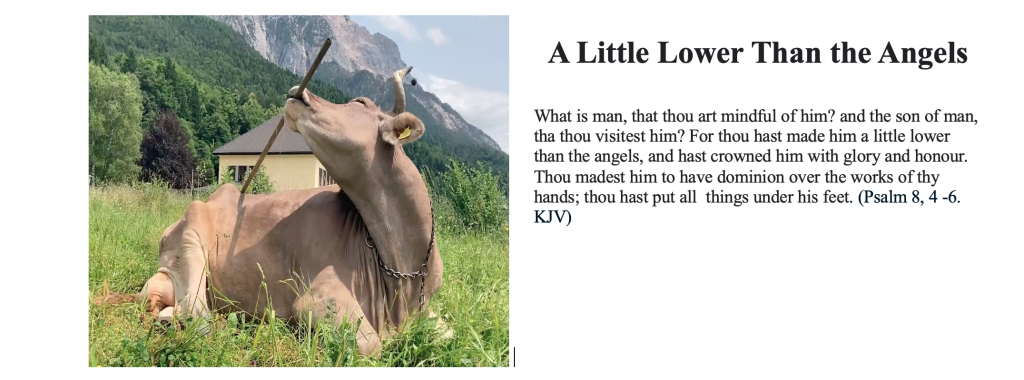
Clearly, as the above epigraph asserts, one source comes from our religious culture. From the most literary of English translations of the Christian Bible (the King James version), that passage has been interpreted as asserting that we humans are apart from nature, given special status by a monotheistic god. It gives humans permission to treat the natural world as a resource to be used, and, as sadly interpreted by some, to be used up. Somehow we have come to think of ourselves, as the epigraph says, as “a little lower than the angels,” creatures supposedly having control over the natural world rather than being subject to the same scientific phenomenon as the rest of creation: as birds of the field, as our primate relatives, to the unfolding of evolution itself. For believers who take such dicta literally, the capital “D”, deity, controls humans, nature does not; and if we human beings are not part of nature, but rather its sanctified overseers, we are at liberty to manipulate nature according to our beliefs and wishes.
In the first essay in the collection, Animals and People in the Ottoman Empire, Benjamin Arbel noted the shift from the rather restrictive piety of medieval Christian sources and St. Augustine’s assertion that because animals lacked a “…’rational soul’ [that]… legitimizes the taking of animals’ lives and their exemption from the protection of ethical and Christian norms.”[iii] This kind of thinking extends to the idea that, in the West, civilization can only advance by subduing nature, including subduing or eradicating other inhabitants of the natural world.[iv]
Contrary to this—though never eliminating medieval thought—the Renaissance advanced some more secular notions cautioning against blind cruelty towards other species. The “rediscovery” of the works of the classical world[v] introduced some new perspectives on this issue. Plutarch cast some doubt upon the idea that human beings have “…absolute mental and moral superiority, while stressing the need for ethical concern towards animals and advocating vegetarianism.”(Arbel, 60-61). An interesting Epicurean notion hinted at a kind of evolution among our species that suggested “…humans originally appeared on the world stage as primitive animals, rather than as the crown of Creation.”(61) Thus humans became part of as opposed to lords of Creation. The classics, however, were apparently not the only source for such thinking; for, starting in the 14th century ideas about proper ethical attitudes towards animals became “a recurrent theme in Western thought.,” and “…several humanists openly expressed their belief that the gulf dividing human beings from other creatures was not as deep as stated in Christian dogma, and that animals were worthy of greater consideration and respect.”(ibid). The dicta regarding the nature, or existence of, a soul amongst other species, raises thoughts regarding, as Darton pointed out to me in another email exchange,
…the dehumanisation of humans via their transformation into (lesser or “dumb” animals, or soulless ones. This extends from some of the Church Fathers denying that women had souls, to the language we’ve used at times toward other humans, i.e. “vermin,” or that wonderful word Schweinhundt. (5/3/26)
A “soul”? Wikipedia does a standard and useful definition of same:
… the soul is the immaterial aspect or essence of a living being. It is typically believed to be immortal and to exist apart from the material world. Anthropologists and psychologists have found that most humans believe in the existence of a soul or spirit, and that they have cross-culturally distinguished between soul (or spirit) and body. (10/3/26)
However, “soulless ones?” The three monotheisms speak of animal souls differently, Christianity being the one which is most likely to speak of animals as lacking them; and intertwined with such ideas is the way these faiths say human beings should treat animals.
In Jewish thought frames the idea of animal souls as nefesh —sacred life force with personality, instinct, emotion—whereas humans have neshama—divine soul. That latter gives humans moral consciousness and free will. As animals are sentient beings created by God, humans must treat them with compassion, and the Torah specifically prohibits causing unecessary pain to living creatures. In the mystical dimension, the Kabbalah says every living being has a divine spark; and some interpret this as allowing animal souls to have an existence after death.
Islam, like Judaism, asserts that animals have souls, and that while their souls do not operate in the same manner as those of humans, they are believed to act in a constant state of worship, glorifying Allah. They have become living beings when Allah breathes a soul into them. Human souls have intellect, moral responsiblity and free will; but on the Day of Judgement, animals will be resurrected and receive justice for any wrongs they suffered. Some, not all, may reside in Paradise.
Returning to Arbel’s essay, after his discussion of medieval vs. Renaissance influences, he then goes on to confirm the Muslim respect for animals—everything from specific organizations devoted to providing food for the strays in their towns and cities to the several versions of Mohammed’s care for his cat. Below I have reprinted a version of the story about the Prophet’s cat as told by a Turkish friend, which also appears in By the Spoonmaker’s Tomb, a collection I have been working on:
Ö. did not respond directly, but told me a story instead—You know, the Prophet had a cat. Because she meowed and made certain distinct noises, he named her “Muezza,” after the Muezzin, who in the old days, climbed the many steps to the tower at the top of the mosque and sang out the call to prayer. One day while the Prophet was at his table, writing and contemplating the mysteries of the faith, Muezza curled up next to him and went to sleep on his sleeve. Finally, when Mohammed finished and wanted to go and refresh himself, the Prophet, seeing the sleeping cat and not wishing to disturb her, cut off his sleeve.
I also have distinct memories of the time I lived in Istanbul and would see little patches of food placed in orderly fashion along the side of a wall for the neighborhood cats. Indeed, I was also told that when the weather was bad—snow especially—the women of that neighborhood would collect the cats and bring them inside away from the storm. Yes, dogs are considered unclean and not welcomed into the house; but when I was there, there was an official program to vaccinate the strays against rabies—for anyone who might incur a dogbite and for both animals’ sake. Dogs, too, Arbel points out are fed by concerned organizations. While I never encountered a specific suggestion that humans are not, shall we say, special to the divine or, among the faithful, a more scientific idea of our being animals as well, the attitude towards other species was, if nothing else, more compassionate. Cruelty to animals was and is frowned upon, even when killing animals for food—they deserve, it is said, a merciful death.[i]
I cannot speculate about Asian religions like Buddhism or what I have heard about reincarnation which suggests, in some cases, that one could be reborn as an animal (not an exalted state, apparently). Even with perhaps a bit more, or different perspective, we are still confronted with the mystery of our human place in the natural world.
However, there is this miraculous thing called life. We are not prefabricated (despite the story, from the same sacred text as the epigram, that one half of our species was created out of a man’s rib): we evolved via a long and slow biological process. We have developed, yes, very sophisticated tools for creation and destruction whilst our primate relatives generally use simpler tools. In fact, while cited for her groundbreaking discovery of chimps using tools, Jane Goodall’s name appears more and more in the footnotes of other researchers investigating other creatures doing the same. Referencing a recent discovery of a cow that uses a broom as a back scratcher (above), yet another opinion piece makes the point that other animals besides Veronica, that cow, use external items in a manner we would call “tool use” and that, indeed, as the Bonobo study affirms, other creatures have consciousnesses. Nonetheless, animals do use tools; and theirs, too, is the desire, the need—to manipulate their immediate environment for survival (food, etc.) Our more complex tool making and tool use, however, does not necessarily imply that we H. sapiens must, or ought to, manipulate nature for whatever purpose strikes us at the moment.
The point here is not so much a particular set of behaviours being more common among other species than we think; but that science affirms that we are also animals, though clearly animals vary in their survival practices. No, I doubt we will ever be able to directly and in depth commune with other species. We do, however, fictionalize their consciousness, imagine what they are “saying,” not only as our pets but, one might cautiously say, in spiritual beliefs. Hence, a few words about the blend of non-human animal and human animal found in some non-Western religions.
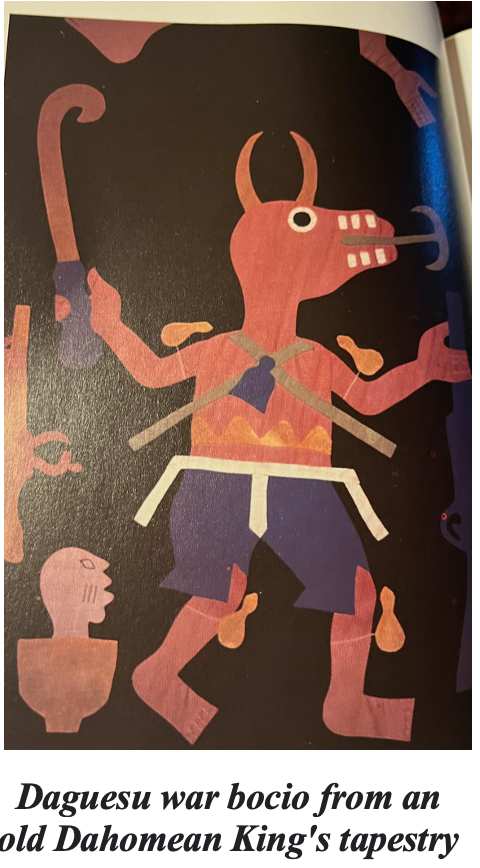
I begin by noting that friend and colleague, Eric Darton, again via an email exchange, asserts that some cultures do not make as fine distinctions between species as we in the West do; and he has pointed out
…the persistence of theriomorphism [see our Vintage Insight for a wry but very misunderstood Victorian comment on this phenomenon], which many cultures take quite seriously, from Japan to Kongo, or riff on fantastically, e.g. I Was a Teenage Werewolf and Catwoman. And inter-special alliances, as in animal “familiars.”
In considering that term, I thought about the ancient Egyptians, who depict so many of their dieties as a combination of other animal forms with that of humankind. Take the ancient Egyptian Anubis, represented as human with the head of a dog, and considered the god of mummification, protector of the dead and important participant in funereal practice. What is it about canines and humans that resulted in this revered combination? That does not hint of our later sense of hierarchy, where humans are indisputably at the top of the heap and clearly separate from other natural life; nor does romanticize the natural world or its denizens.
My own experience with theriomorphism was with the still revered spirits of vodun.[i] I lived in La République du Bénin for the year of 2007-8, where I researched old world vodun and was initiated into several spirits’ groups[ii] These spirits, like those Egyptian dieties, may combine species—at least in terms of being revered symbols of various powers— and they are most certainly regarded as emanating from, and derriving power from, nature. In vodun, for example, a particularly important spirit is Ogun, whose characteristics of aggressiveness, the capacity to face danger, and being straightforward are considered doglike[iii], and he is often pictured with them.
Indeed—and early on—I wrote in my journal at the time that among the many vaccines, shots, etc, I had before coming to Africa, I had had no pre-Rabies shot—one generally given to people who work with animals or are in high-risk, remote areas. Along with contemplating this downside of doggieness, I found this entry:
You are reminded of the astonishing exhibit of Beninois Traditional Art at the Centre Culturel Francaise: a combination of older pieces with some contemporary ones—the Fon/Yoruba creolized pantheon of Elegua, Shango, Ogun (“Gu” in Fon)—and you recall the series of doggie masks. The dog is a hunting dog and Ogun/Gu’s companion. Gu is ‘god’ of iron, war, and, oddly, fertility—a very masculine fellow whose colors, if we believe the color-coding of both Yoruba and Fon, indicate that he is a “hot,” not a calm, diety. Red eyes, a sign that the person-the god-the dog is ready for battle. And there they are, Gu’s doggies, all with their red, ready-to-attack eyes. Red. Rabid.
Ogun/Gu is not quite symbolized as merged with them in the same way as, Anubis, however.
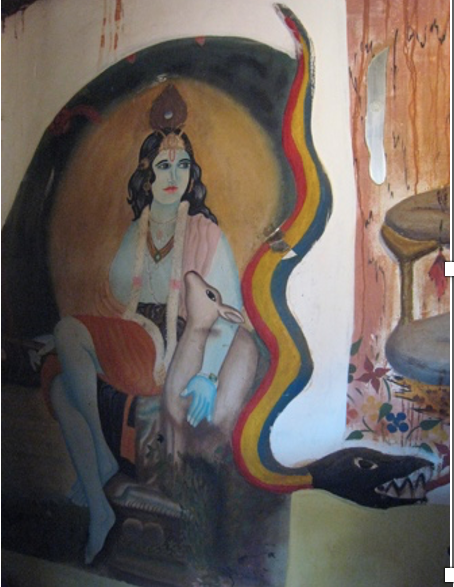
Another of my spirits from that time is Dan, Dangbe or Damballa, often pictured as the Rainbow Serpent and in Haitian voudou, considered to be a bridge back to the African world where enslaved Africans came from. Yet another is Oshun, often pictured as a mermaid with fish’s tail, and considered by many to to be more Yoruba than Fon (the latter being ethnic group whom I followed in Bénin). In some part of the voudou world she is conflated with Mami Wata, though in my experience, Oshun is different. Yes, all these were in a sense symbolic, but that symbols derrived from nature were considered valuable does suggest more reverence for it, perhaps, than we find now. Or, perhaps, a sense of being more integrated into the natural world. And is it possible that polytheism recognizes the natural world as less separate from ourselves?
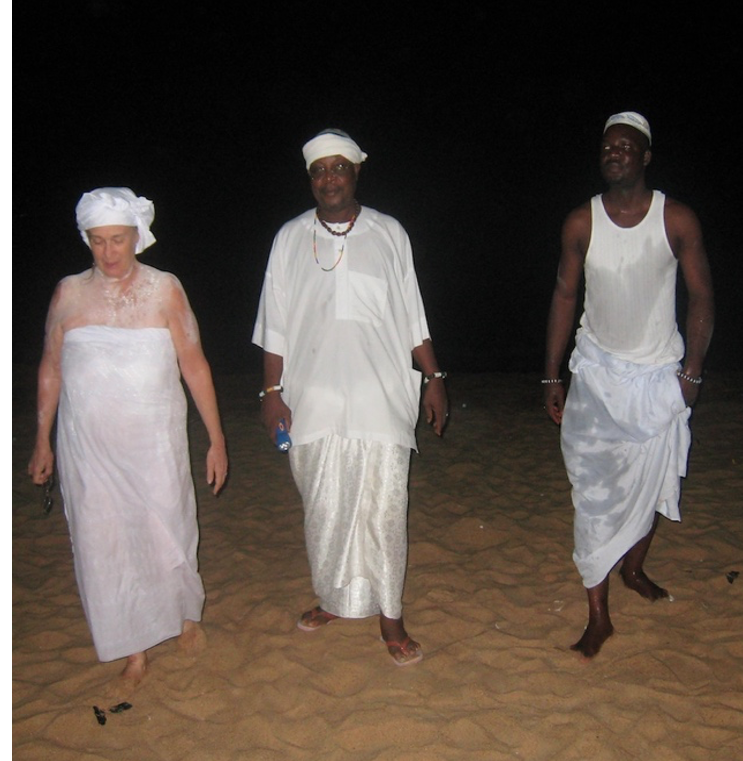
into the sea as part of my initiation into the protection
of the Mermaid. 2008, La Republique du Bénin
All of this goes to say that, over the long term, how we humans think of ourselves in regard to our relationship to the rest of the animal kingdom has not been hard and fast, if not still rather confused. And at times, we have even had to admit that we are animals ourselves and have animal “characteristics.” On the other hand, in the West, the notion of “familiars,” which Darton notes, strikes me as a secularization of animal spirits, though also keeping that notion of our connection to them. In our time, it also hints at something more intriguing than simply projecting our thoughts onto other species—the appearance of animals in our novels and tales.
More of that anon.
— Bronwyn Mills
I remind readers of my posting of BBC world service Desert Disks interview with Jane Goodall in year 2000. just to think about humans’ relationship with the rest of nature.
[i] In La République du Benin, formerly the infamous slavetrading Dahomey, the autochthonous religion is called ‘vodun’, so as not to be confused with ‘voodoo,’ considered a pejorative. In Haiti, where many of these beliefs came with enslaved Africans from Dahomey (Danxome), one calls the religion ‘vodou.’
[ii] Practitioners do not like to refer to these vodun, as they are collectively called, as ‘gods’. Rather they see them as spirits.
[iii] See Wikipedia, accessed 26/1/26
[i] Yes, Sultan Abdümecid (r. 1839-1861) put the city’s stray dogs on an island in the sea of Marmara (when they were returned many cheered); and the same happened with more dire consequences in 1910 in a move that Abdel compares to an attempt at Western “modernity.” Sadly, this time the dogs starved to death.
[i] The Guardian, 10/1/25.
[ii] the New York Times, for those who subscribe see https://www.nytimes.com/2026/02/05/science/bonobos-apes-imagination.html or https://www.youtube.com/watch?v=hYLONHjw0Ss.
[iii] Arbel, p. 59. The quote within a quote is attributed to St. Augustine.
[iv] ibid, 58.
[v] It is well known that Arabic scholars in the Abbasid era (8th–10th centuries) preserved, translated, and expanded upon a vast corpus of Greek, Persian, and Indian texts, particularly in philosophy, medicine, and science and though the Byzantine Empire maintained original Greek manuscripts, the Arabic translation movement provided crucial access to works that influenced the European Renaissance.