
Unrivered
by Donna Vorreyer
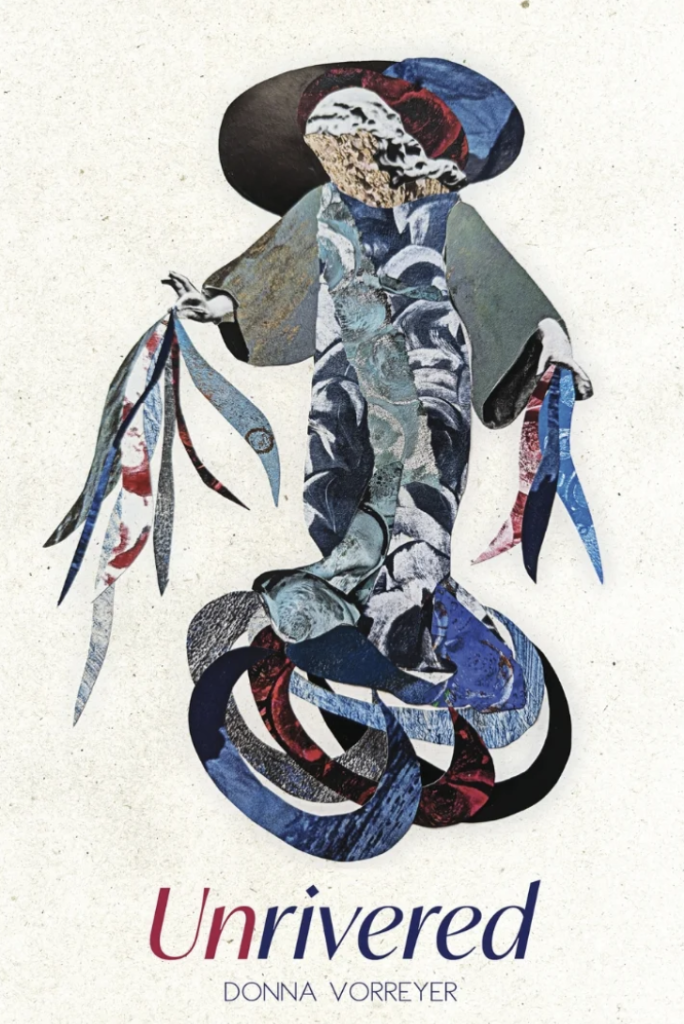
The river of life is one of our loveliest metaphors. It seems an apt description of our younger days: the mountain springs of childhood, our meandering adolescence, the hard-working barge-route of middle age. After that, we become less a river, and more a sea, wider, saltier, and less defined. Unrivered expresses this change. It is a rare—and for me, refreshing—poetry collection that feels all of a piece. That piece is the perspective from the last, unruly miles, when life’s river and the ocean of oblivion start to merge.
The opening poem, “Everything is Terrible & Yet the Fields,” heralds the theme of aging, but with a muted horn. The poem wears “this irksome suit of flesh.” Her “days fall and die like embers.” The body betrays as we age. We feel fatigue and grief. But at the same time, aging is not death, a point the poem and the whole book drive home. A tired body still breathes the scent of soil. The world is full “of seed and sprouts and leaves and rain.”
To live long, as the poet makes clear, is both loss and gain. In her ability to balance these opposites, Vorreyer reminds me of poets who knew how to play with a contradiction, like Emily Dickinson and John Donne. A fine example is the poem “Shriveled, Sweet,” in which the aging body, like ripened fruit, hides delight beneath ungainly skin:
that the body will soften and buckle
under thumb, that it will
bruise, but yield its sweetest honey.
Vorreyer’s poems often find their images in the natural world, not wild and remote nature, but the water, sky, and landscapes close to our human homes. One of my favorite poems in the volume, “Backyard Pastoral With a Little Death,” catalogues the cycles of plant and animal life revolving constantly, close by, and in concert with our own. Ants swarm something dead and unrecognizable. Spent geraniums flowers are deadheaded, to stimulate new growth. Alongside nature, the gardening poet and her partner work, then wait, while “the grill smokes fat-slick and wicked as our dinner spits and whistles.” Every plant and creature in this poem is living it up as it heads for death, a fine prescription for how to conduct ourselves.
Skillful craft allows Unrivered to gather power in thematic expression. Although Vorreyer uses multiple poetic forms—prose poem, rhyming sonnet, lineated free verse — there is stylistic unity amid the variety. Concord among poems arises from both diction, particular in verb choice, along with a subtle formalism.
In every poem, the poet favors robust verbs—to yawn, to burn, to stretch, to whip. Strong verbs connect the poems, and give the book a sense of forward movement that is inexorable and inescapable as the passage of time. The last lines of this sonnet are but one small example of the generosity with which Vorreyer uses verbs:
Compared to others, I live favored,
blessed by every breath as I flex and break
and mend again, each misstep salvation.
A cardinal sets fires from tree to tree—
for now, I’ll continue. Come walk with me.
Formal techniques also unite the book. The techniques are never obvious, never thudding; they whisper in the background, giving a quiet yet insistent rhythm to Unrivered. For instance, there are many rhymes in the book, although I didn’t realize it on my first reading, so delicately are they handled. They can be perfect rhymes, slant rhymes, internal rhymes, even rhymes that add a syllable, such as ending one line with “salt” and another with “exalting.”
Another formal element is structural symmetry. Poems often have firm shapes—the 14 lines of the sonnet, the series of couplets, the poems of longer stanzas each with the same number of lines. Even poems with more variable structure use pattering; one example is the poem “Coppering,” in which a single-line stanza juts into the poem at regular intervals. In addition, the overall flow of poems in the book is carefully ordered—with fifteen numbered sections and sonnets placed at regular intervals. It stuck me that the gentle yet steady formalism of Unrivered is a complement to the gentle yet steady process of living captured in the book.
Vorreyer has taken a big risk in crafting a collection with a singular, clear point of view. The poet does not dissemble. She writes as a mature person, and unabashedly so. To me, this is a strength of the work. Honesty appeals to all readers; it is an ageless virtue. The ultimate lesson of Unrivered derives from the deep truth Vorreyer tells: from moment our lives begin, all of us are growing older—it’s a fact, not a shame. As she writes in the poem “Transubstantiation”:
A body on earth, a temple in ruins
It should not need to be forgiven.
—Dana Delibovi
* * *