
Schmidt
This is Jan Schmidt on October 26, 2026 and I’m talking with Rachel Fleit about her life as a documentarian filmmaker amongst other things. Most recently you completed a film, The Slightest Touch about friendships. How did you get into this documentary with these two people, Emma Fogarty and Colin Farrell?
Fleit
Well, it’s a great story. I was trying to make another film and the film kept having these starts and stops. Then it was clear that the film was not going to happen. I was really upset, because I had spent a year and a half developing this film. I said, “I need a job.”
Then, no joke, a week later, I got an email from a producer who I’d met at a party. I went to the party even though I didn’t want to go. These little things. If this other film hadn’t fallen apart and if I hadn’t met the producer at the party that I didn’t want to go to, I wouldn’t have been so excited to get his email that said, “We’re developing a story about Colin Farrell and his very dear friend Emma Fogarty, who lives with a very rare and very painful disease called epidermolysis bullosa.”
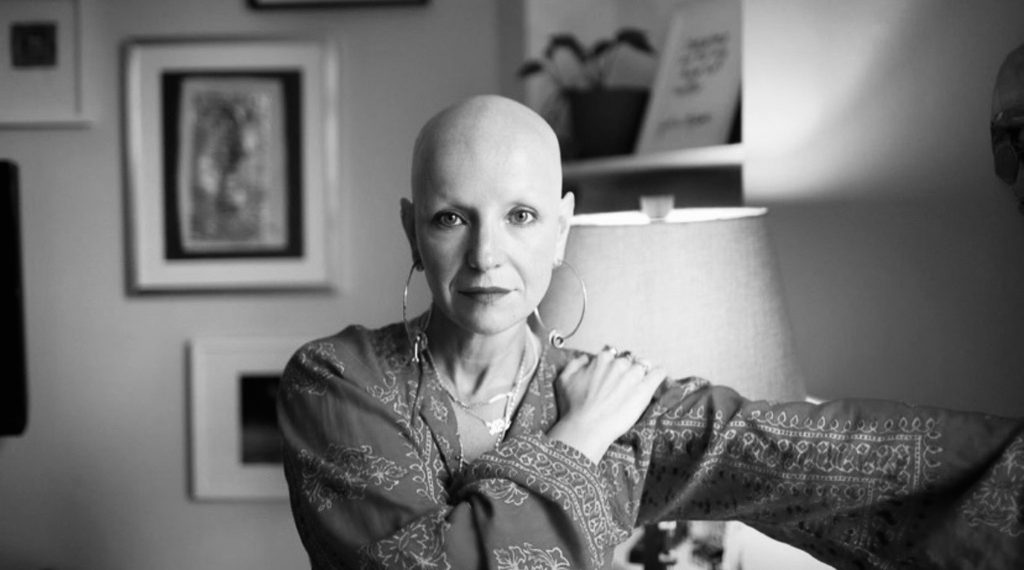
I learned that over the course of their friendship, at some point, Colin said to Emma, “We should run a marathon. That would be a great way to raise awareness for your rare disease, which is a rare disease that gets no money.”
She said, “Well, if I live to 40,” which the doctor said she wouldn’t live past 30, “maybe you can run the marathon for me and for epidermolysis bullosa,” which is also known as EB. “We could raise a lot of money and a lot of awareness.”
Then around Emma’s 40th birthday, she called up Colin and was like, “Remember you said that you were going to run the Dublin Marathon? Well, I have a vision. You’re going to run the Dublin Marathon, but then you’re going to pick me up.” She uses a wheelchair. “You’re going to pick me up at kilometer 38, and you’re going to push me the last four kilometers, which represents the four decades that I’ve survived this disease.”
And Colin said, “I can’t believe I said that. And yes, of course I’m going to do it, but I think we should make a film about us doing it.”
Then this producer who remembered me from the party had seen some of my previous work and said, “You guys should meet with Rachel, because I think she could tackle this with a lot of—.” I guess they thought maybe sensitivity, compassion. It’s the thing that I like to do. So they wrote me, and the timing was impeccable.
I said, “Yes, I’m super interested.” Then I had to have a Zoom interview with Colin to see if there was a vibe, and we did. I made it to the next round, which I say is with the big boss, Emma. We had a Zoom call, and she and I had immediate identification as well. Colin and I had a really nice chat. Then Emma and I had a really nice chat. Then it was clear that we were all getting along quite well, so we should just do this.
We had a time stamp, which was that Emma was turning 40 on June 25th. The marathon was going to be October 27th, 2024. So about two years ago from today. And we were, no pun intended, off to the races. We had to fundraise as we went, because that’s how it goes with documentaries. We just started shooting.
Schmidt
Where did you have to go?
Fleit
First, I went to Los Angeles. Colin Farrell lives in Los Angeles, because that’s where his sons live. Emma Fogarty lives in the Midlands in Ireland, which is gorgeous, absolutely stunning. She’s from a town called Abbeyleix. I went from L.A. to Ireland.
Then Colin, because he’s Colin, was making a film in Macau. We flew to Macau to film with him. It was very special, those days in Macau, because we’re so far away from home and there’s something about Macau. In the film, we have a very powerful interview. I was very, very proud of him for going there, and being vulnerable in Macau. He told me his story of getting sober in Macau. That was really beautiful.
We went to China and then we went to Ireland, and I started to see the through lines of the story. Colin lives with the emotional pain of addiction, which he was very clear about—he’s been sober for over 20 years—and Emma lives with the physical pain of epidermolysis bullosa, and they both are seen by the world in a certain way. People look at her and think, “She’s very sick,” and treat her in a certain way, and Colin, they look at him and they say, “Oh, he’s famous,” and they treat him in a certain way. Because they both have that experience in the world, they have this bond where there’s no BS between them, and they just see each other. They get each other. They have that deep bond.
Schmidt
How long did it take you to make this film?
Fleit
I made a lot of trips. We started filming June of 2024, and we finished filming May of 2025, about 11 months. We started editing around February of 2025, and we finished in September of 2025. Then we did the whole post-production process through November, or maybe December, January. The film was done by January of 2026, and it’s world premiere was in Dublin.
Schmidt
Did this race happen?
Fleit
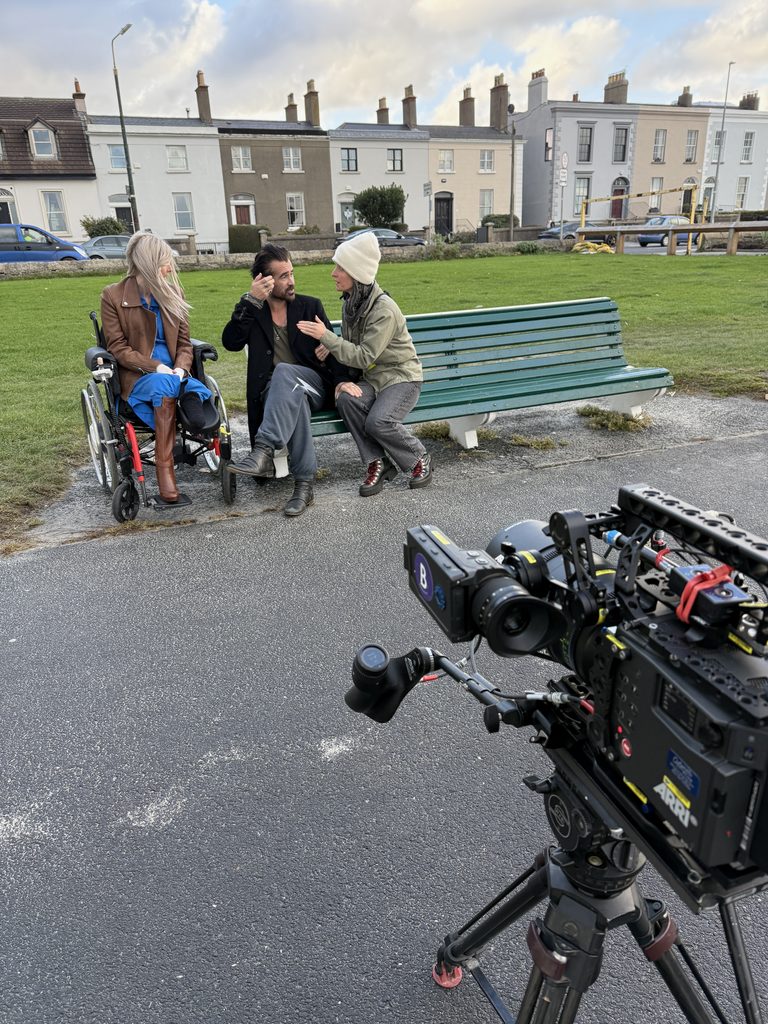
Yes! Oh, my goodness, no spoilers, but they ran the race. It was incredibly emotional. Because this disease ravages your body. Essentially, Emma’s born without an essential protein in her skin, collagen, which, when she gets a wound, it does not really heal. And it’s a progressive disease. When she was born, she had no skin on her left foot, and her entire life it has just progressed. By age 42—now she’s 42—she lives with 80 percent of her body in bandages. She gets no days off except for Christmas. She decided, “I don’t want to do a bandage change on Christmas.” Every single day, she has to get her 80 percent of her body changed, her bandages changed.
Schmidt
So her bandages are like her skin.
Fleit
Exactly. What was profound in the film, which I’m really proud of, is that it was very important for Emma to show the world what EB looks like. Because when she’s out on the streets, you know, she has great style, she has an indomitable spirit, she’s Irish so she’s just cool, and—I love Ireland and I love the Irish; that’s a big takeaway of the film—she’s covered. Her disease is covered in the bandages, and you can sense that her entire body is bandaged.
Schmidt
Her face?
Fleit
No, it doesn’t impact her above her neck, but her hands, her arms, her legs, her everything. Anything that has contact, so usually like joints. She had cancer three times, and so they had to amputate the lower part of her leg, so she uses a wheelchair. Because what happens is when the wounds are trying to heal and they can’t, it’s a greater risk for cancer because the cells come together and form tumors.
She wanted to show the world her disease, and we reveal her disease in the film. She has this different kind of life. The work I want to do is to show a different way of being in the world, because I feel like that’s how I have lived. I’ve had a different way of being in the world. I’m showing what it’s like to have a different way of being in the world.
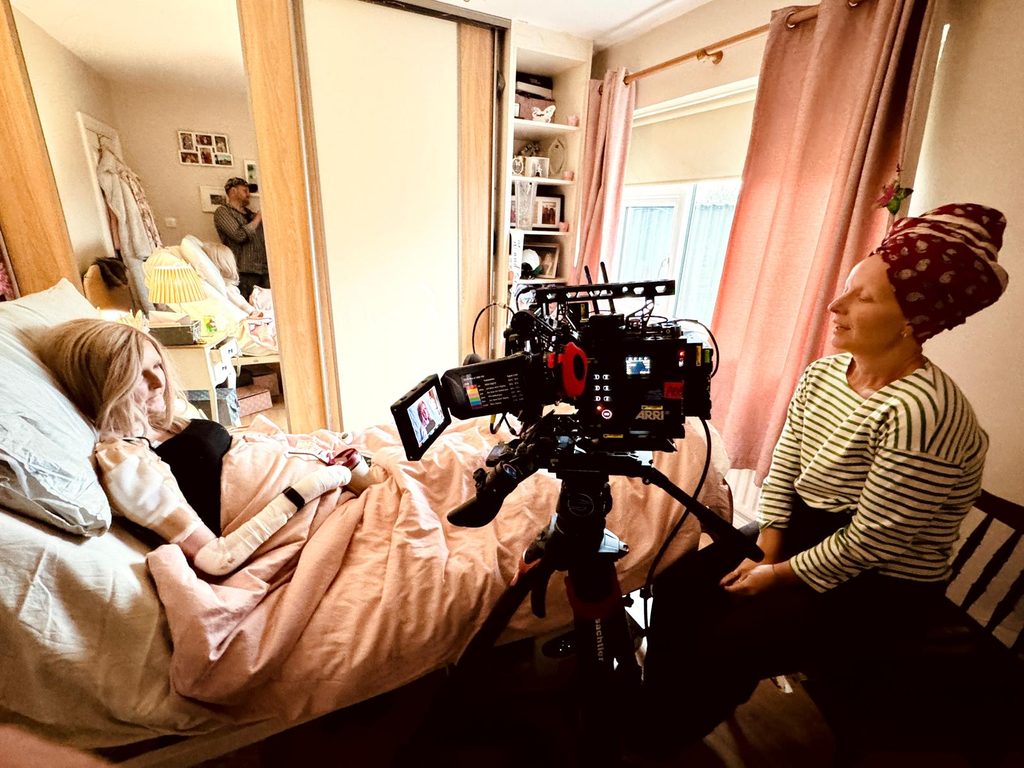
I’m talking about belonging and identity in my work. It’s something that fascinates me. And friendship. Right now, it’s a lonely time in the world. There’s a lot of—without getting super political—there’s just lots of division. What I feel so excited about with The Slightest Touch is it’s a movie about friendship and love and community. It’s about humanity at its best. The marathon happened. It was an incredible experience. The entire country—the country of Ireland, surrounds Colin and Emma. They raised over a million euro. They finished the marathon. It was the best day of all of our lives. My cinematographer and myself and many others ran alongside them for the last four kilometers. You see it in the film—my Alfred Hitchcock moment.
The film has so much love around it. I’ve seen so many of my colleagues are making really, really important work right now that are really hard-hitting issues. This film is a bit of the antidote. It’s what happens when people are very kind to each other. There was a beautiful Substack that someone wrote about Colin that, in this time after the Cornwall 7 situation or scenario, what a beautiful expression of positive masculinity in our film. Amen to that.
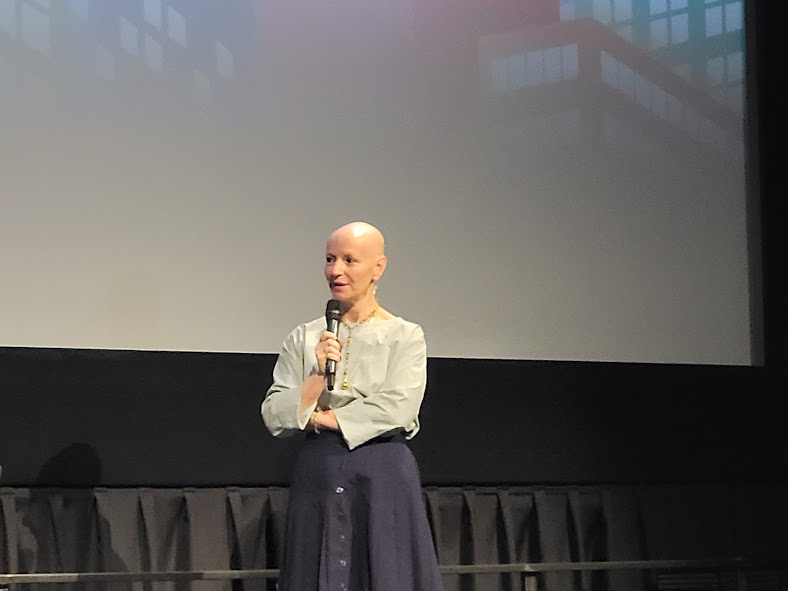
New York Documentary Film Festival 2026.
Photo by Jan Schmidt
Schmidt
This is going to air on HBO.
Fleit
It will air on HBO Max November 25th. It’s worldwide. I’m so excited that they believe in the film and they really want to bring Emma’s spirit to the world.
Schmidt
So, little Rachel. How did little Rachel become this filmmaker?
Fleit
Oh, I think I was in the right place at the right time. Plus, I’ve been telling stories my whole life. When I was a kid, my grandmother said, “I thought you were going to become a writer because you’re always telling all these stories.” I spent many years kind of like self-abandoning my artist life, my creative path, out of fear. The first thing was I loved theater in high school, and I was directing and writing and making plays and performing. Yet I was afraid I couldn’t be successful, so I chose to study production, theater production and management. I was still telling stories, but I was telling other people’s stories. Then I came to New York. I’d been at Ithaca College, then I came back to New York when I was 21, and I started producing theater.
I grew up on Long Island. I was born on 23rd Street and First Avenue and right near Ess-a-Bagel. Those are the best bagels. My dad is a scientist, and he got his dream job at Stony Brook at the university there. So we moved to the suburbs when I was two and a half. There was a family story, “We have to get back to the city. We weren’t meant to live on Long Island.” I really adopted that. I went to college upstate, but every summer I would come to New York, and get an internship and live in the city and hang out with my friends who went to NYU. I couldn’t get back to New York City fast enough.
When I graduated, I came right to New York, and I started producing experimental theater. I did that for maybe two years, while I was also fundraising for a nonprofit arts organization called Chashama, which is still in existence. It’s an arts organization that transforms vacant real estate into studios, galleries, rehearsal spaces, and theaters.
Then in 2004, someone asked me to produce a movie, and I was like, “I don’t know how to produce a movie.”
And they said, “Yeah, but you know how to produce theater. It’s just different medium and different vocabulary words, but it’s all the same.” And I remember the feeling. It was like meeting a boyfriend, the moment I fell in love with filmmaking, was similar. But what was so incredible about a movie was I was producing this short film, and everyone had to come together. We were in this house, and everyone had to do their specific job at the same time in order for the thing to work. It’s the same in theater in some ways, but we were capturing it in this permanent way on this camera. Then at the end of the whole thing, all the hard work, we could hold it. It was a DVD at the time, to date myself. But we were holding a DVD, and we did all this work, and then we had something to show for it. There was something about theater that was so magical, because you have to be there.
Schmidt
It’s ephemeral.
Fleit
It goes away. And it’s so magical, and every performance is different, but I was interested in this idea of permanence. I said, “I want to make movies.” I started producing short films for friends.
Then I got an opportunity to produce a feature documentary. That was wild because my friend had an idea, and I just thought, “I think I can raise the money for this.” And I did. The film took me to Los Angeles, and I was 26 years old. I was sitting with the director and the editor making this film. At a certain point it became unbearable. I didn’t know what was wrong with me. I was in so much pain. I wondered, “Why is this so hard?” I’m making a feature documentary and I’m sitting in the edit going through the whole process. A friend of mine very gently said, “I think the reason why this is so painful for you is that you’re a director and not a producer.”
“But I’m 26. How do I change my career? I’m so old.” Which now is the funniest joke of all. Basically, when I was 27, my life transformed because I realized I needed to become a director, and how was I going to do that?
Schmidt
What was the feature that you were doing?
Fleit
It was called Giving It Up. It was a feature documentary about the paparazzi. It doesn’t have distribution, but it was a really good learning experience for me.
I was 27 and my life radically transformed at this moment. I declared I am an artist, and thank goodness, because I really do believe that the big wild energy, whatever you want to call it, higher power, was like, “Girl, you are an artist and you have to do this.” As soon as I got out of my own way, things started to really happen. It took me a long time. I went to a psychic once who said, “Your creative life is like that little flower that comes out of the sidewalk.” It took so much energy for me to become this artist that I am today because the fear still stood in my way. I finally said, “I want to be a director.”
But then I got a job at this fashion brand, which was creative in many ways, but it wasn’t exactly the vision. I took writing classes on the side and was writing my script. Six weeks out of the year, we did fashion films. This is when I think the universe did for me what I couldn’t do for myself. I was working with these fashion photographers to make these fashion films, and I noticed they didn’t really have a narrative structure. So I said, “Hey, I’m going to write a script for this fashion film.” I wrote scripts that had a beginning and a middle and an end.
Then one day my partner at the business said, “You know what? I don’t like these directors we hired. I think you should just direct it.”
“Me?” She had this intuitive thought that I should just do it.
Then I did it. I remember this actress in the film the next day wrote me an email. I wish I still had it. She wrote something like: “You’re such a natural. You should never stop doing this.” It gave me so much confidence.
Then that fashion brand shifted gears, and again the universe was like, “Okay, go and make movies.” Then I kind of got embroiled in a branded content commercial path, but that was okay because I was still directing and I was practicing my craft.
I knew this couple who had been in a long-distance relationship for over 40 years. He was in L.A., she was in New York. I thought, “I want to make a film about them, an art film about how they talk to each other 15 times a day.” I had no plan to make this a documentary. But I started filming with them.
I had an editor that I was working with at the time for some of the commercial work. I said, “Do you have an assistant who could take a look at this footage and organize it for me? I want to turn it into a short film.”
And she said, “I want to look at it.” Then she said, “The footage is so good. You made a documentary. I want to cut it.”
She cut this short film, and suddenly I’d made a documentary. I didn’t even mean to. Barbara and Stanley: A Modern Romance. At that screening, my friend said, “Oh, my family has this incredible tradition around gefilte fish. You should make a documentary about my family.” I made a film about her family. I kept making work.
When anyone asks me, “How do you do it?” I say, “I don’t know. I went to theater school. I didn’t go to film school.” I tell them, “Just make movies. Take your iPhone and make a movie. Start shooting. If you’re curious about something, keep going. Keep telling the story.”
After I made that film, I met these two cinematographers I thought had a really interesting friendship, and they both were formerly of Mormon families or Mormon themselves, and had come out as transgender and were both cinematographers in a very male-dominated field. So I made a film about their friendship.
I made my first feature in 2019—Introducing, Selma Blair and after that I had a lot of meetings and people would ask, what’s next?
And I said, “I’ve always wanted to make a documentary about the sorority system in America.”
And they said, “Okay. We’re interested in that.”
Then totally separate to me, sorority rush went viral on the internet, and suddenly they said, “Do you want to make this film? We will give you money to go down and make this film.” Suddenly I’m there making that film.
Simultaneously, I’d found this woman on TikTok who is a sugar baby, which means she would get money from men online. I was fascinated by her scamming these men. She and her friends had come up with a way to make money by creating relationships with men that they never had the intention of meeting, but they would get money from them.
What the film is really about is: what it means to grow up in America poor and have to figure out a way to hustle in this very, very hard world. It’s about growing up poor in America than it is about this salacious scam that they were doing.
She was in Louisiana. Then I was in Alabama making the documentary about the sorority girls. The sorority girl movie went to HBO Max and the Sugar Babies movie went to Sundance. Then I got the email about The Slightest Touch.
But I want to tell you one thing because I think it’s important. The thing about the fear is that as soon as I stopped trying to manage and control, and once I surrendered to what I do believe is my higher power’s purpose for me, things started to happen. I look at the work that I do as an act of service. “Okay, put the story in front of me that I’m supposed to tell.” I think that’s how it’s all unfolded.
But I do have a new thing. I never set out to be a documentary filmmaker. I’m a writer. For 2026, I decided, “This is my year of writing.” I have a new draft of my feature script. I wrote a short film and shot it in September.
Schmidt
This is fiction?
Fleit
Yes. Fiction is my true love. I love docs, but I love fiction. I love stories, but I want to expand the vision. I shot my first short film in September. It’s going to come out in January. We’re going to do a screening of it for the psychoanalytic film festival. It’s called The Final Frontier, and it’s about my psychoanalyst that I had for seven years. It’s for the psychoanalyst. I was commissioned. I’m very proud. It made me want to go back into psychoanalysis, making a film or not. Then I’m developing three feature narrative films, two I’m writing and one someone else wrote, but I’ll probably do a little rewrite on it.
We will start raising money, but for right now, it’s creative development, writing and rewriting. I feel in a direct way: “This is the real vision.” There’s nothing else. I love going to the movies. I say: “Do what you love and the money will follow.” That’s a slogan I’ve heard.
I also direct these commercials with real patients for pharmaceutical companies. I love it because I only do this one thing, which is talking with real patients who have benefited from some sort of modern Western medicine. Say what you will about the Big Pharma—again, I don’t need to get political—but for me, as soon as I align my intention to be of service that I can tell these stories, doing those jobs helps me do my creative work, and they know it. They know that I’m coming in there and I think, “This is my strength training for my marathon that I’m going to run, metaphorically, with my feature film.”
Schmidt
You don’t have to talk about this, but I thought you did a movie or a documentary on alopecia and your history with it.
Fleit
I didn’t. I did work with Charlie Villanueva, an NBA basketball player who has alopecia. He wanted to make a documentary about alopecia, so I helped him a little bit with that. But I think what you’re remembering is that for a long time I wanted to, but I didn’t. I started writing a narrative script about it. It’s called Up Island. That’s my big sort of pièce de résistance, which is the thing that I’ve probably been working on for the entire time I’ve known you, and hopefully I’ll get to make that film in the next couple of years. So I’m definitely going to tell my story of wearing a wig as a child and then taking it off in that film. I decided that the truest form of that story is the narrative version because it’s my real vision.
Schmidt
Is there anything you want to add or talk about of your growing up, of your history?
Fleit
One thing I would say, because I think it’s helpful: it was so hard for me to say I was an artist. I felt so unworthy of that. I don’t know how much of it was the external voices, but I had this internal critical voice that was like, “You can’t do that.” I just tell that voice now to shut the fuck up. I think you might’ve told me that.
Schmidt
If I didn’t tell you that, I will now.
Fleit
I know you did. I tell that voice, “Thanks for sharing. That is unproductive.”
I had an experience recently where I was hired to do this thing I’ve never done before. It’s a television pilot. I got hired to do it. I wrote it, and I felt so proud of it. I told myself, “I’m going to do this one day at a time. I’m going to sit down, write the thing.” I had no idea how to do it, but I just did it. I showed up to the proverbial mat every day and wrote.
The thing isn’t going to happen. It got canceled for outside reasons. It’s fine. I have a lot of pots on the stove, and I’m stirring them. Something might not turn out, but we have these other ones. My friend said this thing, which I think works for dating and work and definitely for art making, which is, “What’s yours won’t pass you by.” My life now is I throw a lot of things up on the wall and see what sticks. I don’t need to worry about anything else beyond that, and as long as I’m aligned and I’m being of service and I’m staying true to myself, then we’re good. That’s the whole thing.
* * *