
Raising Hare: a Memoir by Chloe Dalton
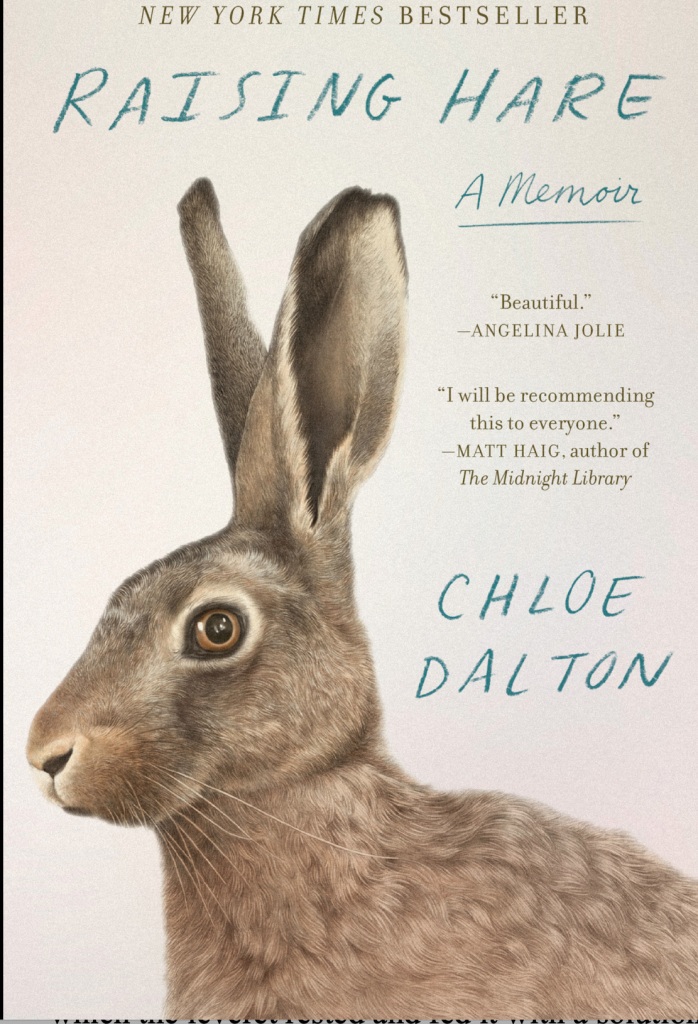
Originally, I turned to Raising Hare; a Memoir, by Chloe Dalton, as an extension of my explorations into we H. sapiens and the rest of the animal kingdom. However, the book became fascinating in itself; for not only is Dalton a skilled writer, but her way of handling a leveret (a hare up to one year in age) i] that she found apparently abandoned in a field showed an incredible amount of both restraint and caring for the creature. She most emphatically did not turn the creature into a pet, nor did she aspire to; rather she hoped to release it back into the wild when it was ready.
Normally Dalton would not have spent so much time in her country home and would have been in and out of London, but it was lockdown. Bringing it inside away from the dangers of predators and the machines of factory farming, she filled a little box with grass in which the leveret rested and fed it with a solution of kitten’s milk a friend gave her. She put it in her walled garden to do its business; and, as its diet necessitated, to eat a variety of grasses growing there. Ultimately, it learned to climb the wall and extended its range. As it grew, and as hares are nocturnal—technically, crepuscular—she left a door cracked so that it could come in and out of the house as it needed; and, indeed, when the creature learned to climb her stairs, it would often sleep under her bed.
Finally, Dalton discovers that it is a female; and she sees the leveret cum hare through several litters presumably the result of trysts with male hares in the fields. I will not take the reader to the bitter end, but as this process of engaging with the animal evolved, Dalton states, “The fact that the leveret appeared to feel safe with me seemed a tacit approval from the wildest of the wild. It made me feel accepted in my environment, akin to living in a state of peace with nature.” (105).
Dalton’s chapters have several interesting quotes from notable authors, often in bold counter distinction: “Man has nothing that the animals have not at least a vestige of, the animals have nothing that man does not in some degree share. —Ernest Thompson Seton, Wild Animals I Have Known, 1898.” (206) Or, “What a destructive, cruel being man is, how many living beings and plants he annihilates to maintain his own life. —Leo Tolstoy, Hadji Murat, 1912 .” (238).
What makes this book is the author’s reflections, not just on the wonder of a living creature that many may take for granted, but on what we, too might take from them: “If it is possible, as William Blake would have it, ‘to see a world in a grain of sand,’ then perhaps we can see all nature in a hare: its simplicity and intricacy, fragility and glory, transience and beauty.” (263).
And, pardon the plethora of quotes, of the hare and her time with her, Dalton concludes,
The sensation of wonder she ignited in me continues to burn, showing me that aspects of my life I thought were set in stone are in fact as malleable as wax, and may be shaped or reshaped. She did not change, I did. I have not tamed the hare, but in many ways the hare has stilled me.” (274-275).
Most definitely this is a recommended and remarkable read.
– Bronwyn Mills
i] For those readers in North America, a hare is not a rabbit, though both are in the same family; and as Dalton further notes:
“The leveret…was a European brown hare—or Lepus europaeus—one of more than thirty species of hare in existence today…..a descendant of the Lepus capensis or Cape hare, the oldest known species of hare, which is generally believed to have originated in the Middle East. Fossilized European brown hare bones have been found dating back to between 126,000 and 1.8 million years ago—to the Ice Age. As the ice retreated and humans spread across the European continent, opening it up for agriculture, hares expanded their range.” (56, Kindle Edition.)