
What is man, that thou art mindful of him? and the son of man, that thou visitest him? For thou hast made him a little lower than the angels, and hast crowned him with glory and honour. Thou madest him to have dominion over the works of thy hands; thou hast put all things under his feet. (Psalm 8, 4 -6. KJV)
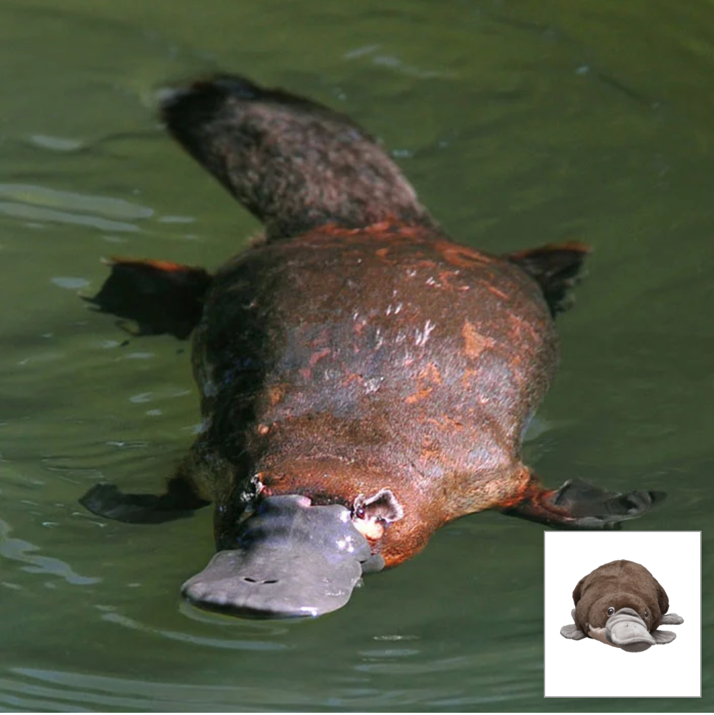
I receive, as I am sure many of you readers do, many emails that ask me to sign petitions and/or donate money; some of those causes are acutely worthy and some less so. Some of those which are genuinely godawful, I hope I have sufficiently rid my mail of. However, not long ago I opened at World Wildlife Fund email which, in addition to the usual information, genuine concern about the animal world, offered a rather odd, if not amusing, quiz whose objective was for the reader to discover their “inner animal.” I took it. And I had to laugh, for my inner animal was, of all things, a duckbilled platypus. This result was given me with the accompanying rather wry photo (click on image to see what critter you might be) and character description :
You are an unconventional original who is completely comfortable doing things differently. Your interests, style, or way of thinking may not fit neatly into one category—and that is exactly what makes you memorable. You are imaginative and independent, but you usually prefer originality without unnecessary conflict or drama.
Ah, well. But here we have example of a playful—ok, a pitch—for contributions that oddly touch on something profound: our relationship with the rest of the animal kingdom. For, indeed, we too are animals.
Now, in the previous, Part 2, of “A Little Lower than the Angels….” I ended with the mention of a clip of David Attenborough from his 1976 film, Life on Earth, and his encounter with some very pleasant gorillas, wondering, quite rightly, “What kind of animal are you?”
…[P]erhaps, then, as this animal attempted, it seems, to communicate with Attenborough—at the very least to ‘say’ “what/who are you?’—it is not so difficult to imagine animal characters in our literature in communion with the human ones. And not, by any means, just in books for children.
As also noted in Part 1 of “A Little Lower than the Angels,” scientists working with Bonobos have recently demonstrated that they, too, have the capacity to imagine; but I do not mean to imply that the rest of the animal kingdom should be simply comparable to human animals’ children. Nor do I believe the “Disneyfication” of the above children’s stories are anything but a sacrilege–the tradeoff being the almighty dollar for the natural wonder and naievete of childhood.
Months later, sitting outside a small town in the hills of Costa Rica and watching cars passing by, I had the thought–here are these animals handling artificial mechanical things which other similar animals have made, using rather complicated processes. These contemporary animals—primates, H. sapiens—are long past chipping flint, rubbing sticks together to create fire, and so on, though these less elaborate technologies were once critical to their survival. And indeed, what other animal makes such mechanicals? And, sadly, too, so many of these particular creatures’ inventions have lent themselves to destroying the natural world.
Yet consider animal creativity. Thousands of years ago H. neanderlaensis (sometimes referred to as Homo sapiens neanderthalensis) made art, art which is still possible to see in certain caves around the world—and those animal cousins of our own animal H. sapiens species were not so different from us. Their art, as art does, points to a capacity for symbolic thinking, language and other such characteristics. Indeed, the art in the Caves of Ardales, near Malaga in southern Spain, was created by Neanderthals about 65,000 years ago, making them possibly the first artists on earth, according to the study published in the Proceedings of the National Academy of Sciences (PNAS) journal.
Further, consider that H.sapiens originated and developed in sub-Saharan Africa. While early on some prior species wandered north and east out of sub-Saharan Africa, H.Sapiens then spread north and east where Neanderthals and Denisovans had earlier emerged, and intermingled. Those remaining in Sub-Saharan Africa created wonderful art too, as well as adding some possible, albeit small, strains of related species (esp. in South Africa, including southern African Khoe-San people); whereas in European and Asian populations, one finds about 2% Neanderthal genes. We animals of H. sapiens heritage are, consequently, quite a mix.[i]
I could go on; however, whatever the fascinating variety in the family of the human animal, I find it interesting to use that word, “animal,” when referring to human beings. While it emphasizes both our biological relationship with other animals it also underlines that awkwardness so many of us feel placing ourselves in relation to the natural world, the “animal kingdom,” and its creatures. In an article from the NYTimes science section (11/4/26) posing the question, “Do Animals Grieve?” the emphasis on that presumed difference which we humans have difficulty, to put it colloquially, “wrapping our heads around”—that presumed difference may seem a little odd for those of us who are or have been pet owners. I had a rather elderly cat whom I left while on a several week visit to family at home; and though fed and well cared for by pet-loving neighbors, that cat went out every day, standing at the edge of the road, clearly waiting for me to come home. The more poignant was this because she was close to death, and died before I returned.
Then there was the famous Koko, the lowland gorilla who learned to sign; and when her favorite pet escaped and was struck down on the road, Koko signed, ““Cat, cry, have-sorry, Koko-love.” To present animals, then, as communicating in words—anthropomorphically–how are we writers then to approach their use as characters in fictional work?
A prevalent attitude may be like that of author, Virginia Evans, US novelist and winner of the British 2026 Women’s Prize for Fiction who manages to skip mentioning nature in her comment about reading—now and earlier in her life, “I loved books about things that can’t exist. I suppose it’s all escapism – crimes solved by children, talking animals, time travel, people two inches tall. I always loved to slip into another, better world.,”
I am not sure that one escapes from nature through following tales with talking animals, not do I particularly agree that work “about things that cannot exist” is “all escapism” and a particular type of reading so much as an exercise of imagination in general. Some work might include characters that could not exist (talking animals, etc.) and some might simply include themes, characters, etc. that are just fictional. Unfortunately social realism—as much as I might honor the attempts of writers to write about a social/political situation in desperate need of amelioration, or the history thereof—unfortunately this category has overwhelmed so much of US literature that other exercises in imagination have not gotten their due respect. After all, fiction itself is but a made up world.
So be it.
Earlier in this series, I began by entering the world of muddled analogies, if I can put it that way: anthropomorphizing animals other than ourselves, theriomorphizing animals cast as one or another beasts in polytheistic religions, and so on. With ever-so-brief references to childrens’ literature, I suggested that some writers do similarly in writings for grownups. Fellow editor, Eric Darton, for example, has done this with humor and sophistication in his Beaky Chronicles and later in Free City, though in the latter the characters are not a rooster and a fox as in the Chronicles, but a mechanical duck of some sagacity. And, while there are certainly a good share of humorous interactions between the fox and his feathered friend (and, yes, that saying, ‘the fox in the henhouse,” did keep running through my mind), thankfully Darton does not ham it up, in the Disneyfied sense of making the Chronicles‘ content cute. Indeed, nothing about these creatures—the Chronicles is exclusively dominated by a rather peripatetic and adventurous bird and a compliant fox; and Free City, featuring the duck in a supporting role as the humans in the book cope with, “the Dawn of the Enlightenment, wherein Science and Magic shall be split, and Technology and Capitalism potently conjoined.” (Goodreads, or Amazon) — nothing about these creatures would fit unadulterated in a cutesy children’s book.
I, too, have used animal characters: for example, Elwood, a muskrat, of a species native to the swamps around Baltimore, Maryland, where my first novel, Beastly’s Tale[ii], is set. The historical background is the time of desegregation of schools in the US [iii]. The muskrat is a fan of the blues and complains vigorously about the phenomenon of white musicians snitching black musicians’ music in that genre without giving due credit to the artists in question (e.g., like Elvis Presley’s copying Big Mama Thornton’s recording of “You Ain’t Nothin’ but a Hound Dog.”) Elwood periodically takes his human friends to a bar, portside, in the Port of Baltimore where blues is played and where some very odd characters indeed are found.
I have another non-human character, a canary, in an ongoing novel. Named after the famous Roman orator, Quintus Hortensius, all of whose works have been sadly lost, this bird has taught himself to read while in a cage in a bookmaker’s shop. He thus becomes an admirer of Maimonides and one of the narrative voices in a novel about the expulsion of the Sefardic Jews from Spain in 1492—and later the Moors.
on the other hand, Paul Yoon’s Etna, a tale told by a dog, begins auspiciously enough:
But it [the farm] was home to me. My mother was there. My brothers and my sisters. An early memory: waking up to a den of pale noses surrounding me before our mother came, the silhouette of her face looming over us in the sky, the tall triangles of her ears pocketing the smell of the coast. (Yoon, Paul. Etna: A Novel (p. 3). Kindle Edition.)
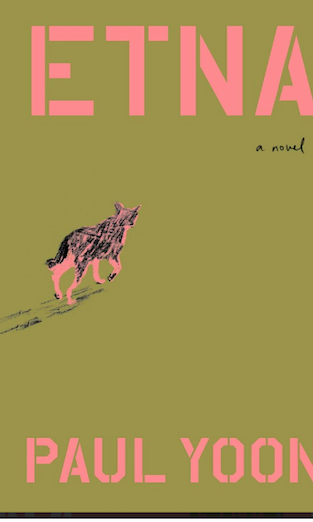
The difficulty is how the author transitions from that cozy beginning to a full-blown tale told by the selfsame canine. The narrative voice transmogrifies: it becomes one which could too easily be the voice of a human being as a dog. To put it bluntly, after the first few—20 or so—pages, there is just not enough dogginess in the narrative voice. A mention of a paw here; scratching behind the ears, there—those token dog behaviors are not quite sufficient.
The background of a war which somehow isn’t over, where guerillas are still very much active despite an official declaration of the war’s end—these, granted, don’t make for an easy tale to narrate from a canine perspective, even from the perspective of a canine trained to work under such circumstances. And, oddly, the dog’s homesickness that supposedly drives him on is underdeveloped. Or, perhaps, it is just that good old-fashioned character development is uneven here.
On the other hand, replete with doggieness is Spencer Quinn’s Dog On It. […the pen name for writer Peter Abrahams, as Abrahams’ website reveals.] The book is first of a a crime series with punned titles such as Thereby Hangs a Tail, To Fetch a Thief, The Sound and the Furry, etc. and featuring Chet the dog, and Bernie, a human and private detective.[i] Rave reviewed by one of my least liked authors, Stephen King, the actual writing is not spectacular: grammatically correct, not especially interesting stylistically nor that literate. No Agatha Christie or Arthur Conan Doyle this. Hamming it up via punned titles (Cat on a Hot Tin Woof is yet another) can’t make up for uninteresting prose—nor can this human animal/canine combo, despite a better developed dogginess in the character of the dog.
Whatever one may say about the dog narrator in Etna, Yoon is a serious writer with good command of his craft; indeed, Etna is listed as one of top 100 books of 2026 by the New York Times. Given the author’s background (he is Korean American) a reader might mistake the backgrounded war as the 1950s Korean War. However, as the tale unfolds it seems more and more like a very heartfelt comment on the horrors of war, period, rather than one in particular. In that, the book is excellent.
Yet the character of Etna, as noted, is another story and the question persists: how does one portray an animal character in an adult book? Is that creature only to be relegated to the role of comic relief and/or a broad form of satire? We— or human religions—have put our species on a pedestal. A little lower than the angels vs. what Orwell satirized in Animal Farm?? Animal characters in our fiction, though quite a leap in terms of realism, may at least take some of the gloss off our supposed distinctiveness as not quite ‘animal.’
And here we are again, returning to our relationship to nature, and to other animals….
— Bronwyn Mills
[i] Interestingly, our early species first had black skins; as an adaptation to the various ice ages we gradually got pale.
[ii] Currently out of print. A new edition may be available soon as a print on demand edition.
[iii] Brown vs.the Board of Education, 1954.
[i] Readers in the UK can find this, “Making Life on Earth: Attenborough’s Greatest Adventure“on BBC’s channel One and iPlayer. It will expire in 6-7 months.