
An Exploration of the Use of Place in the Essays of James Baldwin
First in a Series by Jenine Holmes
Place is often something you don’t see because you are so familiar with it that you devalue it or dismiss it or ignore it. But it is the information your reader most wants to know.
—Dorothy Allison, The Writer’s Notebook:
Craft Essays from Tin House
PART 1: HARLEM, U.S.A
History, across time, can form interesting unions. Although the writers James Baldwin and Dorothy Allison were born twenty-five years apart, Baldwin, with his analysis of race and homosexuality in America, must have had an influence on Allison’s depiction of class, family, and queerness in the rural South. Both writers shared two important qualities: a resistance to dominant American cultural narratives and a shared view of power of place and setting in good writing.
At a young age, Baldwin made becoming a writer his life’s mission. He possessed a magnificent mind, capable of absorbing and analyzing details to such a degree, people and places became a part of his DNA. Place would lay the foundation of his narratives for years to come.
Baldwin defined those ideas by using his physical form and spirit that once occupied those spaces, geographies as a sort of, I believe, a walking psychotherapy. Just as Henry David Thoreau used Walden Pond as a backdrop to search his internal emotional landscape, Baldwin would travel to distant locales, insert himself, and allow the environment to exhume authentic feelings and insights.
Baldwin sought his place in the world as a Black man, an openly gay man, and a writer during a time of great strife in America. Through locales and settings—from Harlem U.S.A. to Paris and to Switzerland—each served as a path to self-discovery for the author. The gift that his writing provides readers is a greater understanding of the era and the craft lessons gleaned from his works.
More than hundred years after the birth of Baldwin, the world looks to his insights and viewpoints more than ever, revisiting the analysis of place found in his creative nonfiction essays to help us today.
Fear is a wonderful place for a writer.
—Dorothy Allison
Born in 1924, the eldest son of nine children, Baldwin lived in a family home in Harlem that didn’t contain an emotional safe space where he could develop his whole self. Reared by a verbally abusive minister stepfather who deeply resented his teenage son’s refusal to commit to a life of the cloth, James Baldwin’s passion for classical literature and the craft of writing made him an outcast in his family home.
His stepfather said Baldwin “Was the ugliest boy he ever saw,” the writer claimed in his essay “The Devil Finds Work,” because of his “pop-eyes.” When Baldwin is taken to the movies by a teacher, to see the Bette Davis in the film 20,000 Years in Sing Sing, he is struck by the similarities of the actress’ eyes to his, and how the world viewed Davis differently. He began to see himself through a new lens. Years later, Baldwin would discover his looks mirrored his birth father.
With the support of his protective mother, the young Baldwin found his first place of safety, among the stacks at the 135th Street Branch of the New York City Public Library. He devoured classics such as Crime and Punishment, Uncle Tom’s Cabin, and more, before the age of 12.
The death of Baldwin tyrannical stepfather would set the stage for the opening of Baldwin’s most important essay, “Notes of a Native Son.” The writer shapes the setting of place for the reader in the 1955 work in the Black enclave from the first scene:
On the morning of the 3rd of August, we drove my father to the graveyard through a wilderness of smashed plate glass.
The day of my father’s funeral had also been my nineteenth birthday. As we drove him to the graveyard, the spoils of injustice, anarchy, discontent, and hatred were all around us. It seemed to me that God himself had devised, to mark my father’s end, the most sustained and brutally dissonant of codas. And it seemed to me, too, that the violence which rose all about us as my father left the world had been devised as a corrective for the pride of his eldest son. I had declined to believe in that apocalypse which had been central to my father’s vision; very well, life seemed to be saying, here is something that will certainly pass for an apocalypse until the real thing comes along.
In this haunting description of place, we see the power of Baldwin’s talents to join disparate visuals to create a decisive third example which works to create a powerful setting.
In Baldwin’s writing about his deceased stepfather, a man who “had been devised to believe in the apocalypse which had been central to [his] vision,” the patriarch as leader in the community is telegraphed to the reader. We know the type of sermons his stepfather levied on his flock, and on his son. The riot running the streets is not a symbol of unrest; it is the final lesson levied by the fire-and-brimstone hurling father from beyond the grave.
Framed by the phrase: “spoils of injustice, anarchy, discontent, and hatred,” Baldwin builds a nightmarish scene from Dante’s Inferno, an upside-down American Dream.
Baldwin’s Harlem is not the setting of the legendary Cotton Club with sexy, sequined show dancers, or one of Billie Holiday, center stage at the legendary jazz club, Small’s Paradise, crooning through a pale fog of cigarette smoke, a fresh white gardenia tucked behind her ear. Baldwin’s Harlem is dangerous, defiant, and potentially deadly. It is a perilous land that honors nothing, not even its dead.
From the vantage point of a twenty-five-year-old, Baldwin redrafted and crafted terrifying memories of his nineteen-year-old self in the midst of a riot. Most of us don’t want to look that far back or so far down. We know pain loiters in the dark places. Still, Baldwin goes there and returns bringing up shards of our society to examine in the raw daylight, from the comfort of safety and our sofas.
Baldwin believed, “When you’re writing, you’re trying to find out something you don’t know. The whole language of writing for me is finding out what you don’t want to know, what you don’t want to find out. But something forces you to anyway.”
This is how Baldwin moved his writing forward and turned that force to a penetrating look at his community, the role of the Christian church, and place. In the essay “Down at the Cross,” religious leaders like his pastor stepfather crafted messages foretold by the Bible, to corral the community using a world shaped by fear and rage. Through the changing ground of place, with the open mind of the writer, place and reality were revealed by observation; his body and mind firmly engulfed in place.
What I saw around me that summer in Harlem was what I had always seen; nothing had changed. But now, without warning, the whores and pimps and racketeers on the avenue had become a personal menace.
My friends began to drink and smoke, and embarked—at first avid, then groaning—on their sexual careers…their incredible metamorphosis, of which the most bewildering aspect was not their budding breasts or their rounding behinds but something deeper and subtler, in their eyes, their heat, their odor, and the inflection of their voices. Like the strangers on the Avenue, they became, in the twinkling of an eye, unutterably different and fantastically present…They began to manifest a curious and really terrifying single-mindedness.
Baldwin’s vision of place is defined by the changes in his very neighbors into a personal menace: the hormonal shift of his teen friends, before his eyes, into adults who will make sex a job, perhaps the only one they will honor or find value in.
To further add intensity to the paragraph, Baldwin employs repetition to pinpoint an undeniable fear coming from the new enemy all around him: their budding breasts, their rounding behinds, in their eyes, their heat, their odor, the inflection of their voices. Through the combination of rhythmic phrases, the use of sensory and visual details, Baldwin makes the reader a witness. With a powerful eye focused on place, we stand in the very community that threatens the writer. We become part of the narrative. We become witness. We can almost see Baldwin’s accusatory finger jabbing the air as he reveals his status as a stranger in a strange land, a place once called home.
Place requires context… Place is where the “I” goes. Place is what the eye looks at, what it doesn’t look at. Is it happy? Is it sad? Is it afraid? Is it curious? What I’m trying to say is that place is not just landscape—a list of flora and fauna and street names.
—Dorothy Allison
Baldwin welded a high level of attunement during his eyes-wide-open childhood. He deliberated his present and future with a surprising level of clarity. While he lived among the community as a neighbor and a citizen, he became a spectator to the theater of the streets that unfolded around him. Never included. Over time, a shift had occurred. Baldwin feared becoming a target in the place that once nurtured him.
For the wages of sin were visible everywhere, in every wine-stained and urine-splashed hallway, in every clanging ambulance bell, in every scar on the faces of the pimps and their whores, in every helpless, newborn baby being brought into this danger…Crime became real, for example—for the first time—not as a possibility but as the possibility.
From his religious upbringing, Baldwin pulls out a sense of the biblical with the thought “For the wages of sin were visible everywhere.” He names the plagues across the land. Baldwin goes to great effort to define them for the reader in every “wine-stained and urine-splashed hallway, every clanging ambulance bell, every scar on the faces of the pimps and their whores,” even every helpless newborn babies.
Here Baldwin recasts community, this place, into a biblical, modern-day Sodom and Gomora, in a land, not even newborn babies were spared. He juxtaposes the guilty against the innocent. Throughout this paragraph, Baldwin injects tension as he engages all the senses through sound with “clanging ambulances” and the odious, “wine-stained and urine-splashed hallway.” ( I can never read that line without wrinkling my nose. That’s how good the sentence is.)
Through his sensory details and thoughtful assessment, Baldwin builds a description of a place no one wants to be but, as writers and readers, we admire. In his urban Dickensian setting, a bleakness, a lack of hope, covers the world. Baldwin saw no helping hand, not even from God, as a man of God.
Yet, James Baldwin valued the possibilities of his life—even as a “Negro” in 1950s America—enough to seek an unrestrained life and what it could deliver to him, as a man, as a writer, even if his father and America did not.
At the age of eighteen, Baldwin set out to explore a new definition of place. Urgency propelled Baldwin to self-evacuate from a predominantly Black society in Harlem before it buried him alive, and moved to the multi-racial, sexually liberated Greenwich Village. A mere eight miles from Baldwin’s family home. But the Village, in fact, Baldwin would discover, was a world away.
PART 2 FORTHCOMING IN SPRING 2027
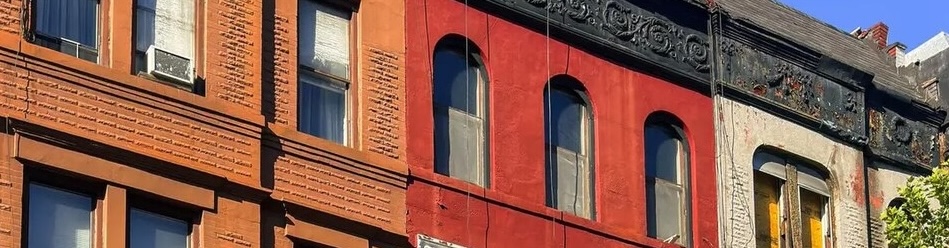
Photo of Harlem houses by Kidfly 182.
* * *