
What is man, that thou art mindful of him? and the son of man, that thou visitest him? For thou hast made him a little lower than the angels, and hast crowned him with glory and honour. Thou madest him to have dominion over the works of thy hands; thou hast put all things under his feet. (Psalm 8, 4 -6. KJV)
In Part One of this essay, I carefully avoided the subject of anthropomorphism. It has come to be understood as the most common form of ascribing human characteristics to non-human creatures. Yet, there is another form, anthropopathism— according to Merriam Webster, ascribing human feelings or passions to something not human, particularly a deity. At one point it appears that this latter term was close to theriomorphism, or even to what we now currently speak of in general as anthropomorphism. Rather than the emotional reaction of a revered animal as animal, though, the term specifically refers to divinity reacting emotionally in human fashion; and its use does indicate a shift of focus that leaves the (other) animal behind in favor of the human.
However, these fine distinctions can be overlooked. Melanie Challenger, author of How to be Animal and also a researcher and broadcaster on environmental history and philosophy of science, in her book uses anthropopathism to refer to,
..idol worship across pre-Christian eras, and object worship too, whether totem poles or magical swords. The term for this kind of mind-swapping is anthropopathism. Through this, we saw spirit in any object made by a human. (Canongate Books, Ltd., 2021, 177.
One can thus see the subsequent qualification, that a diety expresses emotions; divine “regret” or “anger,” are often cited. Does the above quote imply that the diety is created by a human as well? (Some religious persons might object!) In this less theologically focussed age the term appears to have receded back into the world of scholars and theologians.
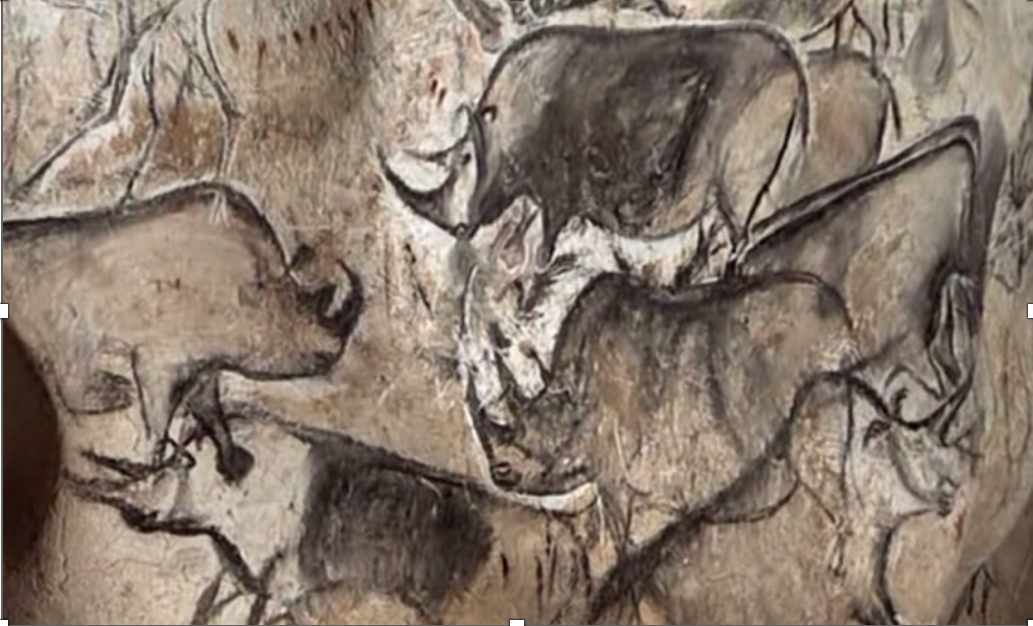
In 2021, art historian James Fox presented a three part series on the BBC, Nature and Us: A History through Art. For those who have access, the series is still available and well worth watching in terms of exploring human beings’ relationship to nature. In the first episode of the series, Fox makes a salient point about early human art, cave art from the Ice Age, which he says is very revealing about early human attitudes toward nature: one would think that, when humans first started making art, “the first thing they would represent would be themselves,” he says, but “prehistoric people hardly ever painted full human figures.” No, they painted animals. These drawings, he says, are not “just beautiful and evocative” but “they are staggeringly accurate, depicting the anatomy and even the behavior of these creatures.” Such art both shows how deeply connected our ancestors were to nature, but also how we were “doing something no other animal could do.”
The episode continues with comments from Steven Pinker who both affirms Fox’s position, that we humans are also animals but also asserts that our behaviour is far more advanced than that of other primates, other animals. Those advances he ascribes to our social and cultural behaviors. Challenger speaks of how human beings have both “one foot in nature, and the other foot in a completely human, cultural, technological landscape—one foot in reality…and the other in the heavens, in our imagination.” She also speaks of how incredibly slow that journey to become this “slightly split creature” has been, taking so many hundreds of thousands of years. I cannot help wondering, if we had not gone on to so profoundly tamper with nature and its other creatures, how long our primate cousins might have taken to evolve certain characteristics appropriate to their species.[i] More accurately, it is quite likely that our early ancestors were far more integrated into nature, or as Fox proposes, “it seems likely that they thought that everything in nature, including themselves, was infused with spiritual energy and power. A belief system often called animism.”
Here we go again. That verb, “thought.” I suspect that in those times, their animism was as much a sensation as an intellectual operation. Rather than an awareness of nature as both an environment in which we living creatures all belong, and a condition we living creatures all embody, we enter the world(s) of belief. From animism to the specifics of theriomorphism, from where the lives of humans and animals are considered to be interconnected to, very loosely, animals as gods (or part of the divine) and ourselves as animals, also possessing spirituality. In short, it is not so simple to disentangle ourselves from other animals.l
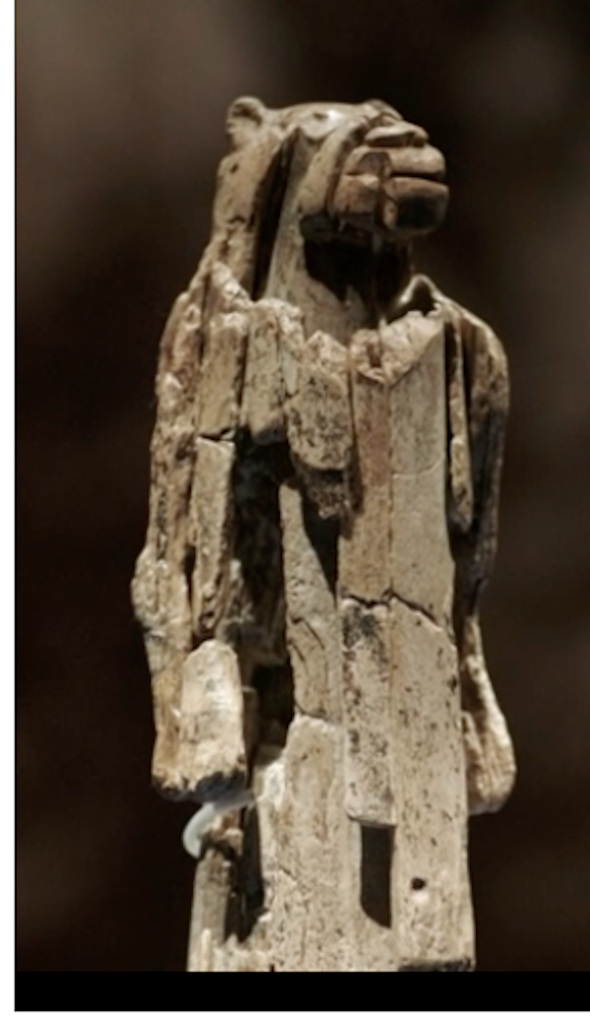
mammoth ivory—human body,
with lion’s head.
Fox and the aforementioned others, however, are very particularly talking about art, as well imagination (therefore, creativity?) which they appear to believe largely a human characteristic.
Mind, along with the sad news of Desmond Morris having passed away (at the ripe old age of 98, bless him) came the revelation to some who only knew of him as a zoologist, that he was also an accomplished artist. Interestingly, in the news coverage of his demise, what I saw was a clip of Morris backgrounded by some of his work, and showing a very interesting painting made by a chimpanzee: Morris commented on the irony that the chimp’s painting brought a higher price than some of his.
Here, again, comes a challenge to human beings’ sense of their uniqueness,the challenge of how we humans really regard nature. As Fox pointed out, artists all over the world continue to produce art that “brings together the human and the animal.” Tempting though it is, I will go no further on the subject of his presentation save where he shows several masks depicting animals and used in rituals to summon and ask various animal spirits for their intervention in the lives of humans—a hippo representing a fishing spirit called upon for a good season, etc.
These also point to the theriomorphic merger of human and other animals. Indeed, the final mask Fox shows is from the Torres strait and combines a humanesque figure with a ferocious crocodile, upon which the humanesque is sitting. What is most remarkable is when the mask is put on, and the dancer begins his movements, by moving his head up and down, or left and right, he can “transform the crocodile into the human and the back into the crocodile—” Again the blending of the human animal and other beasts. and another possible theriomorphic reading of human and and non-human essences.
.
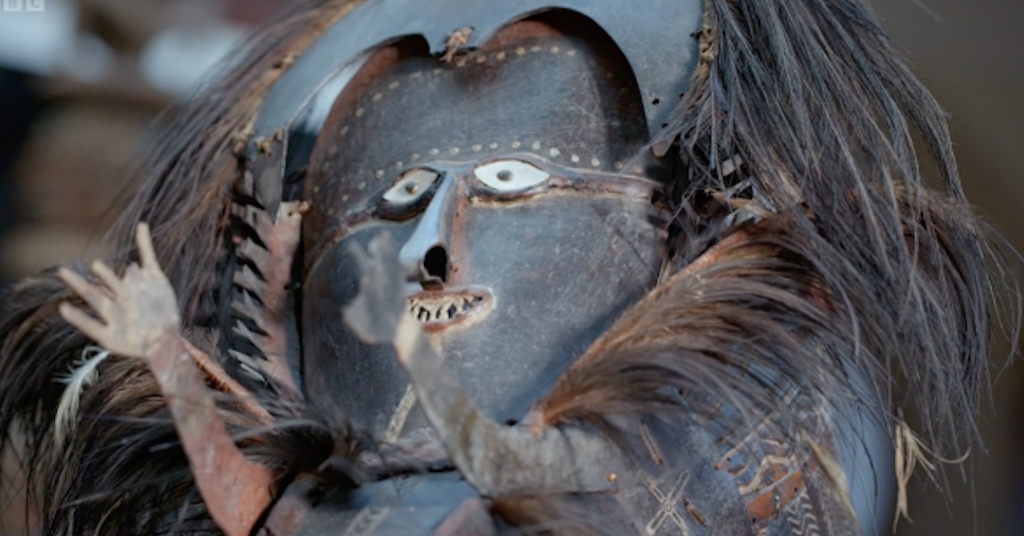
Torres Strait mask
* * * *
To me, anthropomorphism, in its more common contemporary usage, reads like a distancing of “animal-ness” from ourselves while emphasizing “human-ness,” and all this while still holding at least some animals in our affection. I confess, I talk to my pets (two cats). I ascribe various emotions to them. Who knows what they feel, other than the obvious signs of hunger, fear, ferocity when confronted with an agressive or disliked creature? I also have fond memories of children’s books read to me as a child: the good ones like Winnie the Pooh and Wind in the Willows (still among my favorites)[ii]. I never for once doubted that those creatures were as portrayed; but, unless we think of ourselves as gods, when it comes to actually portraying an animal as having thoughts like ourselves, merging spirits with them is not quite the same as thinking of them anthropomorphically. As many have pointed out, the agricultural revolution, which allowed us to begin manipulating nature according to our needs and wishes, the agricultural revolution also diminished our sense of awe in terms of animal as divine. (Indeed, however odd that might sound, many thinkers ascribe our destructiveness to the natural world as originating in this “revolution.”) In terms of the earlier perception of our spirits, as it were, merging with that of other animals, anthropomorphism changes all that and puts humans center stage: we are separate from other animals, and when these are portrayed in relation to ourselves, our thoughts and personalities are superimposed upon them. Both Challenger and Pinker (Challenger being the far more interesting of the two) still seem to describe our human-ness, as it were, as not animal in nature. Human beings become the measure of other animals in the world; and that world, too, is ours, humanesque, not the world as strictly Nature.
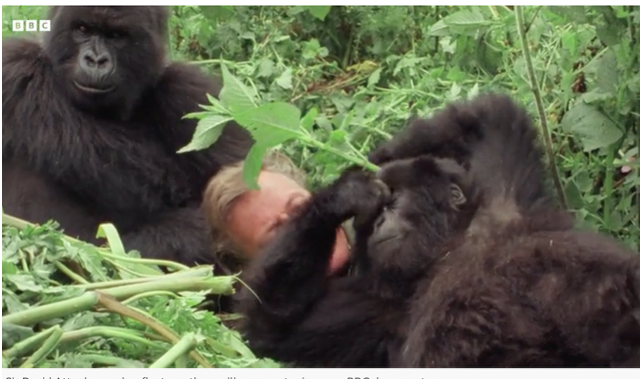
Now, we rarely experience the merger of ‘human-ness’ with ‘animal-ness’; and it seems as though we merely project our thoughts, onto those animals we keep or encounter rather than sensing that they have their own thoughts or feelings sometimes projected onto us. Many years after making his 1979 series, Life on Earth, and just short of his 100th birthday, Sir David Attenborough reflected upon his (filmed) encounter with a group of playful mountain gorillas in a forest clearing in Rwanda. He prefaced the description of the encounter with comments about the complicated relationship we have/don’t have with these gentle animals (as Sir David points out, it is ironic that they are portrayed as so threatening and violent when they are just the opposite and we are the violent and agressive ones.) And in the film, we first see Attenborough in the greenery with an adult, female gorilla all very friendly and peaceful. Next, as John Sparks, producer of the series, describes, two ‘youngsters’ come out and literally sit on Sir David–‘in such an extraordinary and friendly moment’ remarked Attenborough. Then, Sir David continues, the female reached over and put her hand his head, twisting its so she could look ‘straight in my eyes,’ looking inside his mouth and putting her finger in it, making this belch vocalization. “I did my best to respond,” Attenborough continued, and then the animal looked into one and then the other of his eyes. “To this day,” in recounting that experience, Sir David has said it was one of the most extrordinary moments of his life.
And perhaps, then, as this animal attempted, it seems, to communicate with Attenborough—at the very least to ‘say’ “what/who are you?’—it is not so difficult to imagine animal characters in our literature in communion with the human ones. And not, by any means, just in books for children.
More of that anon.
[NEXT: Part 3: Animals and Fiction]
— Bronwyn Mills
[i] As noted in Part 1 of “A Little Lower than the Angels,” scientists working with Bonobos have recently demonstrated that they, too, have the capacity to imagine.
[ii] I hasten to add that the “Disneyfication” of the above children’s stories are a near sacrilege–the tradeoff being the almighty dollar for the natural wonder and naievete of childhood.