
Essay by Jenine Holmes
The world reshapes itself for a gifted child…
…allowing their supernational talents to alter the trajectory of their lives. The story of Amadus Mozart, the boy genius of the music scene in 18th-century Vienna, who began playing the piano and violin at the age of five, lived in my childhood mind. But in adulthood, the story of the young poetry prodigy, Phillis Wheatley, shaped a narrative of female talent, creative identity, and the right to hold passion and craft as the focus of my life, too. Phillis Wheatley showed me that art could matter to people who looked like us.
I’ve often wondered what gifts did Suzzane Wheatley, a white Boston slave holder, see in the small, sickly brown child that caused her to pivot from her plan of forced servitude. What did she witness in the frail Phillis that sent her on an unorthodox mission of educating a Black girl? How much natural talent rose to the forefront for her to enlist her children in the job of teaching the young Phillis?
I can’t begin to even speculate. However, based on the general social norms that framed the standard practice of keeping enslaved Africans illiterate and oppressed, the case Phillis’ talents put forth must have been as impressive and persuasive as a solar eclipse.

The child who would become Phillis Wheatley was stolen from Senegal, West Africa, survived the Middle Passage, and arrived in Boston, sickly and weak, in August 1761. Her estimated age was between seven or eight years old, determined by her missing two front teeth. Susanna Wheatley, the wife of a prominent Boston tailor, “in want of a domestic,” “purchased” the frail Phillis for a small sum.
For a girl who gained her first name from the slave ship that transported her into bondage, and her surname from the family who enslaved her, she didn’t seem destined for a life of world-changing events.
Yet, whether the Wheatley’s viewed Phillis’ ability to learn and flourish as a parlor trick, or an anomaly, they charged their children, Mary and Nathaniel, to tutor Phillis in geography, British history, Milton, Pope, The Bible, the classics: Greek and Latin, Virgil, Ovid, Homer, and no doubt, writing lessons. A hidden world opened to Phillis. The Wheatley’s held the keys.
This was no small act. In 1760s America, education was limited for whites as well as enslaved Blacks. Writing paper was an expensive, hand-made commodity, inaccessible to the poor. But the Wheatleys were a family of means.
At the age of 13, Phillis Wheatley first published a poem, “On Messrs. Hussey and Coffy.” The 1767 work was based on the news of the day, “an amazing sea survival.” It appeared in a Newport Mercury, a Rhode Island newspaper, drawing national acclaim.
I believe there’s a connective passion that can be activated around that age. The same was true for me. I fell in love with art in Detroit, Michigan in the 1970s. My parents, an elementary school teacher, and a record shop owner could care less about art. Yet, somehow, I felt called to purchase a Bainbridge sketch pad. I drew every day. After finding Crayola Crayons lacking in spirit and intensity, I spent my allowance on oil pastels. By my teens, I gained a used car, a lime Vega and began logging hours at the Detroit Institute of Arts, the way my contemporaries hit the mall. There is something about that period of adolescence, before the lure of the glaze of boys’ catches girls, before our hormones and bodies begin to betray us. We have the time and focus, to hoover up knowledge, to birth new passions, at will.
Phillis found her creative stride. Three years later, in 1770, Wheatley published a funeral elegy for a prominent clergyman, Reverend George Whitefield. Published as a broadside and a pamphlet in Boston, Newport, and Philadelphia, An Elegiac Poem, on the Death of that Celebrated Divine, and Eminent Servant of Jesus Christ, the Reverend and Learned George Whitefield,” was a national sensation. A year later, in 1771, the work was featured at the London funeral for Whitefield, drawing international attention to Wheatley’s work.
Attention, at an early age, can be double-edged. It can move against you and for you. Mozart had Sallieri. And as the public interest generated by the quality of Wheatley’s poems were positive, some moved to other means of attention. Some begin to question the possibility that she didn’t create the works. Once the questioning chorus started, it gained numbers.
A committee, comprised of seventeen Harvard alumni, all men, were tasked to determine if Phillis Wheatley possessed the talent and wherewithal to create poetry.
Thomas Hutchinson, governor of Massachusetts; Andrew Oliver, lieutenant governor; James Bowdoin; Reverend Mather Byles, and “Wheatley supporter Dr. Benjamin Rush, one of the signers of the Declaration of Independence,” and others delivered the exam over three days. Did the questions come in the form of Latin? Did the committee ask her to recite her poems from memory? We’ll never know. No records were kept.
But I’ve often wondered what Wheatley felt. Anger at the thought that her work was so good, most doubted she was the author. Or so overwhelmed by the questioning that she focused on submitting solid answers without pause?
I’ve faced such inquiries, of a sort. At the start of my advertising writing career, back in the 20th century, your portfolio preceded you. If the Creative Director liked the work, an interview would be scheduled.
Once, as I sat before a Creative Director with long salt and pepper hair, wire-rimmed glasses, sporting a beard, trying hard to look Soho, but revealed the handiwork of a Fifth Avenue barber, he declared. “You write like a man.”
While I favored writing bold ad headlines, flippant, well-stated facts, I couldn’t ignore the unvarnished truth on his face as he studied mine.
“Well then,” I said, “you must have been doubly surprised when you saw me.”
His face flushed.
Wheatley stood up to the grueling questioning. She passed the test. With a letter of testament in hand, Wheatley again approached Boston publishers with her book collection of 28 poems. Again, Wheatley was rejected.
In February 1772, Wheatley placed subscription advertisements in the Boston Censor. Orders trickled in. Undeterred, the eighteen-year-old Wheatley placed additional ads in March and April. The money trickle never grew into a river.
In the end, as it happens today, making inroads came down to connections. In the fall of 1772, Susanna Wheatley forwarded the Elegy poem to her friend, Selina Hastings, the Countess of Huntingdon, in England. The clergyman had served as the Countess’ chaplain as well. Additionally, the Countess was a “wealthy supporter of evangelical and abolitionist causes.” She was a countess with a cause.
The countess brought Phillis Wheatley’s work to the attention of a London bookseller, Archibald Bell. Wheatley and Bell began a correspondence. This led to preparations to publish the first book of Phillis’ poems,
A little more than six months later, in 1773, the eighteen-year-old Phillis Wheatley boarded a ship, the London Packet , bound for England. Nathaniel Wheatley, the son of Susanna, accompanied her.
Once again, a ship voyage would change Phillis Wheatley.
She left America as an African enslaved talent. She landed in London as an 18th-century celebrity. Her poems were a sensation.
The London Chronicle posted an introduction through an editor’s note, alongside a new poem, “A Farewell to America”, which Wheatley birthed during her ocean voyage.
“You have no doubt heard of Phillis Wheatley, the extraordinary negro girl here [i.e., Boston], who has by her own application, unassisted by others, cultivated her natural talents for poetry in such a manner as to write several pieces which (all circumstances considered) have great merit.”
Such praise followed Wheatley everywhere. She was invited to tour Westminster Abbey and was presented to members of British society. She was even introduced to a foreign dignitary visiting from abroad, Benjamin Franklin.
How odd it must have been for Wheatley and Franklin, to meet on neutral ground, face to face, as equals.
The Earl of Dartmouth said of Wheatley, “In addition to her gift for writing, she appears to have been an unusual conversationalist and to have had no little personal charm. Her popularity in London was immediate and great.”
Phillis Wheatley, poet, had officially arrived. I imagine her life like a character on the Netflix show, Bridgerton, coming to life. Wearing lovely gowns and holding the attention of every person, at every social engagement, in every room she entered.
Quite a head trip for an eighteen-year-old girl.
London opened itself to Wheatley in a manner that nearly three centuries later, I find wondrous. Phillis regarded London with the same awe, that she shared in a letter written to Obour Tanner on October 30, 1773, an African woman she met through the black church.
“The friends I have found there [London, England] among the nobility and gentry, their benevolent conduct towards me, the unexpected and unmerited civility and complaisance with which I was treated fills me with astonishment. I can scarcely realize it. This I humbly hope has the happy effect of lessening me in my own esteem.”
Yet, not, every Londoner was pleased with Phillis Wheatley’s presence. Newspaper editorials “castigated The Wheatley’s for keeping Phillis in slavery “while presenting her to London as the African genius.” Editorials didn’t hold back on the irony of it all: “The Colonists fought for their freedom from England; they enslaved the Negro.”
A year before Wheatley arrived in England, the Mansfield decision was passed, mandating that no enslaved person could be forced to leave England and return to servitude. Now on British soil, Wheatley could choose to remain.
It’s entertaining to imagine what Nathaniel Wheatley did during this social firestorm. Did he take questions? Did he deflect? He wasn’t much older than Phillis.
The Mansfield decision was big news on both sides of the Atlantic. Suzanne Wheatley would have known the risk of allowing Phillis to enter what could be considered, in many respects, the Promised Land.
For the first time in her life Phillis Wheatley was sovereign over her own destiny.
Poetry like jazz, is based on breaks of sound, moderation, and outright definition made at the perfect time. Miles Davis once said, “There are no wrong notes, it just depends on what note follows the note.” Phillis knew how to tune into the harmonies of her poetry, the right line break that would add the most efficacy and clarity to her work. She knew the right time for the right turn. Now, Wheatley had to decide if she would go for a soft turn. Or a completely clean break from the Wheatleys, from America. Literary London waited to see what note Phillis Wheatley would play next.
In this moment, fate offered the poetry of Phillis Wheatley a strange volta, an unforeseen turn, when Nathaniel Wheatley received news from home. Suzanne Wheatley had fallen ill.
As Nathaniel Wheatley made arrangements to return to his mother’s bedside, literary London made their plea for Wheatley to stay. British friends implored Wheatley to live the words of her poem, “Farewell to America.” To make a true farewell. In London, she could remain a poet of acclaim. In London, there were no tests of authenticity. In London, her ability was celebrated. She and her work could be on safe ground, free. Phillis Wheatley was scheduled for an audience with the King of England, George III. It was on the books for her to meet an actual King. One wonders what thoughts crowded her mind, late at night, lying in bed.
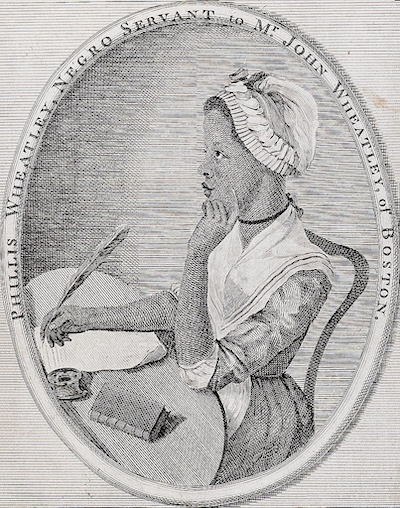
Phillis Wheatley landed in Boston in September 1773. She disembarked the ship into a new version of America. The publication of Poems on Various Subjects, Religious and Moral, by Phillis Wheatley, Negro Servant to Mr. John Wheatley of Boston,” made her an international literary sensation. The same Boston colonists that were largely unwilling to fund literature by an enslaved African writer, now, through English “patronage and influence,” purchased the work of the same Phillis Wheatley.
Some scholars speculate that Wheatley would’ve made her freedom a condition of her return to the colonies. My money would be on the Stockholm syndrome, or Wheatley held a deep love for the woman who had helped give her an unimaginable life. This would not be the first time, nor the last, that Phillis Wheatley would perform astounding acts in the name of love.
Six months later, in March 1774, Suzannah Wheatley died. Before her death, Suzanne Wheatley manumitted Phillis.
As a free Black woman, Phillis Wheatley continued to live and write in the household of John Wheatley. She moved from poems to publishing direct attacks on slavery, in New England newspapers and editorials, “her clearest expression of ethnic consciousness.”
“In every human Breast, God has implanted a principle, which we call Love of Freedom: it is impatient of Oppression and pants for Deliverance.”
An elegant response to a horrific reality.
As a writer of color, the ability to create creeds calling for the freedom of other Blacks, must have held a powerful lure for Wheatley.
Then another turn in the plot line came. The British invaded. The occupation of Boston came in October 1774. John Wheatley, a loyalist, fled the city. Phillis left the only home she had and headed to Providence, Rhode Island. There she joined Mary Wheatley and her husband. Once settled in, Wheatley went right to work. In October 1775, she published a poem dedicated to General George Washington on the siege of Boston. Washington, in the midst of a revolution, received the work in Cambridge and wrote in February 1776:
“I thank you most sincerely for your polite notice of me, in the elegant Lines you enclosed; and however undeserving I may be of such encomium and panegyrick, the style and manner exhibit a striking proof of your great poetical Talents.
“[I]f you should ever come to Cambridge, or near Head Quarters, I shall be happy to see a person so favored by the Muses, and to whom Nature has been so liberal and beneficent in her dispensations.”
The two met in the fall of 1776. Wheatley made the trip to meet Washington at his camp. Unlike the imagined images of Washington crossing the Delaware, sadly, no imagined paintings, etchings, or watercolors, sculptures, or bas-reliefs, exists of the historic moment when a Black free woman and a white American political leader met on equal terms of mutual respect.
Wheatley’s ode to Washington was published in other periodicals, keeping her name and work in the public eye and on their ears.
And the public had plenty to say about Wheatley’s work. Voltaire wrote a friend, that “Wheatley proved that black people could write poetry.” While Thomas Jefferson vilified her work as weak, which comes as no surprise. And John Hancock questioned her talents. Still, at the time, Phillis Wheatley, worked and lived a life closer to an educated white man of the era. Three centuries later, critics still take aim at Wheatley, leveling the argument of more, that she should’ve published more, written more confrontational poems, done more. Many take issue with Wheatley’s poem “On Being Brought from Africa to America,” her thanks for deliverance from a “pagan land,” her African birthplace. Yet, most critics don’t move toward the end lines of the poem, pushing Christians to follow the biblical creed:
“Some view our sable race with scornful eye,
‘Their colour is a diabolic die.‘
Remember, Christians, Negros, black as Cain,
May be refin’d, and join th’ angelic train.“
She wrote those lines at the age of eighteen. Wheatley probably recalled little of her African homeland. She simply used the tools at her disposal in the 1770s, a love of God, and a passion for words. Still, by the mid-20th century, Wheatley was labeled an Uncle Tom, or in the vernacular of the day, an Aunt Jemima. Ironically, another poet, LeRoi Jones, would level the same criticism at Wheatley that Thomas Jefferson had, as he shape-shifted into becoming Amiri Baraka.
Why didn’t Wheatley write poems about the Black Diaspora of the time? Critics viewed her work as copycat or mimicry. Yet, she studied the classics; she wrote in the style of the classics. It’s like asking why Shakespeare didn’t write for 21st-century minds and ears. A 20th- century Black Arts revolutionary lens cannot be put on 18th century, pre–Civil War acts of creativity.
It’s like comparing apples and Ford F-150 truck.
Then there was a matter of time. Writers need free, unimpeded space to think, to absorb thoughts into ideas, poems, movements. But what we do know is this: an 18th-century enslaved woman took the language of the Western world, English and Latin, and made it her own, made it extraordinary. The western classical forms fit in Phillis Wheatley’s brain, into her brand of creativity. My mind is inspired, more or less, the same way. The arts spoke to me, as a child, and I talked back. As a Black woman raised in Detroit proper, who became fluent in Italian after falling in love with its musical tones and inflections, the feel of Italian on my tongue, and who choice to begin the study of classical cello at the age of thirty-two, propelled by a deep, intuitive love of Bach, I understand Wheatley like my creative sister separated by a very, very, strange birth.
No matter her critics, Phillis Wheatley kept at her work. She followed up the good notes with even better notes. Later scholars would uncover letters and poems crafted for the emancipation of the enslaved, requests that whites see Africans as human beings through the lens of Christianity. Meanwhile, Wheatley secured legal title to her work, managed the shipments of her books from London, and sold them in the colonies.
She was the embodiment of the American spirit: hard work, dedication, and fortitude. Then Phillis Wheatley made her most important foray into self-management since returning to the colonies: Phillis Wheatley made plans to marry.
Friends disapproved of John Peters. Perhaps they held impossible standards for their famous friend. Perhaps they wanted a specific kind of man for the great poet; a race man, like Prince Hall, an abolitionist, who petitioned the Massachusetts legislature to end slavery. The man Phillis Wheatley decided to marry defined himself as a lawyer, a grocer, a baker, a barber, and at times, Dr. Peters.
Scholars have suggested the competitive labor market 1770s Boston for a free black man would have hobbled him. However, his claim of being a doctor and a lawyer, as well as descriptions that framed him as a man “who wore a wig, carried a cane, and acted out ‘the gentleman’” to my mind, suggests another view.
Wheatley was accomplished enough, smart enough, to choose a mate. However, the heart and the mind, even one as brilliant as Wheatley’s, can act as independent thinkers. And by the close of 1776, life was framing an existence that changed Phillis’s worldview. Two years after the death of Suzanne Wheatley, her husband John Wheatley followed in March 1778. Six months later, Mary Wheatley Lathrop joined her father. Those in Wheatley’s world who represented a sense of home and stability vanished at an astonishing speed.
At her core, this globally revered poet, remained a Black woman in a white world. She was as much a target as a celebrant. Wheatley had a protocol, a standard, and an expectation she had to rise to just by walking out her front door.
Just as women today of all races, I imagined Wheatley longed for her special place in the world. A home of one’s own, A place where she could open the front door and find someone who loved her on the other side. A place that would always hold her persona sonatas. A place where she and John Peters would make a couplet.
So, on November 26, 1778, Thanksgiving Day, Phillis Wheatley married John Peters. Wheatley took Peters’ surname. And it seems, that was one of the few tangible items he provided.
The next stanza of Phillis Wheatley’s life delivered a hard shift. Like an experimental jazz riff, the notes came wild and furious, from active present to passive and fragmented.
Peters could not support his wife. And now neither could Phillis’ writing. The Revolutionary War made publishing a faded glory for the genius poet. While British and American readers continued to admire Wheatley’s work, few purchased subscriptions. And while Virginia Wolff was more than two centuries away from proclaiming the importance of a room of ones’ own, and the funds to create for women, Phillis Wheatley lived the reality.
Perhaps Wheatley, who had long lived a life surrounded by largely good people, couldn’t foresee a negative force riding in on a relationship, on words of love.
When John Peters could not pay his debts, he was imprisoned. Wheatley, in an act of love unseen since her return from freedom in London to the colonies, decided to sell her one treasure, her gifted volume of Milton’s “Paradise Lost,” given to her by the Mayor of London. She used the proceeds to help pay her husband’s debts.
What must she have thought, handing over the last links to her treasured past? Leaving behind the words she cherished. I suspect she could no longer easily hear the music of her poems. The panicked screaming in her head would have drowned them out.
Now, the Black Adam and Eve fell from grace in a shockingly fast fashion.
Phillis Wheatley entered a strange, remote land, one she had never encountered, in all her travels.
“The world is a severe schoolmaster, for it frowns are less dangerous than its smiles and flatteries, and it is a difficult task to keep in the path of wisdom,” Wheatley wrote.
For her family’s survival, Wheatley began to hire herself out as a servant.
As Wheatley worked as a charwoman, scrubbing the clothes of strangers, dumping their slop jars, and bouncing their living babies off her hips as her milk-dried breasts ached for the two infants she lost to death, I’ve wondered what thoughts riffed across her mind.
Did she craft poems in her head, as a distraction, as a salve of salvation? Or did she look upon her calloused, cracked hands, the tools that once crafted works celebrated on two continents, hands that embraced those of statesmen, and mayors, and could have even gestured before a King, and weep?
At the age of 31, a bad marriage made Phillis Wheatley truly a slave.
“The world is a severe schoolmaster.”
And it has schooled millions of talented, creative geniuses. But it seems to school talented women in the roughest of ways. When we fall, we fall into servitude. Zora Neal Hurston did. The singer Darlene Love, too. It happens so often that it has become a sort of cultural meme, the Third Act fall from grace.
In the 2013 documentary “Twenty Feet from Stardom,” Darlene Love recounts her rock-bottom point. By the 1980s, Darlene Love was divorced from her husband, and crushed by the control of her work husband, Phil Spector. Love fought against Spector’s dominance and abuse of her talents, his control of her recordings, and the oversized amounts of money he made from her voice. Unable to record or finding no other vocal work, like Wheatley, Darlene Love entered the world of servitude.
One day, as she cleaned a house a holiday tune started up.
“Oh, I love this song!” the mistress of the house said, as “(Merry) Christmas, Baby Please Come Home”, the 1963 holiday classic stabbed the airways, and surrounded the woman welding the cleaning rags and cleanser, the same woman whose voice made it famous.
I cannot imagine this level of horror, of having a normal day transform into a personal hell.
Love said she continued to work, shifting her face away, hiding the humiliation of knowing the voice on the radio belonged to her.
In that moment, Darleen Love, a talent voted by Rolling Stone Magazine as one of the 100 Best Voices of All Time, resolved to fight her way back into the music business.
And she did.
Phillis Wheatley fought back too, with her tools, her words, wit, and grit. She tried to create her way out of financial misery and servitude. In 1779, from October to December, Wheatley published proposals for a new volume of poems in the Boston Evening Post, six times. The subscriptions never came.
By 1780, an economic depression hit Boston, driven by the “efforts by commercial creditors to collect prewar debts (which) led to business failures.” In 1784, Peters applied for a license to sell alcohol in his grocery, “for the purpose of supporting himself & his family.” His application was denied. John Peters was prosecuted for debt and returned to debtor’s jail.
Wheatly would not find a creative resurrection. Anchored to a debtor, to her bad partner choice, by November, Phillis Wheatley lay in a dirty rooming house beside a sickly child, dying. I wonder as she struggled in the airless room, heavy with the funk of fear and the weight of death, did she think of England?
What could have Wheatley created if she had given herself the freedom, the chance? What poems died with her that December day? Poems that could have inspired me and others like me? Poems shaped from the epic experiences of her life. She created words to move George Washington. Perhaps she could have conjured up works that moved Grant and Lee, altered the Civil War, and prevented the deaths of millions of men.
As an adult, I think of Phillis Wheatley differently. In my girlhood, Wheatley served as an inspiration in her ancient kerchief and a thoughtful, knowing pose. When my teachers dusted off her image, a writing quill in hand, every Black History Month, my attention stayed with her among the other historical dignitaries. She was a child genius; she was an inspiration.
As an adult, I can hold up the images and actions of Wheatley’s life against mine; the lines of clarity. I see them for what they are, a signpost, a warning.
“Be careful who you marry,” Wheatley advises across the centuries.
“Men don’t seem to have a problem finding a good mate,” an older, Black, female Wall Street mentor once told me, “but if a woman picks the wrong partner, it can ruin her life.”
I long to read the poems Wheatley made in a last attempt, in her last get-out-of-servitude card move; the words she crafted to save herself and her family. What images did she rest her dreams on? Scholars estimate that Wheatley wrote more than 30 poems for the collection. Upon release from debtor’s prison, coming home to a dead wife, John Peters tried to publish the last of his wife’s work. When that effort failed, Peters sold the volume and all of Wheatley’s papers.
In nearly three centuries’, only one poem “Ocean” has surfaced at an auction, written after Phillis left the safety of England and returned across the Atlantic, headed for Suzanne Wheatley’s deathbed. This lone survivor is strangely poetic.
At an auction in 1998, Christie’s estimated this work would go for $18,000-$25,000. The final gavel price: nearly $70,000.
Wheatley’s story, once heard, I couldn’t put aside. Like a great jazz riff, it continues to echo in my mind. Her creative death holds more than creative loss. It yields lessons. I guard my writing time, my mental health. I turned down one marriage proposal. And so far, day by day, as I grow older, that seems okay. The adoption of a child has, frankly, taken the edge off.
And if the single Phillis Wheatley of Boston, could get her work out into the world and write until the end of her life, surely I can write through single parenthood, global warming, the Iraq war that isn’t called a war, and Project 2025 becoming the harsh realities of 2026. I can find a path forward following the creed etched on Wheatley’s headstone to, “Enlarge the close contracted mind, And fill it with thy fire,” every day.
By any means necessary.
Selected Sources
Gates, Henry Louis. “Phillis Wheatley on Trial.” New Yorker. January 13, 2003. https://www.newyorker.com/magazine/2003/01/20/phillis-wheatley-on-trial. Accessed June 9, 2026.
Helen Weller. “Phillis Wheatley and the Countess of Huntington.” https://www.westminster.cam.ac.uk/wp-content/uploads/2019/10/2019-10-BLOG-Phillis-Wheatley-in-the-Cheshunt-Archives.pdf. Accessed June 9, 2026.
* * *