
Translated by gábor g. gyukics from the book
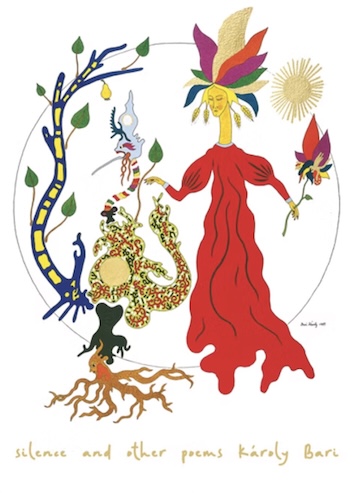
Silence and Other Poems

Holtak arca fölé
Elsárgult vadfüvek kavarogtak
az égre. Az ágyúdörgés
hosszú lábaival a házak között
mászkált, nyomában betörtek
az ablakok, rommá lőtt házfalak
vonaglottak. A döglött lovak
ködöt nyihogtak a kitépett villanyoszlopok
és felrobbantott sínek közt heverő
holtak arca fölé.
A fák hiába rázták
kiszáradt öklüket,
szürke felhők terpeszkedtek ágaikra,
a holtak sem tudtak már
a varjúk fekete siratóénekére felelni,
sötét szemgödrükből kibuggyant a vér.
Over the Faces of the Dead
Flavescent wild grasses swirled
up to the sky. With its long legs
the roar of cannons walked
among the houses; in its trail
the windows, the walls shot to ruin
writhed. Dead horses neighed mist
over the faces of the dead lying
among torn out lampposts and
blown up railroad tracks.
In vain the trees shook
their withered fists,
gray clouds sprawled on their branches,
the dead no longer could respond
to the black lamentations of the crows,
blood gushed from their dark eye-sockets.

Keleti Dallamra
Elámul egy rózsaszál.
Fényjáró fülemüle zeng.
Ajaj, sír az idõ, a szép pásztorlány.
Sípja nincs, elveszett,
sár eszi.
Sár eszi a sípját.
Sziklákat terel.
Hajfonata a halál.
To the Rhythm of an Eastern Melody
A rose is amazed.
A light-walking nightingale singing
Alas, weeps the time, the fair shepherdess.
She has no whistle, she has lost it,
Mud is eating it.
Mud is eating her whistle.
She is herding rocks.
Death is her braid.
Translator’s Note—gábor g. gyukics
Károly Bari (1952) is a poet of prodigious ability and precocious achievement who at the age of seventeen published a volume of poetry of such startling originality and power that he immediately established himself as a major figure in Hungarian literature. Bari’s poetry features arresting imagery, passionate intensity and exotic evocations of Romani life. He is also a storyteller, translator, editor, painter, and folklorist. Author of over forty publications in different genres. He received most of the major Hungarian literary prizes. The poem titled “Homeland” made the Hungarian authorities put him in jail in the mid-seventies.
His poetry conveys the malaise of its people with a sensitivity rich in visual cues. He is surreal in spirit. He organizes his memories and visions with conscientious editing. His imagination and his vision of reality are realistic down to microscopic detail. His metaphors are essentialized living things. He draws bold associations that turn his visions into concrete spectacle. He is not afraid of any part of language; he is at home in all of it. He does not operate via images meant to astonish, since surrealism is not an adventure for him, but a perception of the world, a mode of representation, a language of form, an expression of the truth. His pure-minded outbursts resonate throughout his works. He believes in the liberating power of surrealism, believes that the world can be changed. He fights against lies and trusts in the power of the written word. He is bold and rebellious. Behind his calmness, he works with temper, speaks in a passionate voice, and is chased by his transcendent faith. Bari is grim, he can’t afford to be ironic. He is not a believer in traditional constraints, but rather a combination of inner thoughts that swing back and forth as he speculates about the nature of the world.
The poems published here are from Silence and Other Poems, which has been published by El Martillo Press in the United States, Fall 2026.
Autumnal photo by Jason Thompson.
Leaf illustration by fathicon.
* * *