
Poem
Santa Teresa de Ávila
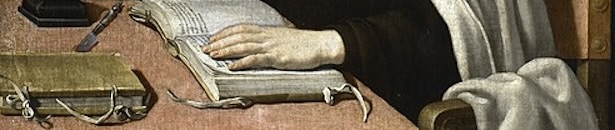
Santa Teresa de Ávila:
In which I struggle to understand the ecstasy of a 16th century nun
He pierced me with an arrow
smeared with the poison of love
I dawdle in the shade of a stone wall
as the sun sears the cobblestones
near a convent she built. Nagged by doubt,
lines frozen in my head, I stare at a figure
in the distant dust and shimmer.
It’s Teresa. Her feet (are they bare?)
bump and flare the dark hem
of her habit as she trudges toward me.
Does she plot her poems
with her stride’s rhythm?
When the sweet Hunter
shot me and left me wounded,
when my soul lay panting
in those tender arms
I marvel at her ecstasy, 500 years
between us. Man or woman in her bed?
But no god for me. I struggle to abstract.
Here in my century,
poplars green the river Duero,
its shallows calm, crystalline.
At my elbow, a rustle. She’s here,
squinting, incipient smile working.
“You think calm is an antidote
to ecstasy?” she asks, not waiting
for me to finish a stammered
not-what-I-meant though I don’t know
what I meant. “You Americans.
Obsessed with smoothing things over.”
It’s still light but the moon has begun to rise;
its pearled roundness repeats in the glassy river.
She softens. “At first I worried
about the sensations
that ripped through my body,
left me limp when I prayed.”
Other women went through this,
she says. “Was it demonic? Madness,
as some insisted?” She summoned
learned men to authenticate
hers as spiritual experiences. “I had to,” she says.
“My authority to reform the Carmelites was
in question.” Women in her convents learned
to read, write letters, a freedom behind bars
denied other women. Threatening.
You mean the ecstasy was a pose? I ask.
“No, no, no,” she answers.
“How else to talk to God?”
She laughs. “It confounded the theologians,
those Dominicans especially.
Always prattling away, imposing rules.
No regard for my intellect
or for any woman’s. No wonder
we expressed all in feelings.”
Less than a century after you died,
I manage to say, the Carmelites embraced
Bernini’s depiction of you in ecstasy.
Very sexual, even in marble.
“A martyr in the throes,” she sighs,
remembering. “17th century artists
were so good. It helped spread the word.
What’s wrong with that? I validated women’s
spirituality at a time when women weren’t valued
for anything. You’re not so far from the time
a glimpse of ankle could inflame a man.
Maybe you, my dear, need to gather up
some generational memory of spirit
and pleasure. Reach back
to my time. Get over your fear
of an overpowering love.”
“Remember, I too was busy. I ran the convents,
fought the Inquisitors, wrote letter after letter
to the king, the patrons (who I tried to avoid.)
I kept the prioresses in line, my family afloat,
my confessors out of jail. My discussions
with God energized me.” She turns
to face me, hands on hips. “You’re just jealous.”
No, I demur. Curious. I’m a poet.
She looks at me sharply. “What’s wrong?
Your melancholy is palpable.” She grasps
my hand; her touch is cool, despite
the warmth of her rough wool habit.
“Are you eating enough meat? When my nuns
fasted and prayed to excess, they fell
into melancholia; it was a constant battle
to keep them healthy.” She reaches into a hidden
pocket and comes up with a small cloth bundle.
Orange blossoms for tea. As she hands it to me,
she searches my face. “Excess prayer is not
your problem,” she finally says, patting my hand.
“Still, you should attend to your spiritual
development. Ecstasy might do you good.”
She reminds me that Spanish cinema exploded
with nudity and sex (Penelope Cruz bared her breasts!)
after Franco died. “It was crazy; the dictator’s
prudishness had suppressed everything.
Nobody could progress spiritually, although fascists
in the church claimed otherwise.
My point,” she presses, “you live in repressed times;
the barest hint of ecstasy gets narrowly interpreted.”
Gently, with suavidad:
“You’ll probably ignore this advice,
but think of love. Think of it as a room in the soul—
What’s wrong, are you not even sure
about souls? (Did she wink?) An extremely rich
palace (now she’s quoting herself) built entirely
of gold and precious stones,
inhabited by a great King, God.”
Does she see in my face that glitter and royalty
are barriers for me? She waves her hand.
“Don’t imagine you are hollow inside.
That’s what I’d tell the nuns.
Remember your inner richness, beauty.
Cultivate your own soul
at your own pace. You think my pace
is a transaction. I call it barter;
the Spanish he trocado is
forthright: I exchanged.”
I gave it all, relinquished all,
and in this way, I bartered:
my Love belongs to me,
and I belong to Him.
She scuffs a hemp sandal over a stone.
“Savor the bliss,” she says,
almost to herself. “Against all odds,
I retained joy.”
Author’s note: In the final section, italics in stanzas 3, 4, 6, and 7 are from St. Teresa’s Way of Perfection, as reproduced in Teresa de Ávila: Lettered Woman by Bárbara Mujica. Other italics in the final section, the first section, and the epigraph are from St. Teresa’s poem “About Those Words: ‘My Beloved Is Mine,’” translated by Dana Delibovi from her book, Sweet Hunter: The Complete Poems of St. Teresa of Ávila.
Icon: Vector Stall
* * *