
Una cadena de emociones, casi una crónica
Marithelma Costa
Supe de Bad Bunny dos años después del inicio de su vertiginosa carrera, lo cual podría ser un tiempo largo o breve, según se mida en canciones o lugares donde crecía su fama. Corría el verano del 2018, estaba de visita en la casa de Gabriela Caballero, pintora y amiga que vive en Cádiz, una de las ciudades más pequeñas de Andalucía. Y Gabriela le alquilaba una habitación a Yumni, una coreana llegada allí para estudiar español. Cuando me la presentó, la joven llevaba calcetines blancos sobre chanclas, moda que aún me sorprendía. Al saber que nací en Puerto Rico se le encendió el rostro y me habló de Bad Bunny.
Me quedé in albis, no tenía ni idea de Benito, quien por dos años había subido canciones a SoundCloud desde su casa en Vega Baja, y ya tenía varios temas pegados de trap latino. Se hallaba además a punto de arrasar con “Estamos bien”, grabada a raíz del huracán María del 20 de septiembre del 2017, el desastre más severo en la historia moderna de Puerto Rico. La canción pronto se convirtió en un himno a la vida y su video, en su versión con letra, hoy cuenta con 646 millones de visualizaciones solo en YouTube.
Conviene recordar algunos de sus versos, pues ya contienen temas que reaparecen en canciones posteriores: la bendición de la madre, la fugacidad del tiempo y el mensaje de empoderamiento que se hizo evidente en el espectáculo del Halftime. En el 2017 cantaba “Si alguien puede eres tú/Aunque pa’casa no ha llega’o la luz/Gracias a Dios porque tengo salud, /eh eh / La vida no tiene repetición, / Después que mami me eche la bendición yeh // No te preocupes, estamos bien…”. Nueve años más tarde en California, tras saludar e identificarse con su nombre completo Benito Antonio Martínez Ocasio, repetirá el mismo texto, “Si alguien puede eres tú”, frente a la cámara.
Miré el video “Estamos bien” con cierto alivio, pues en aquellos meses me dedicaba a enviar a Puerto Rico desde Nueva York cajas con alimentos y baterías. No volví a pensar en Bad Bunny hasta el 2022, cuando salió Un verano sin ti y sentí la crítica de sus textos que, según el excelente estudio Bad Bunny, siempre político, nunca impolítico. Feminismo y resistencia frente al colonialismo estadounidense de Ariadna Estévez(Editorial Teseo, 2025), ya estaba presente desde su álbum del año de la pandemia, el 2020, que yo apenas conocía, “Yo hago lo que me da la gana (YHLQMDLG)”.
En ese disco lanza tres canciones emblemáticas “Yo soy de P FKN R” que, como me hizo ver Wigmaris, una conductora de Uber, pegó increíblemente. Mientras me llevaba a la ciudad universitaria, le pregunté si le gustaba Bad Bunny y respondió que no lo seguía, pero, con alegría cantó y casi hasta bailó: “Yo soy de P fuckin’ R (P fuckin’ R)/ Eh-eh-eh-eh-eh /Par de loco’ con la’ R (par de loco’ con la’ R)/Prr-prr-prr-prr-prr/. Evidentemente la canción que establece el orgullo de ser de aquí, la había marcado.
El segundo tema radical de YHLQMDLG es la paradigmática “Yo perreo sola”. Estévez señala que el video problematiza el acoso callejero a la mujer y la falta de consentimiento. La canción también critica los esquemas de género del trap y el reguetón, la homofobia y la transfobia. El video clip de la canción se publica justo un mes después del crimen de odio contra Alexa Negrón Luciano, mujer trans sin hogar, asesinato fechado el 24 de febrero del 2020 aun si esclarecer en el que muchas personas fueron cómplices. Benito le rinde homenaje a Alexa en el texto y en el video, donde canta con un ajustado vestido rojo de mujer, maquillaje, uñas pintadas, y rodeado de figuras femeninas sexualmente autónomas, que perrean por placer sin necesidad de validar el deseo masculino. La canción desplaza el arquetipo de la mujer-objeto e introduce una nueva subjetividad femenina: activa, deseante y libre (Estévez 89).
“Safaera” del mismo álbum aun suscita el entusiasmo de David Ruiz de 28 años, quien no sigue a Benito sino a su contrincante Anuel. En la canción, que constituía un homenaje al viejo reguetón, se introducen múltiples cambios de ritmo —algo poco común en el género—, y se lleva hasta el paroxismo el uso del lenguaje sexual directo. Para los jóvenes, “Safaera” capturaba la esencia cruda y original del reguetón nacido en Carolina con Tego Calderón, lo que los henchía de orgullo y se volvió tendencia en casas, fiestas, automóviles y redes. La cantaba junto a Jowell & Randy, a quienes invitó a su reciente concierto en Japón del 7 de marzo del 2026 para cantarla ante el público de Tokio al que electrizaron desde el primer instante.
En julio del 2020, debido al éxito en ventas de YHLQMDLG, la Sociedad Americana de Compositores, Autores y Editores (ASCAP) lo nombra Compositor del año, lo que suscita una inmensa polémica. Benito responde con “Compositor del año” una canción en rap firmada con su nombre y apellido (que solo sus seguidores conocían). En el texto abandona el lenguaje soez y sexual de la mayoría de sus composiciones (vinculado a los géneros del reguetón, trap y dembou, y al gancho comercial de este léxico) y se declara abiertamente contra el racismo, en favor de los inmigrantes y los derechos de la mujer. Afirma “Black Lives Matter/ que en paz descanse Kobe / 2020 y el racismo es peor que el COVID/ Un negro con pistola / ya eso es un criminal / Pero un blanquito se la engancha/ y dicen que es un hobby”. Más adelante, “La mujer no salió de la costilla del hombre/ Fuimos nosotro’ que salimo’ de su pelvis” [….] “ (hay) Cosa’ má’ importante’ /como luchar por los derecho’ de lo’ inmigrante’” […] “Y está cabrón ir pa’ la iglesia a rezar/ Y correr el riesgo de que te puedan violar”. Ahí me di cuenta de que “Bad Bunny siempre es político, y el contenido de sus letras y su música reflejan un activismo personal en el contexto de las resistencias frente a la política colonial de EE. UU.” (Estévez 9).
Y llegamos a mayo del 2022, año de Un verano sin ti que tuve la suerte de vivir en Puerto Rico donde me había trasladado desde marzo para evitar los fríos de Nueva York. La canción “Apagón” me hizo abrir los ojos. Justo al llegar vi en una cafetería a un adolescente con un camiseta extraña. Le pregunto qué significa y responde orgulloso, “soy fan de Bad Bunny”. Llevaba el logo de la promoción del disco que marcó ese verano: un corazón triste con solo un ojo sobre un fondo de colores tropicales, imagen que a los pocos días se propagó por las vallas publicitarias del país.
Yo seguía sin entender del todo el fenómeno, hasta que una tarde sentada en la arena escuché “Apagón” y me eché a llorar. Se trata de una canción en tres partes, cuyo inicio alegre “Puerto Rico está bien cabrón” enumera ciudades-municipio emblemáticas (Carolina y Bayamón), músicos esenciales (Ismael Rivera y Tego Calderón), el besito de la abuela, los vecinos de República Dominicana, los apagones y nuestra superioridad numérica: “somo’ un montón”. En la segunda parte, tras dar la bienvenida “Welcome to the calentón”, se inicia un atrevido y pegajoso rave. Y en la tercera cambia radicalmente de tono. Se oye de nuevo su voz que explica “esto es una cosa más o menos informal” seguido de la voz femenina y melódica de Gabriela Berlingeri quien canta de forma repetitiva: “No me quiero ir de aquí /Que se vayan ellos /Lo que me pertenece a mí /Se lo quedan ellos /Que se vayan ellos //Esta es mi playa / Este es mi sol. / Esta es mi tierra /Esta soy yo”.
El impacto fue tremendo. Estaba sentada en la playa de mi infancia y me repetían lo que veía por todas partes: la turistificación y gentrificación de la Isla por estadounidenses que, en una invasión 2.0 se aprovechaban de las políticas de un gobierno corrupto que había transformado el país en un paraíso fiscal del que se beneficiaban especuladores en bienes raíces (quienes pagaban y aun pagan en efectivo por las propiedades) y negociantes en criptomonedas.
Mientras más escuchaba la canción, más lloraba. Me fui joven del país y gracias a la generosidad y visión de mi amigo Paul Segarra, tenía lo que desde niña había soñado: un espacio propio frente a la playa. Y Gabriela Berlingeri me repetía como un mantra que me tenía que aferrar a él.
De hecho, al final de ese verano prodigioso, en el quinto aniversario del huracán María sale “El apagón-Aquí vive gente”. En esta versión del tema, tras la canción se presenta el documental de veintitrés minutos dirigido por la periodista Bianca Graulau que denuncia la gentrificación, el desplazamiento de los puertorriqueños por inversionistas estadounidenses que se mudan a la isla gracias al teletrabajo y las exenciones fiscales, el desempleo, la crisis energética y el derecho a la vivienda. Hay que señalar que la primera persona a la que Graulau entrevista es una señora dominicana.
Entonces me puse a estudiar las canciones de Bad Bunny con la ayuda de Elizabeth Rodríguez, mi amiga dominicana radicada en Nueva York, quien me explicaba muchas de sus palabras y frases (una mezcla de la jerga de los jóvenes y las del reguetón). Primero me ayudaba ella, quien siente las canciones de Benito como suyas, y más tarde, Pablo Varona Borges, a quien yo había conocido durante el movimiento Occupy Wall Street y que regresó a Puerto Rico después de estudiar en Nueva York. Pablo ha vivido de cerca muchos detalles del proceso de Benito y los compartió conmigo mientras corríamos olas sin tablas de surfing.
A partir de mayo del 2022, cuando se caminaba por la playa sólo se escuchaban canciones de Un verano sin ti. Con los automóviles que pasaban por la avenida sucedía igual. Sonaba “Tití me preguntó”, que recrea el imperativo machista inculcado a los niños en Puerto Rico y en República Dominicana de tener muchas mujeres. De nuevo, conviene señalar que las titís que hablan en la canción son de la isla vecina. La canción tuvo tal éxito que hasta Carmen Yulín, exalcaldesa de San Juan, la cantó en público. También se oía “Después de la playa”, donde a ritmo de merengue, con trompetas, tambora y güira, se celebra una fiesta playera en un espacio que, como repetía Gabriela Berlingeri en “Apagón”, nos estaban arrebatando.
Constaté que iba en buen camino al escuchar “La noche de anoche” que Bad Bunny había grabado con Rosalía y lanzaron el día de San Valentín del 2021. Seguí estudiando sus canciones y comenzó mi cruzada de convencer a los amigos que convenía escuchar a Benito. Que no todo era perreo, sexo y palabras soeces. Pero poco lograba. Era predicar en un páramo.
En la canción inicial del quinto álbum de octubre del 2023 Nadie lo que va a pasar mañana afirma: “Este disco no e’ pa ser tocado, ni un billón de vista’./ E’ pa que mi’ fan’ reale’ estén contento’/ aunque yo por dentro no me sienta al cien por ciento” y “Vendí en Bugatti porque lo sentía lento / Y porque lo’ mío’, no caben en un asiento”, antes de vaticinar la fama meteórica que alcanzaría tres años más tarde. Esa capacidad para moverse dentro de la línea del tiempo y anunciar o mostrar comportamientos que luego se producen me la señaló inicialmente Pablo Varona Borges y me la ratificó la teatrera y gestora cultural comunitaria Iliana García, quien subrayó que le sucede desde chiquito.
Nadie lo que va a pasar mañana coincide con la época en que se dedicó a explorar el mundo de los billonarios de Montecarlo y las Kardashians. Elizabeth Rodríguez no lo podía soportar. Yo le explicaba que se había tomado un año sabático para investigar ámbitos que ni podía imaginarse que existían siete años antes en su casa de Vega Baja mientras trabajaba de bagger del supermercado local. Ese año por las playas se escuchaban canciones muy parecidas a las suyas, pero cuando preguntaba, siempre me respondían que eran de otros cantantes.
Y llegó el 2024 tras los cuatro gobernadores incompetentes que se habían sucedido en Fortaleza después de María —uno obligado a renunciar tras las protestas masivas en las que participó Benito junto a René Pérez (Residente) y Ricky Martin, y la otra, arrestada bajo cargos de corrupción pública. Y no fue solo el huracán, añado otros datos. La Isla arrastra una deuda impagable en términos financieros y constitucionales por lo que desde el 2016, un año antes de María, es controlada por una junta de control nombrada por decreto desde Washington. Los gobernadores son meros administradores. El país tiene además el 40% de la población bajo la línea de pobreza extrema, debe importar el 85% de lo que consume de los Estados Unidos con impuestos altísimos y muchas familias se hallan fracturadas por la despoblación aguda (baja tasa de natalidad combinada con cerca de un millón de habitantes que han emigrado masivamente).
El 16 de septiembre, en el séptimo aniversario del huracán, sacó “Una velita” que conmovió a todos. Él mismo lo explicó a la prensa: “Obviamente los traumas de María estarán presentes en una canción como esta, como también el coraje y la frustración por la ineptitud, abuso y crueldad del gobierno” (Telemundo, 23 de septiembre del 2024).
En Debí tirar más fotos del 2025 se consolidaron y expandieron los temas del despoblamiento forzado consecuencia de las políticas corruptas después de María y la denuncia de los asentamientos necrocoloniales explicados en el documental de Bianca Graulau. Tomo el término del pensador camerunés Achille Mbembe, quien propone que, a diferencia de lo neocolonial (enfocado en el control económico y político), lo necrocolonial describe sistemas de poder que ejercen su dominio decidiendo quién es desechable en el territorio.
Antes de que se iniciara el año, Benito había publicado en YouTube, dos nuevos videos. Primero, “EL CLúB” (5 de diciembre del 2024), rodado entre un edificio de la capital y una casa en las montañas. En el video se desdobla y canta “¿Dónde estará mi ex?” mientras se multiplican imágenes de menos de un segundo de duración con mensajes de índole política (la explosión de un Bugatti o bebés recién nacidos a los que se les graba en la frente “clase media”, “clase baja”). Además, aparecen las pavas o sombreros de paja de los agricultores del país que se han de poner de moda de inmediato. En su cierre vuelve la imagen satelital de María mientras arrasa la isla y el misterioso DTmF 2025 que nadie lograba descifrar. Era el primer anuncio de su nuevo álbum.
Después de Navidad, publica “PIToRRO DE COCO” con música de aguinaldo donde destaca el cuatro, instrumento nacional del país. Ambientado en una fiesta de Año Viejo, Benito de nuevo canta al desamor bajo un cartel que dice “Aquí te espero boricua”, mientras unas jóvenes bailan y una niña duerme en una silla (imagen que se repetirá en el espectáculo del Halftime).
El 3 de enero del 2025 estrena el cortometraje de casi trece minutos DeBÍ TIRAR MáS FOToS donde el nonagenario Jacobo Morales, el actor más respetado del país, conversa en una casa de campo con su amigo el sapo Concho (un anfibio endémico en peligro de extinción, que reprodujeron en el estudio con la técnica del stop motion). Hablan sobre el paso del tiempo y los cambios culturales. El actor camina a la panadería del pueblo en busca de un desayuno para él y para Concho, la nueva cajera estadounidense no comprende el vernáculo y bajo la nueva administración ya no se acepta el efectivo. El personaje pide saldar la cuenta más tarde y ante la negativa de la empleada un vecino se acerca, le dice “tranquilo”, paga con su teléfono y le subraya “Seguimos aquí”. Con la misma frase cerrará la enumeración de países que conforman las Américas en el espectáculo del Halftime al año siguiente.
Por fin, la víspera del Día de Reyes salió el disco completo que fue el tema de su residencia No me quiero ir de aquí. Conviene recordar el inmenso valor cultural e identitario de la víspera y el Día de Reyes para la psique puertorriqueña. La feminista Nirvana González Rosa se lo explica a Ariadna Estévez, quien la cita: “para nosotros no es cualquier fecha: es la celebración navideña más significativa para la cultura boricua, una festividad familiar, comunitaria, profundamente cargada de afecto y memoria” (Estévez 109).
La mañana del 6 de enero los vecinos se juntaban en la playa para escuchar una canción tras otra. Las dos sillas blancas frente al racimo de plátanos de su portada se convirtieron en una señal de dónde Benito cantaría por sorpresa, algo que hizo frente a El Boricua de Río Piedras (un bar donde se dan cita universitarios, activistas, músicos y artistas) y en el techo de una gasolinera de la calle Loíza, un barrio popular de San Juan.
La postura pedagógico-política de este disco resulta contundente. Cuando lanza las canciones en YouTube, aparecen acompañadas con datos de la historia de Puerto Rico. En la primera, “DTmF”, leemos, “Desde la plena y la bomba hasta el reggaetón (1500s-1990s)” y explica la historia de estos ritmos populares y autóctonos a los que añade la salsa en la canción. En otros temas figuran “La invasión de 1898 (1898-1917)”, “La guerra después de la guerra (1898-1899)”,“Jíbaros desafiantes” (1905), “Represión y vigilancia en Puerto Rico (1960s-1980s)” y muchos más. Conviene señalar que el texto histórico no está necesariamente vinculado a lo que dicen las canciones, y que su fuente principal es el libro de Jorell Meléndez-Badillo, Puerto Rico: Historia de una nación (Ed. Planeta/ Princeton University Press, 2025).
El álbum Debí tirar más fotos abre con “NUEVAYoL”, celebración de la identidad de la diáspora puertorriqueña. En ella Benito elige una canción clásica “Un verano en Nueva York” grabada por El Gran Combo en 1975 y mezcla la salsa y el reguetón boricua con el dembow dominicano. El video se inicia, bajo una nevada, y las primeras voces que se escuchan son de personajes dominicanos que se quejan del frío, lo que también sucederá al principio del HalfTime, cuando un guitarrista dominicano exclame en medio de un cañaveral: “¡Qué rico es ser latino!”. Esto tiene una explicación que no carece de interés. Además de su defensa de los valores culturales puertorriqueños, desde muy temprano Benito afirmó en sus canciones la integración popular en el ámbito regional, es decir, República Dominicana y Puerto Rico como una unidad cultural, algo por lo que luchó uno de los próceres del país, Eugenio María de Hostos, a quien menciona al final del álbum en “LA MuDANZA”.
Con “BAILE INoLVIDABLE” impregnada de nostalgia, hace un homenaje a la salsa, pilar musical del país. El tributo a la música tradicional se extiende a “CAFé CON RON”. En esta pegajosa canción se une al grupo Los Pleneros de la Cresta para reivindicar la plena, género que nació en Ponce a finales del siglo XIX como comentarios o bochinches sobre acontecimientos del diario vivir o, según Ramón López, el bembeteo (Los bembeteos de la plena puertorriqueña, Ediciones Huracán, 2008). Esta función comunicativa permite que abarque un arco que va desde lo puramente lúdico a la crítica política y social.
Es precisamente esta canción, junto a “DTmF” la que logró que Liliana, quien rechazaba radicalmente a Benito cuando le propuse que lo escuchase, cambiara de opinión y terminara defendiéndolo con ahínco frente a su familia por impartirle a los jóvenes orgullo de ser de aquí. Este sentimiento de autoestima está totalmente reñido con los relatos y estructuras del colonialismo imperante. El fenómeno lo explica el pensador boliviano Juan José Bautista quien propone que estamos colonizados de tal modo que no creemos en la validez o en el grado de verdad de nuestros propios horizontes históricos, culturales y míticos. Creemos lo que la modernidad (hegemónica-europea-norteamericana) dice de ellos, que son inferiores.
El disco cierra con las emblemáticas “LO QUE LE PASÓ A HAWAii” (sobre los asentamiento necrocoloniales y sus consecuencias, y la imperiosa necesidad de afirmar los elementos culturales identitarios del país); “EoO” del más puro perreo donde recupera una canción clásica del reguetonero Tito el Bambino; “DTmF” que suscita el consenso de muchos detractores del cantante, ya que en un carpe diem inverso y mediatizado por la cámara fotográfica, expresa el arrepentimiento por no haber valorado lo suficiente ciertas personas y momentos de la vida y “LA MuDANZA” donde habla de sus raíces, detalla la historia de sus padres Tito y Lisy, destaca la disciplina y valores que le inculcaron desde niño a la vez que hace referencia a la lucha por la independencia de Puerto Rico: “Si mañana muero, yo espero que / nunca olviden mi rostro/ Y pongan un tema mío el día que traigan a Hostos”. Se refiere aquí a Eugenio María de Hostos, sociólogo, político y Ciudadano de América quien dedicó su vida a la lucha por la independencia de Puerto Rico, y la unidad de las Antillas Mayores e Hispanoamérica. Su último deseo fue que se le enterrara en Santo Domingo (sus restos se hallan en el Panteón de la Patria) y se trasladara a Puerto Rico cuando su patria fuera libre e independiente.
Entonces Benito anunció su residencia No me quiero ir de aquí, treinta y un conciertos (y 400,000 entradas agotadas en cuatro días) basados en la estética e ideas desplegadas en el álbum DTmF. El lugar elegido fue el céntrico Coliseo de Puerto Rico José Miguel Agrelot, llamado popularmente el Choliseo, en honor al personaje Don Cholito de Agrelot, un referente nacional en la televisión y la radio del país.
Al escenario, dividido entre una casita típica de concreto y la reproducción de las montañas locales, flora y fauna incluidas, se sumaban proyecciones sobre la historia, cultura y realidades de Puerto Rico. Los espectáculos duraban entre dos y tres horas y cada noche aparecía un invitado sorpresa. Desfilaron leyendas, Ricky Martin, Gilberto Santa Rosa y Marc Anthony; y cantautoras como Ile (quien interpreta “LO QUE LE PASÓ A HAWAii” con un vestido que recuerda la ropa que llevaba la nacionalista Lolita Lebrón cuando la arrestaron). También llegaron Arcángel y Jowell & Randy, clásicos del reguetón, y RaiNao y Young Miko, jóvenes compositoras del género urbano.
Todos eran puertorriqueños salvo el panameño Rubén Blades que aparece en la residencia el 31 de agosto e improvisa con Benito al final de “BAILE INoLVIDABLE” varios soneos. En ellos, Rubén elogia la salsa y celebra la unión entre los dos pueblos; mientras Benito menciona canciones clásicas de Rubén y le agradece su presencia de parte suya, de su mamá, de su papá, de Los Sobrinos y del país.
Los músicos que participan en la residencia y la gira mundial —iniciada el 21 de noviembre del 2025 que se extenderá hasta el 22 de julio del 2026— fueron Los Pleneros de la Cresta, la orquesta Los Sobrinos (conformada por jóvenes músicos que el mismo Benito eligió) y Chuwi, una banda puertorriqueña formada por tres hermanos y un amigo que desde 2019 fusiona ritmos caribeños y electrónicos. Benito grabó con ellos “WELTiTA” y en la gira, le sirven de teloneros.
Vuelvo Estévez a, cuyo análisis explica el fenómeno de la residencia No me quiero ir de aquí de forma muy lúcida:
La presencia escénica de Bad Bunny trascendió el acto de cantar: se configuró como una forma de habitabilidad simbólica de la isla. El artista no se limitó a interpretar canciones, sino que intervino en un territorio emocional y político, haciendo visible lo que con frecuencia permanece fuera de foco: la precariedad infraestructural, el deterioro de los espacios públicos, la lógica del abandono estatal y los efectos materiales del despojo económico. Cada presentación, en este sentido, operó como un gesto de reterritorialización simbólica, un acto performativo de resistencia y de reivindicación de un espacio históricamente negado o vulnerado. Lejos de ser una mera exhibición artística, la residencia se constituyó como un acto sostenido de enunciación política a través del lenguaje escénico” (Estévez 131).
La artista y editora Tata Guzmán me ofreció una explicación adicional basada en sus vivencias. Tuvo la suerte de asistir a uno de los primeros conciertos y compartió en las redes lo que sintió allí. Quería volver a la última presentación, pidió ayuda para conseguir un boleto, pero estaban hiper agotados.
Por ello el 20 de marzo la llamé por teléfono para que me contara su experiencia, y lo que me dijo ayuda a comprender por qué el fenómeno Bad Bunny ha prendido globalmente como la pólvora. Según ella, la alegría que se prolongó desde el 11 de julio hasta el 14 de septiembre constituye uno de los pilares de la resistencia boricua. Conviene recordar a Franz Fanon: donde hay opresión también hay resistencia.
Según Tata, los puertorriqueños tenemos dos trincheras que nos han permitido sobrevivir 553 años de coloniaje. Primero está la alegría, la risa, el vacilón. La residencia de Bad Bunny fue un periodo extendido de gozo, los conciertos, un recordatorio de que hay que activar la alegría y no sucumbir a la desesperanza. Benito ponía en primer plano la importancia del cuerpo que danza, el cuerpo que ríe, algo que mucha gente en el mundo reconoce. El arquitecto Miguel Rodríguez Casellas contó recientemente en su espacio La Cuneta Calibana de Youtube.
Mi amiga Shoufay, la australiana, quiere una camisa de DTMT. No la compró en el concierto de Sydney, y ahora se arrepiente. ¿Saben cómo conseguirlas? Si fueran las que vendió en la residencia, mejor. La razón que me da para querer una me enternece. Me explica que tener algo de Benito — sticker, logo, t-shirt, lo que sea—, es un código en Sydney para atraer gente chula, que se le acerca a uno y conversa.
En efecto, Benito afirma el eros, el deseo, la vida y la alegría que triunfa sobre el tanatos extendido como mancha de aceite, con el neoliberalismo imperante, la precariedad laboral, el deterioro y privatización de los espacios públicos, los efectos inmediatos del despojo económico y, particularmente en Puerto Rico, los asentamientos necrocoloniales.
La segunda trinchera de la resistencia (palabra muy cercana a residencia) es la lengua, el español en su variante puertorriqueña, denostada por latinoamericanos y españoles por igual. Se trata de un habla que comparte con el Caribe su carácter innovador, en la que se combinan rasgos fónicos de Islas Canarias y Andalucía como la aspiración de la /s/ implosiva o reducción de la /s/ a final de sílaba, con la controvertida neutralización de las líquidas o lateralización, es decir el intercambio de los sonidos de la erre y la ele. En un verso de “Nadie sabe” resume ambos fenómenos: “La’ termino con la “L”, con la “R” suena mal”. Y en “MuDANZA” del 2026 lo afirma triunfante: “….soy cultura/ de Borinquen, Puerto Rico, archipiélago perfecto/ En el mundo entero ya conocen mi dialecto, mi jerga”.
Bad Bunny se negó también a utilizar el inglés hegemónico como hicieron Ricky Martin y Shakira a fin de ser aceptados por el mainstream. Asimismo, no quiso utilizar el español neutro para que todos lo entendieran. Lo afirma en el título de YHLQMDLG, con cuyo logo, una calavera blanca sobre un fondo negro empapelaron la ciudad en enero, justo antes del COVID (lo que llevó a que sus canciones se escucharon intensamente durante el confinamiento). Bad Bunny impone las reglas sin importarle lo que digan los demás. Y ese español puertorriqueño lo ha validado en su forma de cantar, apariciones públicas, entrevistas y discursos.
En el inicio de febrero del 2026, Benito recibió tres GRAMMYS por DTmF: Mejor interpretación musical mundial, Mejor álbum de música urbana y Álbum del año. Era la primera vez en la historia de los premios, iniciados en 1959, que ganaba un álbum grabado en español. Cuando sube al escenario lo primero que dice es “Ice out”, por lo que recibe una ovación. Luego afirma el valor de los emigrantes (no somos salvajes, no somos animales, no somos aliens [extraterrestres] somos humanos y somos americanos) y declara “The only thing that is more powerful than hate is love”. Al día siguiente las vallas publicitarias de Puerto Rico amanecieron con esta afirmación.
Una semana más tarde, monta en Halftime del Superbowl, un espectáculo de trece minutos que llega a 4,15 mil millones de espectadores del globo (Megan Ziezler, Live Now Fox). Transforma el estadio de futbol de Santa Clara, California, en un cañaveral, donde aparecen elementos de los barrios de Puerto Rico y las calles de Nueva York. Conviene que nos detengamos en cada uno de los cuadros del show pues concentran a nivel simbólico muchos de los temas desarrollados por Bad Bunny a lo largo de su carrera, a la vez que despliega una defensa política de los latinos, en el partido final de la liga nacional de fútbol, uno de los entornos primordiales de la cultura estadounidense.
Se inicia en un cañaveral donde, guitara en mano, Anthony Santos, un bachatero dominicano exclama: “Que rico es ser latino. Hoy se beeeebe”, frase que hizo famosa. Tras una vista panorámica de las tierras de cultivo, aparece Bad Bunny caminando entre cortadores de caña mientras canta “Titi me preguntó”. Lleva un balón de fútbol en la mano y muestra la gestualidad de los jugadores de dicho deporte. En su recorrido pasa por espacios típicos de Puerto Rico como un puesto de cocos fríos, cuatro hombres que juegan al dominó, dos mujeres que se hacen la manicura (en cuya mesa deja el balón) y otras cuatro en un trabajo de construcción. Compra una piragua que entrega a un vendedor de tacos, pasa bajo dos boxeadores en pleno match y un joyero le da una caja con lo que parece anillo de matrimonio del que se deshace de inmediato.
Cambia el espacio escénico y aparece encima de la casita que utilizó en el cortometraje del 3 de enero y reprodujo en la residencia. Ahí comienza el reguetón. Afirma el derecho de las mujeres a no ser acosadas “las mujeres del mundo entero perreando sin miedo” y más de veinte mujeres perrean al unísono mientras él interpreta “Yo perrero sola”, “Voy a llevarte pa’ Puerto Rico” y otros clásicos del género. La fiesta continúa. Pero Bad Bunny se traslada, de nuevo balón en mano, frente a una orquesta de violines. Allí se presenta, “Buenas tardes, California. Mi nombre es Benito Antonio Martínez Ocasio. Si hoy estoy aquí en el Superbowl 60, es porque nunca, nunca dejé de creer en mí. Tú también deberías creer en ti. Vales más de lo que piensas. Créeme”.
Culmina entonces una ceremonia de boda en vivo y se inicia la fiesta, con todo y bizcocho, mientras Lady Gaga interpreta “Die with a Smile” adaptada a la salsa. No es necesario decir que todos bailan. Al terminar, Benito recoge caballerosamente a la cantante neoyorquina, y canta “BAILE INoLVIDABLE” seguido de “NUEVAYoL”. El espacio se hace en ese momento urbano y aparecen la marqueta del Barrio, en el East Harlem, una barbería y el bar de Toñita, quien le ofrece un trago. Se trata de María Antonia Cay, una icónica mujer puertorriqueña de ochenta y cinco años, dueña del Caribbean Social Club en el barrio de Williamsburg (Brooklyn), a quien se le considera un referente de la comunidad boricua por mantener vivo, desde 1974, un espacio cultural e identitario frente a la gentrificación imperante en la ciudad.
Benito canta rodeado de bailarines de dembow y salsa y, tras el verso “a mí el campeonato nadie me lo quita” hay un corte y aparece un niño que mira en la televisión cómo Bad Bunny recibe sus Grammys. Acto seguido es el propio Bad Bunny quien se lo entrega en persona y le dice “cree siempre en ti”. Se escucha la música de cuatro y la cámara enfoca a Ricky Martin quien canta emocionado un fragmento de “LO QUE LE PASÓ A HAWAii”. Está sentado en las sillas plásticas símbolo de DTmF frente a varias matas de plátano.
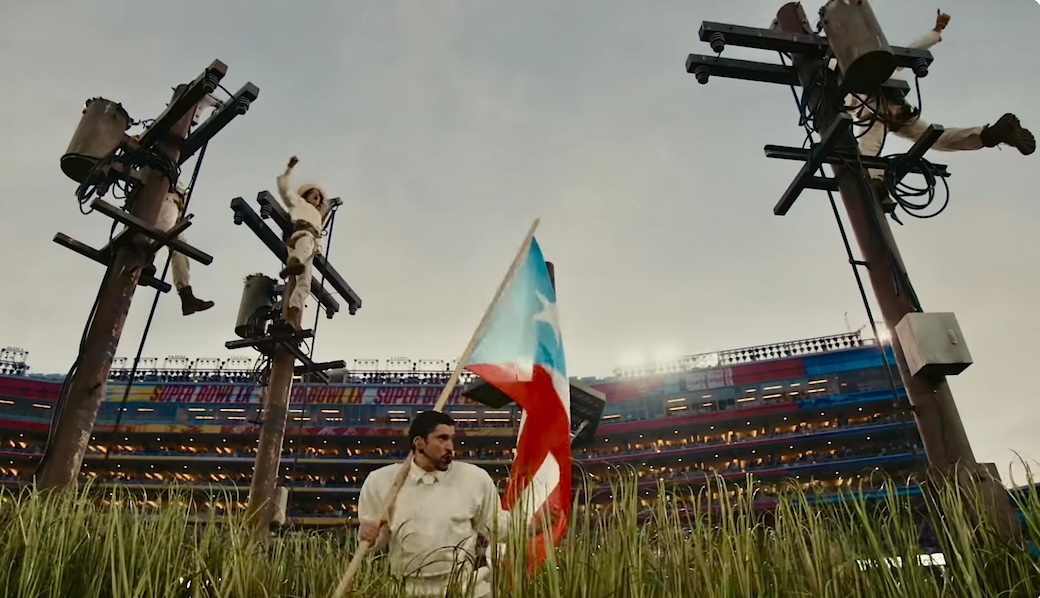
Entonces Benito retoma la voz cantante con “Puerto Rico está bien cabrón”, entre postes de electricidad en reparación. Anuncia “Welcome to the calentón”, hay un apagón general y comienza “Café con ron” trepado en uno de los postes que dos técnicos y una técnica intentan reparar. Sigue cantando mientras baja, lo recibe un grupo de músicos con panderos y güiros y un desfile de banderas iniciado segundos antes. Nuevamente balón en mano afirma “God bless America” pero introduce una variación a la frase canónica estadounidense, pues enumera todos los países del continente americano comenzando por Chile. Lidera el desfile de banderas latinoamericanas mientras menciona cada país y se enciende una pantalla con letras negras sobre un fondo blanco con el mensaje de los Grammys “The only thing that is more powerful than hate is love”. Al llegar al último, my motherland Puerto Rico, termina como un profesional del futbol que con el touch down logra el punto final y afirma “Seguimos aquí”. El concierto cierra con fuegos artificiales y la canción “Debí tirar más fotos”.
El Halftime fue un espectáculo complejo de inclusión y celebración de lo latino en el que destaca la libertad de las mujeres para disfrutar el baile en libertad. También se enfrenta contra las políticas racistas y antimigratorias del gobierno estadounidense y proyecta la unidad entre los pueblos de las Américas sobre el trasfondo de las realidades culturales puertorriqueñas de la isla y la diáspora.
El efecto Bad Bunny, inicialmente de índole popular, pronto llegó a la academia y desde el 2022 se dictan cursos universitarios y organizan simposios sobre el fenómeno en las universidades de San Diego, Loyola Marymount, la Universidad Autónoma de México (UNAM), Yale, Princeton y el Centro de Estudios Puertorriqueños de Hunter College.
En la Isla, algunas visitantes se pasean hoy con la flor de maga en el cabello, accesorio que había caído en desuso. La camisa masculina caribeña tradicional, la guayabera, también se ha puesto de moda y hay diseñadores creando versiones contemporáneas de la prenda. Cynthia Trigo de U Creative Atelier produce pañuelos inspirados en la estética rescatada por Benito en DTmF en el Taller Comunidad La Goyco, de Santurce. En el mismo centro cultural, la artista gráfica Yolanda Velázquez inició desde los conciertos de la residencia una serie de grabados con versos de canciones y diferentes frases que aluden a los discos de Benito.
Existe además una red de complicidades entre la población. Mi vecina, por ejemplo, para pasear a su perro se peina con dos moñitos que recuerdan las orejitas del logo de Bad Bunny. Por otra parte, cuando hace unas semanas fui al teatro de la compañía Agua Sol y Sereno, quise fotografiar los cabezudos creados a lo largo de tres décadas y expuestos allí. Pedí permiso porque quería mandarle algunas fotos a una amiga y la respuesta fue inmediata. No se podía desobedecer a Bad Bunny y tenía que tirar muchas fotos.
Al despertar el 11 de marzo, cuando empecé a escribir estas páginas, en el teléfono apareció el video de un joven indio bailando “NUEVAYoL” con pasos de Bhangra del Punjab. El algoritmo estaba indudablemente encendido, pues le siguió la Murga de Urdemales uruguaya cantando “Debí tirar más fotos”. Era miércoles. Tras desayunar, me dispuse a escuchar el programa de la radio de Las Madres de la Plaza de Mayo de Buenos Aires que todos los martes invita a Atilio Borón, una de las personas que mejor conoce las dinámicas geopolíticas latinoamericanas. Primero se discutió a fondo la guerra de Irán. Después le pidieron a Atilio que hablara sobre Bad Bunny y eligiera un tema del cantante. Sus palabras fueron lúcidas. Al terminar, los primeros compases de la canción elegida revelaron que se trataba de “LO QUE LE PASÓ A HAWAii” La emoción pudo más que yo, me eché a llorar y me senté a escribir…
Cangrejo Arriba
7 abril 2026
Marithelma Costa nace en Puerto Rico y ha vivido en Nueva York desde 1978. Durante tres décadas enseñó en Hunter College. Ha publicado tres libros de poesía, varios de entrevistas y estudios de literatura hispánica, y las novelas Era el fin del mundo y La bendición de Rosalía. En este momento su colección de cuentos Otros cismas de Occidente se halla en proceso de publicación. Sus obras han aparecido en Revista de Occidente, 80 Grados, Revista Conjunto, Frontera D, Hawansuyo.blogspot.com, American Letters & Commentary, y Cable Street.
*
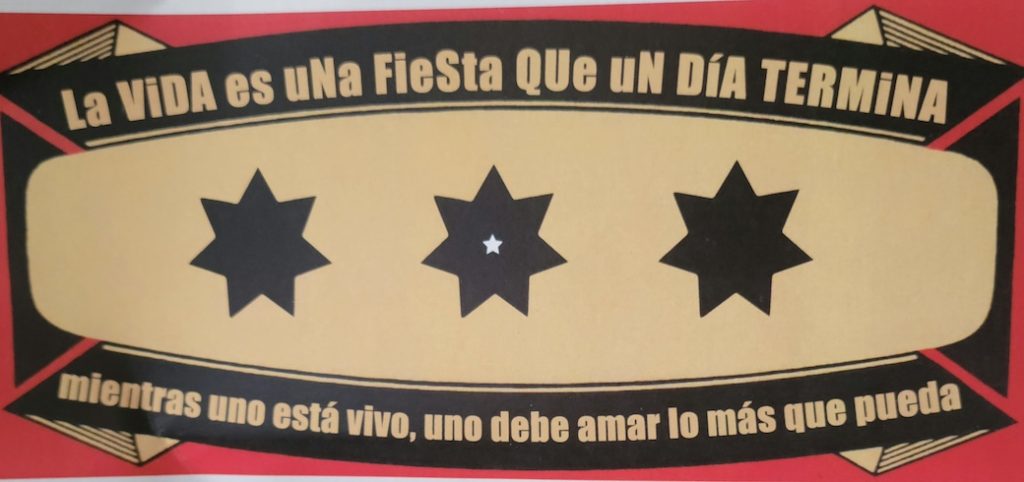
Life is a party that ends one day. While you’re alive, you should love as much as you can. Impresión de Yolanda Velázquez, del Taller La Ciénaga, basado en la letra de Bad Bunny. Print by Yolanda Velázquez, from Taller La Ciénaga, based on lyrics by Bad Bunny.
From Bad Bunny to Our Benito
A Chain of Emotions, Almost a Chronicle
I learned about Bad Bunny two years after the beginning of his meteoric rise—a span that could feel long or short, depending on whether one measures it in songs or in the places where his fame was spreading. It was the summer of 2018. I was visiting the home of Gabriela Caballero, a painter and friend who lives in Cádiz, one of the smallest cities in Andalusia. Gabriela rented a room to Yumni, a Korean student who had come there to study Spanish. When she introduced us, the young woman was wearing white socks with sandals—a fashion that still surprised me. As soon as she learned I had been born in Puerto Rico, her face lit up and she began talking to me about Bad Bunny.
I was completely at a loss. I had no idea who Benito was, even though for two years he had been uploading songs to SoundCloud from his home in Vega Baja and already had several Latin trap hits. He was also on the verge of breaking through with “Estamos Bien,” recorded in the aftermath of Hurricane Maria on September 20, 2017—the most severe disaster in modern Puerto Rican history. The song quickly became an anthem to life, and its video with lyrics now has 646 million views on YouTube alone.
It is worth recalling some of its lines, since they already contain themes that would reappear in later songs: a mother’s blessing, the fleeting nature of time, and a message of empowerment that would later become evident in his Halftime performance. In 2017 he sang: “If anyone can do it, it’s you / Even though the power hasn’t made it back home / Thank God I have my health… / Life has no replay / After my mom gives me her blessing… / Don’t worry, we’re good.” Nine years later, in California, after greeting the audience and identifying himself by his full name, Benito Antonio Martínez Ocasio, he would repeat those same words —“If anyone can do it, it’s you”— before the camera.
I watched the “Estamos Bien” video with a certain sense of relief, since during those months I was sending boxes of food and batteries from New York to Puerto Rico. I didn’t think about Bad Bunny again until 2022, when Un Verano Sin Ti was released and I began to feel the critical edge of his lyrics, something that, according to the excellent study Bad Bunny, Always Political, Never Unpolitical: Feminism and Resistance against U.S. Colonialism by Ariadna Estévez (Editorial Teseo, 2025), had already been present in his pandemic-year album, 2020’s YHLQMDLG (Yo Hago Lo Que Me Da La Gana), which I barely knew.
On that album, he released three emblematic tracks. The first, “Yo Soy de P FKN R,” which, as Wigmaris—an Uber driver—made me realize, was an enormous hit. As she drove me to the university campus, I asked whether she liked Bad Bunny. She replied that she didn’t follow him, but happily sang along—almost dancing: “I’m from P fuckin’ R…” Clearly, the song’s affirmation of Puerto Rican pride had left its mark on her.
The second radical cut on YHLQMDLG is the paradigmatic “Yo Perreo Sola.” Estévez points out that the video addresses street harassment and the absence of consent. The song also critiques gender norms in trap and reggaetón, as well as homophobia and transphobia. The video was released just one month after the hate crime against Alexa Negrón Luciano, a homeless trans woman murdered on February 24, 2020—a case still unresolved, in which many were complicit. Benito pays tribute to Alexa both in the lyrics and in the video, where he appears in a tight red dress, wearing makeup and painted nails, surrounded by sexually autonomous women who dance for pleasure without needing to validate male desire. The song displaces the archetype of the woman as object and introduces a new female subjectivity: active, desiring, and free (Estévez, p. 89).
“Safaera,” from the same album, still excites David Ruiz, 28, who does not follow Benito but rather his rival Anuel. The recording, conceived as a tribute to old-school reggaetón, introduces multiple tempo changes—something unusual in the genre—and pushes the use of explicit sexual language to its limits. For young listeners, “Safaera” captured the raw and original essence of reggaetón born in Carolina with Tego Calderón; it filled them with pride and became ubiquitous in homes, parties, cars, and social media. He performed it with Jowell & Randy, whom he invited to his recent concert in Japan on March 7, 2026, electrifying the Tokyo audience from the very first moment.
In July 2020, due to the commercial success of YHLQMDLG, the American Society of Composers, Authors and Publishers (ASCAP) named him Songwriter of the Year, sparking enormous controversy. Benito responded with “Compositor del Año,” a rap track signed with his full name—known only to his followers. In it, he abandons the coarse, sexual language of most of his compositions—linked to reggaetón, trap, and dembow, and to the commercial appeal of that lexicon—and openly positions himself against racism, in favor of immigrants, and in defense of women’s rights. He declares: “Black Lives Matter / rest in peace Kobe / 2020 and racism is worse than COVID / A Black man with a gun—that’s already a criminal / But a white kid straps one on and they call it a hobby.” Later: “Woman did not come from man’s rib / We came out of her pelvis” […] “There are more important things / like fighting for immigrants’ rights” […] “And it’s messed up to go to church to pray / and risk being raped.” That is when I understood that “Bad Bunny is always political, and the content of his lyrics and music reflects a personal activism within the context of resistance to U.S. colonial policy” (Estévez, p. 9).
And so we arrive at May 2022, the year of Un Verano Sin Ti, which I was fortunate to experience in Puerto Rico, where I had moved in March to escape the cold of New York City. The song “Apagón” opened my eyes. Just after arriving, I saw a teenager in a café wearing a strange T-shirt. I asked what it meant, and he replied proudly: “I’m a Bad Bunny fan.” It bore the promotional logo of the album that would define that summer: a sad heart with a single eye against a background of tropical colors—an image that, within days, spread across billboards throughout the island.
I still didn’t fully understand the phenomenon—until one afternoon, sitting on the sand, I listened to “Apagón” and burst into tears. The song unfolds in three parts. Its cheerful opening—“Puerto Rico está bien cabrón”—lists emblematic municipalities (Carolina and Bayamón), essential musicians (Ismael Rivera and Tego Calderón), a grandmother’s little kiss, neighbors from the Dominican Republic, the blackouts, and our numerical strength: “there are so many of us.” In the second part, after the welcome—“Welcome to the calentón”—an audacious and infectious rave begins. And in the third, the tone shifts radically. His voice returns: “this is something more or less informal,” followed by the melodic female voice of Gabriela Berlingeri, repeating: “I don’t want to leave here / Let them leave / What belongs to me / they’re taking / Let them leave / This is my beach / this is my sun / this is my land / this is me.”
The impact was overwhelming. I was sitting on the beach of my childhood, hearing articulated what I saw everywhere: the touristification and gentrification of the island by Americans who, in a kind of 2.0 invasion, were taking advantage of the policies of a corrupt government that had turned the country into a tax haven benefiting real estate speculators—who paid, and still pay, in cash for properties—and cryptocurrency investors.
The more I listened to the song, the more I cried. I had left the country young, and thanks to the generosity and vision of my friend Paul Segarra, I now had what I had dreamed of since childhood: a space of my own facing the beach. And Gabriela Berlingeri’s voice repeated like a mantra that I had to hold on to it.
In fact, at the end of that prodigious summer, on the fifth anniversary of Hurricane Maria, the video “El Apagón – Aquí Vive Gente” was released. In this version, the song is followed by a twenty-three-minute documentary directed by journalist Bianca Graulau, which denounces gentrification, the displacement of Puerto Ricans by U.S. investors relocating to the island through remote work and tax exemptions, unemployment, the energy crisis, and the right to housing. It is worth noting that the first person Graulau interviews is a Dominican woman.
That was when I began to study Bad Bunny’s songs with the help of Elizabeth Rodríguez, my Dominican friend based in New York, who explained many of his words and phrases to me—a mixture of youth slang and reggaetón vernacular. At first it was she who guided me, as she feels Benito’s songs as her own; later, Pablo Varona Borges, whom I had met during the Occupy Wall Street movement and who returned to Puerto Rico after studying in New York. Pablo has witnessed many details of Benito’s trajectory firsthand and shared them with me as we body-surfed in the waves.
From May 2022 onward, whenever one walked along the beach, one heard nothing but songs from Un Verano Sin Ti. The same was true of the cars passing along the avenue. “Tití Me Preguntó” was everywhere, recreating the macho imperative instilled in boys in Puerto Rico and the Dominican Republic to have many women. It is worth noting again that the “aunties” who speak in the song are from the neighboring island, D.R.. The track was such a success that even Carmen Yulín, former mayor of San Juan, sang it in public. One also heard “Después de la Playa,” which, to the rhythm of merengue—with trumpets, tambora, and güira—celebrates a beach party in a space that, as Gabriela Berlingeri repeats in “Apagón,” was being taken from us.
I realized I was on the right path when I listened to “La Noche de Anoche,” which Bad Bunny had recorded with Rosalía and released on Valentine’s Day 2021. I continued studying his songs, and my own crusade began: to convince friends that Benito was worth listening to—that it wasn’t all perreo, sex, and crude language. I achieved little. It was like preaching in a wasteland.
In the opening track of his fifth album, released in October 2023, Nadie Sabe Lo Que Va a Pasar Mañana, he declares: “This album ain’t for radio play, not for a billion views / It’s for my real fans to be happy / even if inside I’m not feeling one hundred percent,” and “I sold the Bugatti because it felt slow / and because my people don’t fit in it’s seats,” before foretelling the meteoric fame he would reach three years later. That ability to move along the line of time—to anticipate or stage behaviors that later come to pass—was first pointed out to me by Pablo Varona Borges and later confirmed by theater-maker and community cultural organizer Iliana García, who emphasized that he has had it since he was very young.
Nadie Sabe Lo Que Va a Pasar Mañana coincides with the period in which he devoted himself to exploring the world of billionaires—Monte Carlo, the Kardashians. Elizabeth Rodríguez could not stand it. I explained to her that he had taken a sabbatical year to explore realms he could not have imagined existed seven years earlier, back in Vega Baja, when he worked as a supermarket bagger. That year, along the beaches, one heard songs very similar to his, but whenever I asked, I was told they were by other artists.
And then came 2024, after four incompetent governors had succeeded one another in La Fortaleza following Maria—one forced to resign after massive protests in which Benito participated alongside René Pérez (Residente) and Ricky Martin, and another arrested on charges of public corruption. And it wasn’t just the hurricane—other facts must be added. The island carries an unpayable debt, financially and constitutionally; since 2016, a year before Maria, it has been controlled by a fiscal oversight board appointed from Washington. Governors are little more than administrators. Forty percent of the population lives below the extreme poverty line; the island must import 85 percent of what it consumes from the United States under high taxes; and many families are fractured by acute depopulation—a low birth rate combined with nearly one million residents who have emigrated en masse.
On September 16, the seventh anniversary of the hurricane, he released “Una Velita,” which moved everyone. He explained it himself to the press: “Obviously the traumas of Maria are present in a song like this, as well as the anger and frustration at the ineptitude, abuse, and cruelty of the government” (Telemundo, September 23, 2024).
In Debí Tirar Más Fotos (2025), the themes of forced depopulation—stemming from corrupt post-Maria policies—and the denunciation of necrocolonial settlements explored in Graulau’s documentary are consolidated and expanded. I borrow the term from the Cameroonian thinker Achille Mbembe, who proposes that, unlike the neocolonial (focused on economic and political control), the necrocolonial describes systems of power that assert dominance by deciding who is disposable within a territory.
Before the year even began, Benito had released two new videos on YouTube. First, “EL CLúB” (December 5, 2024), filmed between a building in the capital and a house in the mountains. In it, he doubles himself and sings “Where might my ex be?” as images flash by—each less than a second long—with political undertones: a Bugatti exploding, newborn babies stamped on the forehead with “middle class” and “lower class.” Also present are the pavas, the straw hats of Puerto Rican farmers, which immediately came back into fashion. The video closes with a satellite image of Hurricane Maria sweeping across the island and the mysterious “DTmF 2025,” which no one could decipher. It was the first announcement of his new album.
After Christmas, he released “Pitorro de Coco,” set to aguinaldo music and featuring the cuatro, the island’s national string instrument. Set at a New Year’s Eve party, Benito once again sings of heartbreak beneath a sign that reads “Aquí te espero boricua,” while young women dance and a child sleeps in a chair—an image that would reappear in the Halftime performance.
On January 3, 2025, he premiered the nearly thirteen-minute short film DeBÍ TIRAR MáS FOToS, in which the nonagenarian Jacobo Morales, the country’s most respected actor, converses in a rural home with his friend, Concho the toad—an endangered endemic amphibian recreated through stop-motion animation. They speak about the passage of time and cultural change. The actor walks to the town bakery to get breakfast for himself and Concho; the new American cashier does not understand the vernacular, and under the new management, cash is no longer accepted. He asks to settle the bill later; when she refuses, a neighbor steps in, tells him “don’t worry,” pays with his phone, and emphasizes: “We’re still here.” With that same phrase, he will later close the enumeration of the countries of the Americas in the following year’s Superbowl Halftime performance.
Finally, on the eve of Three Kings’ Day, the full album was released and it became the centerpiece of his residency No Me Quiero Ir de Aquí. One must recall the immense cultural and identity-based significance of this date for the Puerto Rican psyche. As the feminist Nirvana González Rosa explains to Ariadna Estévez: “For us, it is not just any date: it is the most meaningful Christmas celebration in Puerto Rican culture, a family and community festivity deeply charged with affection and memory” (Estévez, p. 109).
On the morning of January 6, neighbors gathered on the beach to listen to one song after another. The two white chairs in front of the cluster of plantains on the album cover became a signal of where Benito would appear unexpectedly—something he did in front of El Boricua in Río Piedras and on the roof of a gas station on Calle Loíza, a working-class neighborhood of San Juan.
The pedagogical and political stance of this album is unmistakable. When he released the songs on YouTube, they appeared accompanied by historical notes about Puerto Rico. In the first track, “DTmF,” one reads: “From plena and bomba to reggaetón (1500s–1990s),” outlining the history of these popular and autochthonous rhythms, to which he adds salsa in the song itself. Other tracks include references such as “The invasion of 1898 (1898–1917),” “The war after the war (1898–1899),” “Defiant jíbaros (1905),” and “Repression and surveillance in Puerto Rico (1960s–1980s),” among many others. It is worth noting that the historical text does not necessarily correspond to the content of the songs, and that its principal source is Jorell Meléndez-Badillo’s Puerto Rico: Historia de una nación (Planeta/Princeton University Press, 2025).
The album Debí Tirar Más Fotos opens with “NUEVAYoL,” a celebration of Puerto Rican diasporic identity. In it, Benito chooses the classic song “Un Verano en Nueva York,” recorded by El Gran Combo in 1975, and blends salsa and Puerto Rican reggaetón with Dominican dembow. The video begins under falling snow, and the first voices heard are Dominican men complaining about the cold—something that will also recur at the beginning of the Halftime show, when a Dominican guitarist exclaims in the middle of a sugarcane field: “How good it is to be Latino!” This has a meaningful explanation: alongside his defense of Puerto Rican cultural values, Benito has, from early on, affirmed popular integration at the regional level—Puerto Rico and the Dominican Republic as a cultural unit—an ideal championed by one of the island’s great thinkers, Eugenio María de Hostos, whom he invokes at the end of the album in “LA MuDANZA.”
With “BAILE INOLVIDABLE,” imbued with nostalgia, he pays homage to salsa, one of the country’s musical pillars. This tribute to traditional music continues in “CAFÉ CON RON.” In this infectious track, he joins Los Pleneros de la Cresta to reclaim plena, a genre that emerged in Ponce at the end of the nineteenth century as a form of commentary—or gossip—on everyday events, or what Ramón López calls bembeteo (Los bembeteos de la plena puertorriqueña, Ediciones Huracán, 2008). This communicative function allows it to span a wide arc, from the purely playful to social and political critique.
It was precisely this song, along with “DTmF,” that led my friend Liliana—who had initially rejected Benito outright when I suggested she listen to him—to change her mind and ultimately defend him passionately before her family for instilling in young people a sense of pride in being from here. This feeling of self-worth stands in stark opposition to the narratives and structures of prevailing colonialism. The phenomenon is explained by the Bolivian thinker Juan José Bautista, who argues that we are so deeply colonized that we no longer believe in the validity or truth of our own historical, cultural, and mythical horizons. Instead, we believe what modernity—hegemonic, European, North American—tells us about them: that they are inferior.
The album closes with the emblematic tracks “LO QUE LE PASÓ A HAWÁII” (on necrocolonial settlements and their consequences, and the urgent need to affirm the country’s cultural and identity markers); “EoO,” pure perreo, where he revives a classic by the reggaetón artist Tito el Bambino; “DTmF,” which has won over many of the singer’s detractors, since in a kind of inverted carpe diem, mediated by the photographic camera, it expresses regret for not having sufficiently valued certain people and moments in life; and “LA MuDANZA,” where he speaks of his roots, recounts the story of his parents, Tito and Lisy, and highlights the discipline and values they instilled in him from childhood, while also invoking the struggle for Puerto Rico’s independence: “If I die tomorrow, I hope / they never forget my face / and that they play one of my songs the day Hostos is brought back.” He refers here to Eugenio María de Hostos, sociologist, political thinker, and Citizen of the Americas, who dedicated his life to the independence of Puerto Rico and the unity of the Greater Antilles and Hispanic America. His final wish was to be buried in Santo Domingo (his remains lie in the Panteón de la Patria) and to be returned to Puerto Rico when his homeland became free and independent.
Then Benito announced his residency No Me Quiero Ir de Aquí: thirty-one concerts (with 400,000 tickets sold out in four days), built on the aesthetic and ideas developed in DTmF. The chosen venue was the centrally located Coliseo de Puerto Rico José Miguel Agrelot—popularly known as the Choliseo, in homage to Don Cholito, Agrelot’s iconic radio and television character.
The stage, divided between a modest concrete house and a recreation of the island’s mountains—complete with flora and fauna—was accompanied by projections on the history, culture, and realities of Puerto Rico. The shows lasted between two and three hours, and each night featured a surprise guest. Legends appeared—Ricky Martin, Gilberto Santa Rosa, Marc Anthony—as well as singer-songwriters like iLe, who performed “LO QUE LE PASÓ A HAWÁII” wearing a dress reminiscent of what the nationalist Lolita Lebrón wore when she was arrested. Also present were Arcángel and Jowell & Randy, pillars of reggaetón, along with younger urban artists such as RaiNao and Young Miko.
All were Puerto Rican except for the Panamanian Rubén Blades, who joined the residency on August 31 and improvised several soneos with Benito at the end of “BAILE INOLVIDABLE.” In them, Rubén praises salsa and celebrates the unity of the two nations, while Benito mentions some of Rubén’s classic songs and thanks him on behalf of himself, his mother, his father, Los Sobrinos, and the country of his birth.
The musicians participating in the residency and the world tour—which began on November 21, 2025, and will run through July 22, 2026—include Los Pleneros de la Cresta, the orchestra Los Sobrinos (made up of young musicians personally selected by Benito), and Chuwi, a Puerto Rican band formed by three brothers and a friend, who since 2019 have fused Caribbean and electronic rhythms. Benito recorded “WELTiTA” with them, and on tour they serve as his opening act.
I return here to Estévez, whose analysis lucidly explains the phenomenon of the No Me Quiero Ir de Aquí residency:
Bad Bunny’s stage presence transcended the act of singing: it became a form of symbolic inhabiting of the island. The artist did not limit himself to performing songs but intervened in an emotional and political territory, making visible what often remains out of focus: infrastructural precarity, the deterioration of public spaces, the logic of state abandonment, and the material effects of economic dispossession. Each performance, in this sense, operated as a gesture of symbolic reterritorialization, a performative act of resistance and reclamation of a historically denied or violated space. Far from being a mere artistic display, the residency became a sustained act of political enunciation through the language of the stage (Estévez, p. 131).
Artist and editor Tata Guzmán offered me an additional explanation based on her own experience. She was fortunate enough to attend one of the first concerts and shared on social media what she felt there. She wanted to return for the final show and asked for help getting a ticket, but they were completely sold out.
So on March 20, I called her to hear about it firsthand, and what she told me helps explain why the Bad Bunny phenomenon has spread globally like wildfire. According to her, the joy that extended from July 11 to September 14 constitutes one of the pillars of Puerto Rican resistance. It is worth recalling Franz Fanon: where there is oppression, there is also resistance.
According to Tata, Puerto Ricans have two trenches that have allowed us to survive 553 years of colonial rule. The first is joy—laughter, vacilón. Bad Bunny’s residency was an extended period of collective delight; the concerts, a reminder that joy must be activated, that one must not succumb to despair. Benito foregrounded the importance of the dancing body, the laughing body—something people around the world recognize. The architect Miguel Rodríguez Casellas spoke of this recently on his YouTube program La Cuneta Calibana.
My friend Shoufay, the Australian, wants a DTmF shirt. She didn’t buy one at the Sydney concert and now regrets it. Does anyone know how to get one? If it were one of those sold during the residency, even better. Her reason for wanting one moves me. She explains that having something of Benito’s—a sticker, a logo, a T-shirt, whatever—functions as a code in Sydney, a way of attracting cool people who come up to you and start a conversation.
Indeed, Benito affirms eros—desire, life, and joy—prevailing over thanatos, which spreads like an oil slick through neoliberalism, labor precarity, the deterioration and privatization of public spaces, the immediate effects of economic dispossession, and, in Puerto Rico in particular, necrocolonial settlements.
The second trench of resistance (a word so close to residency) is language: Spanish in its Puerto Rican variant, often disparaged by Latin Americans and Spaniards alike. It is a form of speech that shares with the Caribbean its innovative character, combining phonetic traits from the Canary Islands and Andalusia—such as the aspiration of the implosive /s/ or its reduction at the end of syllables—with the controversial neutralization of liquids, that is, the interchange of the r and l sounds. In a verse from “Nadie Sabe,” he EXPLAINS THE phenomenon: “I end them with an ‘L,’ with an ‘R’ it sounds wrong.” And in “MuDANZA” (2026), he proclaims triumphantly: “…I am culture / from Borinquen, Puerto Rico, perfect archipelago / the whole world now knows my dialect, my slang.”
Bad Bunny also refused to adopt hegemonic English, as artists like Ricky Martin and Shakira once did to gain mainstream acceptance. Nor did he opt for neutral Spanish to be universally understood. He states this clearly in the title YHLQMDLG, whose logo—a white skull on a black background—covered the city in January, just before COVID, when his songs were heard intensely during lockdown. Bad Bunny sets his own rules, indifferent to what others might say. And he has validated Puerto Rican Spanish through his singing, his public appearances, his interviews, and his speeches.
At the beginning of February 2026, Benito received three Grammys for DTmF: Best Global Music Performance, Best Urban Music Album, and Album of the Year. It was the first time in the history of the awards, established in 1959, that a Spanish-language album had won. When he took the stage, the first thing he said was “Ice out,” drawing an ovation. He then affirmed the value of immigrants—“we are not savages, we are not animals, we are not aliens, we are human and we are American”—and declared: “The only thing that is more powerful than hate is love.” The next day, billboards across Puerto Rico displayed that very statement.
A week later, he took the stage at the Super Bowl Halftime show—a thirteen-minute spectacle that reached 4.15 billion viewers around the globe (Megan Ziezler, Live Now Fox). He transformed the football stadium in Santa Clara, California, into a sugarcane field, where elements of Puerto Rican neighborhoods and the streets of New York appeared. It is worth pausing on each tableau of the show, for they condense, at a symbolic level, many of the themes Bad Bunny has developed throughout his career, while also mounting a political defense of Latinos in the final game of the National Football League, one of the central arenas of U.S. culture.
It begins in a cane field where, guitar in hand, Anthony Santos, a Dominican bachata singer, exclaims: “How good it is to be Latino. Tonight, we drink,” a phrase he made famous. After a panoramic view of the farmland, Bad Bunny appears walking among cane cutters while singing “Tití Me Preguntó.” He carries a soccer ball in his hand and adopts the gestures of the sport’s players. Along his path, he passes through typical Puerto Rican scenes: a stand selling cold coconuts, four men playing dominoes, two women doing their nails (on whose table he briefly sets down the ball), and four others at a construction site. He buys a piragua, which he hands to a taco vendor; he passes beneath two boxers mid-fight; a jeweler offers him a box with what appears to be a wedding ring, which he immediately discards.
The stage shifts, and he appears atop the small house used in the January 3 short film and recreated during the residency. There, reggaetón begins. He affirms women’s right not to be harassed—“women all over the world dancing without fear”—as more than twenty women dance in unison while he performs “Yo Perreo Sola,” “Voy a Llevarte pa’ Puerto Rico,” and other classics of the genre. The party continues. Then Bad Bunny moves, once again holding the ball, to stand before a string orchestra. There he introduces himself: “Good afternoon, California. My name is Benito Antonio Martínez Ocasio. If I’m here today at Super Bowl 60, it’s because I never—never—stopped believing in myself. You should believe in yourself too. You’re worth more than you think. Believe me.”
A live wedding ceremony then concludes, and the celebration begins—complete with cake—while Lady Gaga performs “Die with a Smile,” adapted into salsa. Needless to say, everyone dances. At the end, Benito gallantly extends his hand to the New York singer, then performs “BAILE INOLVIDABLE,” followed by “NUEVAYoL.” At that moment, the setting becomes urban: the marqueta of El Barrio in East Harlem appears, along with a barbershop and Toñita’s bar, where she offers him a drink. She is María Antonia Cay, an iconic eighty-five-year-old Puerto Rican woman, owner of the Caribbean Social Club in Williamsburg, Brooklyn, considered a pillar of the Boricua community for having sustained, since 1974, a cultural and identity-based space in the face of relentless gentrification.
Benito sings surrounded by dancers of dembow and salsa, and after the line “no one can take the championship from me,” there is a cut: a child appears watching on television as Bad Bunny receives his Grammys. Immediately afterward, Bad Bunny himself hands the award to the child in person and tells him: “Always believe in yourself.” The sound of the cuatro is heard, and the camera turns to Ricky Martin, who sings, visibly moved, a fragment of “LO QUE LE PASÓ A HAWÁII.” He sits on the plastic chairs—symbol of DTmF—before several banana plants.
Then Benito takes up the lead again with “Puerto Rico está bien cabrón,” amid power lines under repair. He announces, “Welcome to the calentón”; a total blackout follows, and “Café con Ron” begins as he climbs one of the poles that two technicians—a man and a woman—are trying to fix. He continues singing as he descends; a group of musicians with panderos and güiros receive him, along with a parade of flags that had begun seconds earlier. Once again holding the ball, he declares “God bless America,” but introduces a variation to the canonical phrase, listing all the countries of the American continent, beginning with Chile. He leads the parade of Latin American flags while naming each country, as a screen lights up with black letters on a white background displaying the Grammys message: “The only thing that is more powerful than hate is love.” When he reaches the last—“my motherland, Puerto Rico”—he finishes like a football player scoring a final touchdown and declares: “We’re still here.” The concert closes with fireworks and the song “Debí Tirar Más Fotos.”
The Halftime show was a complex spectacle of inclusion and celebration of Latinidad, foregrounding women’s freedom to dance without fear. It also confronts the racist and anti-immigrant policies of the U.S. government and projects unity among the peoples of the Americas against the backdrop of Puerto Rico’s cultural realities, both on the island and in the diaspora.
The Bad Bunny effect, initially popular in nature, quickly reached academia. Since 2022, university courses and symposia on the phenomenon have been offered at institutions such as San Diego, Loyola Marymount, the National Autonomous University of Mexico (UNAM), Yale, Princeton, and the Center for Puerto Rican Studies at Hunter College.
On the island, some visitors now wear the flor de maga in their hair—an accessory that had fallen out of use. The traditional Caribbean men’s shirt, the guayabera, has also come back into fashion, with designers creating contemporary versions. Cynthia Trigo, of U Creative Atelier, produces scarves inspired by the aesthetic Benito revived in DTmF, at the Taller Comunidad La Goyco in Santurce. In that same cultural center, the graphic artist Yolanda Velázquez has, since the residency concerts, created a series of prints featuring song lyrics and phrases alluding to Benito’s albums.
There is also a network of quiet complicities among people. My neighbor, for example, styles her hair in two small buns when she walks her dog—resembling the ears of Bad Bunny’s logo. And when, a few weeks ago, I went to a performance by the company Agua, Sol y Sereno, I wanted to photograph the cabezudos created over three decades and displayed there. I asked for permission because I wanted to send some photos to a friend, and the response was immediate: one could not disobey Bad Bunny—I had to take many photos.
On the morning of March 11, as I began writing these pages, a video appeared on my phone of a young Indian man dancing to “NUEVAYoL” with Bhangra steps from Punjab. The algorithm was clearly awake: it was followed by Uruguay’s Murga de Urdemales singing “Debí Tirar Más Fotos.” It was Wednesday. After breakfast, I set out to listen to the radio program of the Mothers of the Plaza de Mayo in Buenos Aires, which every Tuesday invites Atilio Borón, one of the sharpest analysts of Latin American geopolitical dynamics. First, they discussed the war in Iran in depth. Then they asked Atilio to speak about Bad Bunny and to choose one of his songs. His words were lucid. When he finished, the opening bars revealed his choice: “LO QUE LE PASÓ A HAWÁII.” Emotion overcame me. I burst into tears—and sat down to write.
Cangrejo Arriba
April 7, 2026
Marithelma Costa was born in Puerto Rico and has lived in New York since 1978. She taught at Hunter College for three decades and is the author ofthree poetry collections, several books of interviews and studies of Spanish Literature, and the novels Era el fin del mundo andLa bendición de Rosalía. Her collection of short stories Otros cismas de Occidente is about to go to press. Her works have appeared on Revista de Occidente, 80 Grados, Revista Conjunto, Frontera D, Hawansuyo.blogspot.com, American Letters & Commentary, and Cable Street.
* * *