
by Dana Delibovi
1
My family and I have been driving a long time on Route 51. Tall pines and oaks cast their deep shadows. We pass a sign for Lac du Flambeau, the Reservation of the Lake Superior Chippewa Indians. The reservation can’t be seen from the road, just the sign and, every so often, a dirt trace disappearing into the trees.
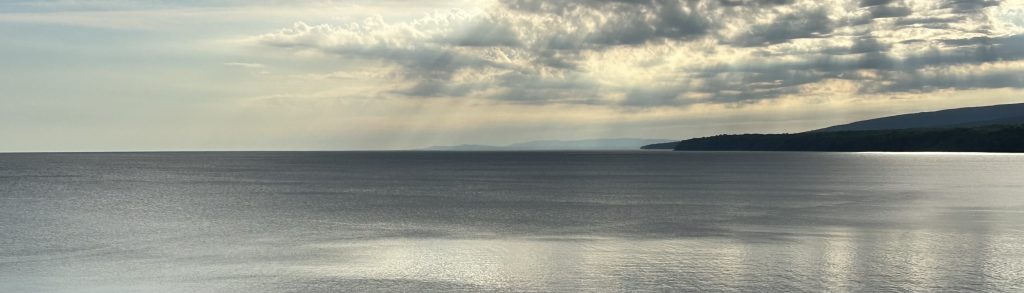
We cross from Wisconsin into Michigan’s Upper Peninsula, between the towns of Hurley and Ironwood, on Lake Road. Soon, the trees wall us in again, their darkness a contrast to the yellow light of the summer afternoon, which every so often dapples the shaded asphalt ahead. After 18 miles, Lake Road comes to a T at Little Girl’s Point, and we face a body of water, shocking in its immensity so far from any ocean. The knowledge I had of Lake Superior has not prepared me for my astonishment.
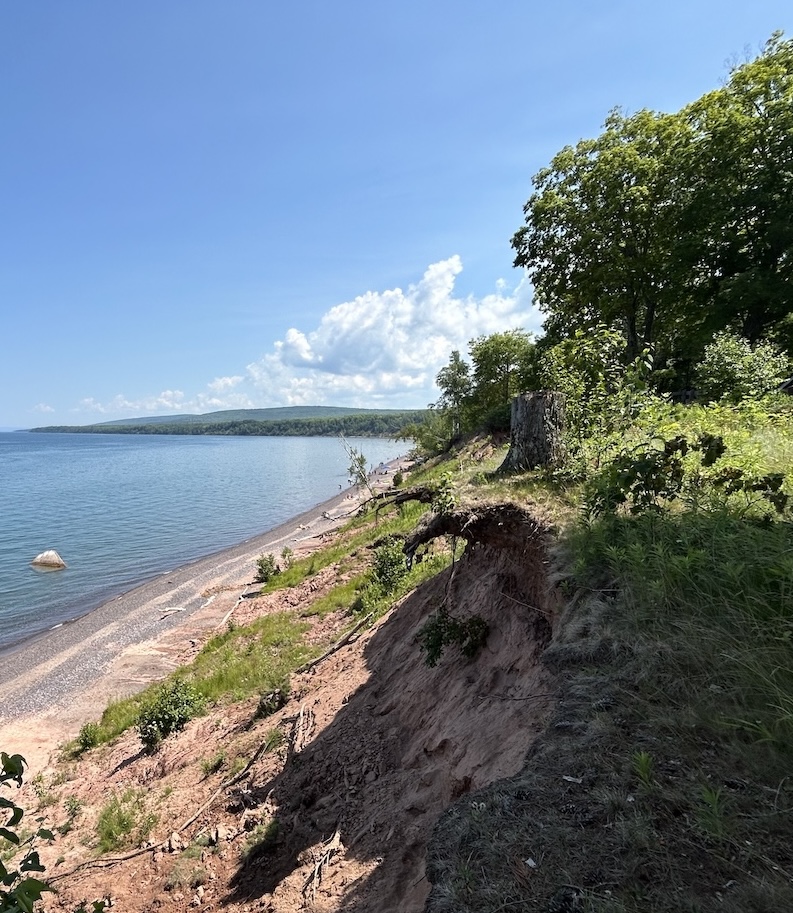
roots of a dead tree
jut from the bluff
sound of gray water
2
Little Girl’s Point takes its name from a supposed Chippewa legend. It’s hard to trust the origin story, because white hunters, soldiers, and settlers frequently embellished or concocted “Indian” tales.
Leelinaw was the daughter of a great Chippewa hunter. She loved nature, and the piney outcrop now known as Little Girl’s Point fascinated her. So did a breed of pyxie, the “Puk Wudjiinees,” which inhabited the point and its groves. Leelinaw, unlike her superstitious kin, did not fear the pyxies, and she visited the spot more and more as she grew.
When the girl came of age to marry, her parents chose a husband and set a date. But the free-spirited Leelinaw wanted no part of it, and on the day of the wedding she escaped—perhaps on foot, perhaps by canoe. A search ensued, but it was fruitless; Leelinaw had disappeared.
Time passed. One evening, fishermn rowing close to the point saw a female figure on the beach. She wore green, and was accompanied by a young man with a green feather in his hair. As the fishermen drew closer, the two ran off. From that day forward, everyone called the spot Little Girl’s Point.
In 1892, a Missourian named George Absalom Triplett settled near the point. There, he raised eight children, including three girls, one of whom, Minnie Olive Triplett, lived until 1986. George became known in the area as the eccentric “Grandpa Triplett.” He could quote the Bible and spin a very believable yarn. He helped to spread the legend that a Mayan expedition, fleeing the conquistadors, came to Lake Superior via the Mississippi River and buried a hoard of gold in the vicinity of Little Girl’s Point. George spent time prospecting for the treasure, as did speculators seeking riches in the area.
Little Girl’s Point is awash in legends. Maybe it’s named for Leelinaw, or for George’s girls, or for a chunk of bluff that a prospector thought looked like a little girl.
cawing crows
a blonde family
spreads out their towels
3
Yooperlites draw dozens of people every night to the beach at Little Girl’s Point. “Yooperlite” is a compound word of “Yooper,” a nickname for Michigan’s Upper Peninsula, and “sodalite,” a mineral that fluoresces under ultraviolet light.
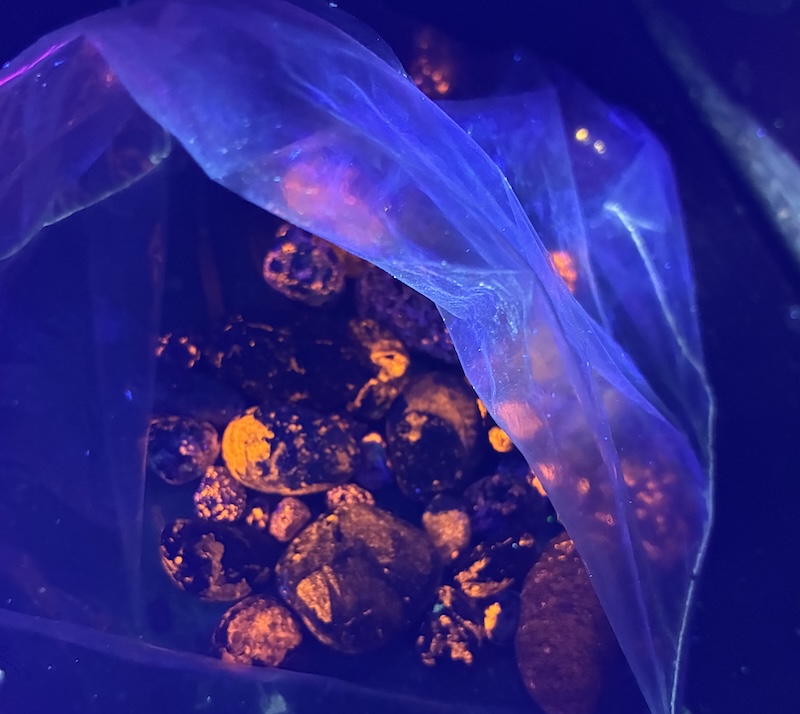
By day, a Yooperlite looks like a standard-issue gray pebble. But at night, under a UV flashlight, flecks of sodalite in the stone glow orange, the color of embers in a fire.
Geologists think that, about 1.1 billion years ago, magma from the earth’s mantle spewed through a massive rift in Canada’s tectonic plate—the same rift that began the process of forming Lake Superior. The liquid magma cooled into syenite, an igneous rock containing sodalite. During the ice ages that have occurred since then—including the most recent that peaked about 18,000 years ago—ice-age glaciers picked up sodalite-rich rock in Canada, and on their retreat, deposited it on the southern shore of Lake Superior.
My family hunts for Yooperlites Saturday and Sunday nights at Little Girl’s Point. Bent over at the waist, we sift through the shingle of the beach, crying “found one” when our black lights catch a glint. Long, pale, winged insects are emerging from amid the stones; this does not put us off, so eager are we for Yooperlites. One of my sons has traveled with us; he is a geologist, and educates his father and me on the deposition of rocks on the Upper Peninsula. I burst with maternal pride at having a scientist son. I deflate with shame when I realize that a Yooperlite hunt can turn into an exercise in greed.
Early on during the first evening’s hunt, I notice I get a little rush every time I find even the tiniest gleaming cobble. I want more, bigger, better. I want to win. My husband, I observe, feels the same, and is envious when a fellow finds a Yooperlite the size of an apricot—very large on the picked-over shores of Little Girl’s Point. My husband and so do manage to collect a whopping plastic bag of Yooperlites, glowing like a sack of hot coals under their black lights, but without the coveted “big one.”
There is no feeling that disturbs me more than avarice. From it spring every addiction and resentment I have ever had. I leave the beach soon and don’t go back the next night. I possess three tiny Yooperlites of my own. They will do.
night by the water
smelling
the far-off latrines
4
I grew up near a beach on Long Island Sound. I swam in cold water from Memorial Day until the end of June. By then, the water had warmed. By then, after boaters had taken many a summer sail, their detritus had hit the beach. I remember swimming past a slice of lime, no doubt from some sailor’s gin and tonic. The jellyfish would swarm in August. The soft sand burned, so I had to run the whole way from towel to surf. I always preferred the cold-water months.
The morning after our arrival at Little Girl’s Point, my son and I swim in Lake Superior. In mid-July, the water is very cold. But so clear, I can see down to my feet on the rainbow pebbles that comprise the beach here—Yooperlites included. The pebbles hurt to walk on, and at every swim I feel relief when I can finish wading in, lift my legs, and float. My buoyancy surprises me, because my mother, ever the science lover, often repeated that bodies are less buoyant in fresh than in salt water. I paddle easily through the gentle lake waves, the deep blue sky overhead.
near a tree trunk
washed up on the beach
a blue bassinet
My son and I don’t swim at the same time. I try it first, then report back to our little family camp that the water is frosty but beautiful. My son then heads down the dirt path to the beach, to swim on his own. Of course, I check on him every so often from up on the bluff. Do all mothers check on their kids like they are still toddlers, forever? We have had our differences, my son and I, because I couldn’t help but pass along some of the perfectionism and pressure to achieve my parents gave me. I lost his trust by overdoing this, especially in his high school years.
But I believe I also passed along the fact that buoyancy in fresh water is less than in salt water, and my son is a scientist today.
5
I sit in a camp chair above the largest freshwater lake in the world. The Caspian Sea has a greater surface area than Lake Superior, but it is saline. Yet as I perch by this vast blue-gray expanse, I fixate on a tiny daisy that grows on Little Girl’s Point.
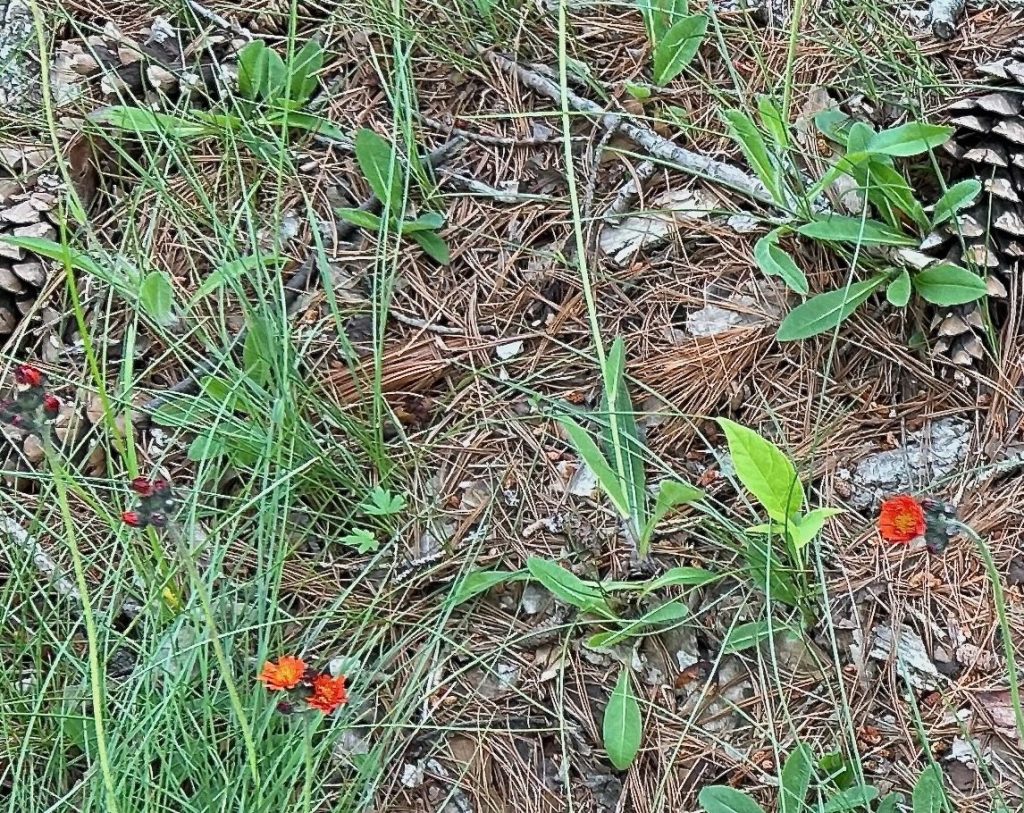
The daisy has red petals with a yellow center. About half an inch across, it grows in clusters of anywhere from three to ten atop grassy foliage. The red pulsates. It does not mimic the color of a lipstick, or a popsicle, or even a garden flower like a rose or a tulip. The color matches what people once called Chinese Red, from the cinnabar used in Chinese lacquers since the Yangshao culture (5000–4000 BCE). Now, people more commonly call this color vermilion or, in Crayolish, red-orange. After much internet searching, I have determined that the little flower is orange hawkweed, Hieracium aurantiacum.
I have always loved miniature things. As a child, I had vast collections of small things—2-inch Japanese dolls in brilliant purple and green robes, immature pine cones, Disneykins, jingle shells, and slivers of mica. Sixty years later, promoting a book I published, my favorite swag items are mini-bookmarks designed with various paintings, etchings, or stained glass of St. Teresa of Ávila. I often tell people I like the mini-bookmarks better than the book. I have been working on a second book, for which I have already created mini-bookmarks. These happen to be black, white, and, to my delight, vermilion.
What’s small is companionable. Small things are pretty or charming, never sublime in the way of Lake Superior. Never engulfing in the way of the internet. Normally, the moment something catches my eye or crosses my mind, I look it up on my phone. Before the internet, when I did something akin to my hawkweed investigation, I had to wait. I had to get to school, or to the library, or back home to our set of encyclopedias. Waiting meant I only researched what mattered to me enough to recall over hours or days. No flood of meaningless digital information, rushing from every corner of existence. I knew little, but I knew it well.
ceaseless horizon
a shiny black ant
tickles my phone-thumb
6
A filigree of lichens encases the limb of a pin-oak. Nearly set, the sun colors the lake a hawkweed red. Fireflies compete with stars in the dimming day. At the picnic table, I sense that my son trusts me again. I have tried to be more trustworthy, but it’s a life’s work.
smooth, warm lake stones
weighting
white paper napkins
Photo of Yooperlites under black light by Jim Hess.
* * *