
B J Atwood-Fukuda
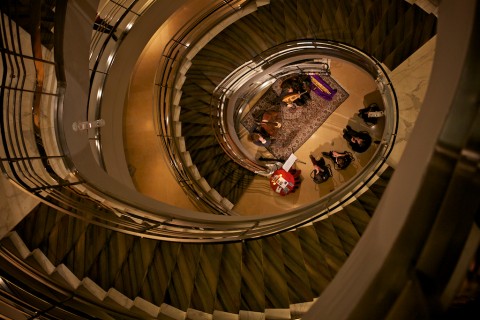
The Rubin Museum of Art, Central Staircase. Photo: Evi Abeler.
On October 6 of this year, the Rubin Museum of Art will close its doors for the last time, after just twenty years. This seems an unconscionably short lifespan for a museum, especially one that filled a niche unique in the city’s cultural life. When it opened in 2004, on the site of the old Barney’s New York at Seventh Avenue and Seventeenth Street, it was the only museum in the country, let alone the city, dedicated to the art of the Himalayan region. At the time, that art was still a relatively new field of study for scholars and art historians, just coming into its own as beyond mere “ethnography”—itself a term and category invented by cultural anthropologists, largely western, white and male. Over the years, the RMA contributed greatly to the field, diversifying its reach and practice around the world.
I had the pleasure and honor to work at the Rubin as a volunteer docent for ten years, from 2006 to 2016. A part of me still misses that life. Sometimes I feel I’ve left a piece of my soul floating somewhere in the air around the spiral staircase, amid the all-but-vanished echoes of the museum’s best days and greatest shows—years before the pandemic threatened its life.
*
Your fascination with the Himalayas dates back to your childhood. Following the first successful summit of Everest by Tenzing and Hillary, you devoured John Hunt’s account of the expedition, George Lowe’s documentary The Conquest of Everest, and Tenzing’s autobiography Tiger of the Snows. For years you longed to climb the mountain yourself, a dream that remained a fantasy. It was the Sherpas who got to you. Dark, indigenous, radiant of smile, seemingly super-human in their quiet strength; endlessly patient with rich white tourists who lived at sea-level on the other side of the world and knew next to nothing about their culture, their traditions, their art. Or so you imagined.
For you as for so many travelers over the centuries, the Himalayas have loomed as a distant mirage, pace Shangri-La. Spectacular in their otherworldly beauty, jagged pinnacles of rock and ice so high they seem not to spring from the Earth but to hover above it, rising up from behind it as they soar into the sky.
You visited Bhutan in 2002, where you were amused to find—in the drawer of your bedside nightstand next to the Gideon Bible—a copy of Lost Horizon.
While hiking in Tibet in 2000, you and several friends happened upon a series of small caves whose walls were covered in paintings somehow untouched by the Cultural Revolution. The few of you ventured in, alone on the slope, the wind roaring past your ears. You found the art hauntingly beautiful, and wanted to know more about the riot of color, figures and symbols barely visible against the dark walls.
Back in New York, when the Rubin invited an initial group of volunteers to train to become guides, you jumped at the chance.
*
It’s a beautiful September afternoon in 2006. You pull open the glass door and enter upon a foyer fragrant with the smell of the wood floors and walls and the materials the art is made of: oils and mineral pigments, stretched canvas, ancient silk and threads, bronze and brass, clay and black stone. You pass the visitor’s desk and coat check and descend the few broad steps into the rotunda. Just to your right you see the spiral staircase winding up the five storeys, the space between each step open, where a riser would be, so that as you gaze upward the stairs appear to be dynamic, almost floating, as if they could rise indefinitely, disappearing into the ether. Each of the five floors surrounds this staircase, creating a multilayered mandala. Visitors new to the museum often assume that the Rubins had the staircase designed especially for the purpose—though in fact it was already there when they bought the building, already there years earlier when it was Barney’s, a high-end department store you used to kill time in when you should have been studying for law-school exams.
As you walk by and turn left, away from the staircase, you notice a crowd beginning to form along the wall stretching past the shop and toward the cafe, where you’re meeting a fellow docent—each of you a new recruit, having just passed your application and interview.
A low murmur echoes in the high-ceilinged area: quiet, but excited, punctuated by bursts of soft laughter. Many of the visitors are in full Tibetan or Bhutanese dress; others are Sikh men, bearded, tall and dark, sporting huge bright-orange turbans. (The museum’s inaugural show of Sikh art, “I See No Stranger”, has just opened. Could they be here for that? But no, they must have already seen it and now linger among the others, curious to see what is about to happen.) It’s a Sunday, and the mood is festive. No cordon holds the crowd back from the larger space and access to the shop and cafe; everyone is respectful, even the little kids, adorable in their wildly colorful outfits. Mothers hold their smallest ones in striped baby-carriers slung across their bodies; fathers hang back, their eyes bright with anticipation.
You continue toward the cafe, its irresistible hints of espresso and dark chocolate, cinnamon and nutmeg, South Asian spices and herbal teas floating on the air. What’s the occasion? you ask your new friend. Well, don’t tell anyone, he says, affecting an air of mock gravity, but a certain world-class international celeb is due to arrive momentarily. He’s getting a tour of the museum, top to bottom, from our boss. First time here.
Wow. You can’t say who he is? But clearly all those people know something. . .
We’ll see! he says.
In just that moment a woman’s voice sails out from the shop. What’s going on here? What are they waiting for? Some movie star? Why can’t anyone tell me who it is? Her harsh tones rise in exasperation. You look at each other and break into a laugh. You picture the two women behind the cashier’s desk, one of them Tibetan and one Thai, sharing a conspiratorial grin. You know that if you were in the shop with them they would invite you, eyes glinting, to share their secret. For whatever reason, you assume they know.
And suddenly, there he is, the personage they’ve all been waiting for. Moving down the banked crowd, he greets each eager face with a grin of pure merriment. His people return the look, eyes radiating joy. He’s short and wizened-looking in his voluminous red robe, his own face large, his smile infectious. Though you’ve never seen the Dalai Lama in person before, and have no spiritual attachment to him or any other religious leader, you find the scene playing out before you moving, wondrous, a moment out of time, itself a kind of found art. . .and you realize that you’ve been fortunate, even privileged, to glimpse an event of great meaning to all those gathered here, a chance of a lifetime for them.
On your first day.
It occurs to you then that this place is no mere repository of relics, however beautiful. Nor just of the events offered to entertain and enlighten visitors, from jewelry-making workshops to performances of jazz and South Indian ragas to erudite talks and little-known documentary gems. No, unlike any other museum in the city, it has the aura of a place where auspicious things are possible. Spontaneous events that touch people’s lives, fleeting or enduring; memorable. Events perhaps unlikely anywhere else.
The moment passes. The one they call His Holiness is whisked upstairs, along with a small entourage, to view the art—paintings, tapestries, thangkas and sculptures sure to please his heart.
*
To train as a docent at the RMA in 2006 was to become absorbed in a treasure-house of worlds barely known to you. The study of Buddhist and Hindu art took all the time you could give it, and more. You got to know all the deities, Hindu and Buddhist, a vast lively extended family battling and coupling, bestowing boons and casting curses; their avatars, their affinities and antipathies, their peaceful and wrathful aspects. You were delighted to stumble upon a concept so fortuitously handy in your marriage. You and hubby joked about your peaceful and wrathful modes, still do, even as you wonder if real aficionados ever put it to similarly personal use.
You learned the stories of the Buddha’s life, past lives and future manifestations; the famous tale of how a Hindu prince renounced all to become the Enlightened One; how he roamed the area spreading his teachings; how he died. Tainted fish or a poisonous mushroom? Accounts vary. How he urged his followers to regard him not as a god, but as a human being no different from themselves, assuring them that they, too, could achieve liberation from the endless cycle of samsara if they practiced his teachings. You learned about the male bodhisattva of mercy—Avalokiteshvara in India, Chenrezi in Tibet, who became female in East Asia: Guan-Yin in China, Kan-non in Japan. You learned of wonder-women: yoginis and dakinis, the warrior-protector Durga; Ekajati, she of the single braid; the Taras, green and white, and the dark goddess Kali.
You studied pre-Buddhist Bon, the compassion of Jain—the art of each of these traditions featured in its own show, the first of its kind anywhere. You became aware of the esoteric practices of Dzogchen, strictly off-limits to the uninitiated. You explored creation stories and cosmologies; sky burials, charnel grounds, netherworlds of hells not only hot, but cold; chakras, yantras, mandalas, stupas; reincarnation; the Tibetan Book of the Dead. The great map of the Wheel of Life, gripped in the clutches of Yama, Hindu god of Death, and divided into six Realms of Dependent Origination, representing each of your post-death alternatives. How, unlike the medieval Wheel of Fortune, it doesn’t spin, because karma, not chance, determines your fate: the realm of your next rebirth. You read accounts of the miracle lives and mythic exploits of Milarepa and Padmasambhava, so vividly specific in both art and text, and wondered, as visitors asked, did those figures really exist? Were they legends or composites? You traced the long line of Dalai Lamas dating back centuries, including one whose name was never to be mentioned on the gallery floors and one considered stark-raving mad because he wrote erotic poetry, which you read and relished.
These stories, and so many more, formed the foundation you needed to illuminate the works for viewers who asked, what am I looking at? You sought to show them, to invite them to see for themselves, how the artists, mostly anonymous, brought those narratives to life for a people who could not read, in times and places where literacy applied only to the elites. You learned about regional painting styles, iconography and iconometry, the meaning and use of color and pigment, the lost-wax method of bronze sculpture; how the Newar people of Nepal were still considered the best metalworkers in South Asia, still creating sculptures in the ancient mode.
You studied the histories of the various regions, their sects and variants, their warring factions; the fraught relationship of China and Tibet over the centuries; the Gandhara region of Pakistan where sculptures of the Buddha resemble ancient Greeks, following the invasion of Alexander the Great. You learned the Eight Auspicious Symbols and their meanings, always curious to find among them the conch shell, so far from the sea. How did it get to the slopes and plateaus of the Himalayas? Via the Silk Road? It was never far away, in history, geography or metaphor.
You tracked the role of Tibet in pop culture around the world over more than a hundred years (viz. Shangri-La, the Tintin books) for the popular exhibit Hero, Villain, Yeti: Tibet in Comics. You studied the origins, mystique and misuse of the swastika, a sacred symbol widespread in Asia, as you recalled your shock at seeing one chiseled in the stone of an ancient temple courtyard in Japan, amid the similar reactions of westerners similarly ignorant. How the Nazis purloined it from ancient India, the word itself Sanskrit for well-being. How the symbol has appeared, independently, in archaeological sites as far afield as the Americas; how its name was the title of a popular magazine for girls in the 1920s—in the United States.
You learned the lore and role of rainbows, snow, clouds and wind; the mountains themselves the abodes of spirits, not to be climbed but circumambulated. Pyramid-shaped Kailash, shrouded in mystery, beacon of pilgrims throughout the region; the legendary Mt. Meru, golden axis of the world. Wutaishan, thousands of miles northeast of Tibet in China’s Shanxi Province: ancient abode of Manjushri, bodhisattva of wisdom who, it is said, sometimes wanders as a monk in step with other seekers, more often assuming the form of a five-colored cloud revered by photographers.
You considered the phenomenon of pilgrimage in preparation for a show on the subject and its enduring universality. Kailash, Wutaishan, the Hajj; Ohenro, circuit of 88 temples on Shikoku Island in Japan; the Santiago de Compostela. The twelve-year cycle of the Hindu Kumbh Mela, largest gathering of humans on earth, visible from space.
More locally, the NYC Marathon? A bucket-list ordeal for many, for some a quasi-spiritual journey.
And then there was the “dream-over”, a hugely popular event unique to the Rubin, wherein kids and parents gathered after hours in the lobby “base camp”, equipped with backpacks and sleeping bags, to ascend the spiral staircase to the “summit”. They spent the night there and awakened to the dawn shining through the skylight, then descended to have breakfast in the cafe. You heard stories of weirder-than-usual dreams, of disembodied sounds in the night, the breath of spirits lingering on the air in the fraught final hour before dawn.
*
You bonded with your fellow docents, a group widely varied in every sense. Young and old, men and women, gay and straight; African-American, Caribbean, Chinese-American, Indian, and Tibetan as well as white, from backgrounds as diverse as the city itself. You recall a Catholic nun who didn’t stay, and find yourself wondering if she might have been freaked out by the unabashedly erotic, playful character of much of the art—itself a major attraction for you.
Visitors asked: are you a Buddhist? You laughed and said No, I’m not disciplined enough. You briefly fantasized exploring a sort of Buddhism-lite as a way to tone down the noise of all the appetites, urges, obsessions ever jangling in your brain, a possible followup to the therapy you abandoned years earlier. But the closest you came was your proximity, for a few hours a week, to the world reflected inside the museum, its soft echoes reverberating as you closed the door behind you and scuttled to the subway.
The second floor, just above the lobby, featured Gateway to Himalayan Art—the place most visitors came to see first. It was on permanent view, though pieces were rotated from time to time. Docent training began with this show. You chose a piece to focus on in depth, and gave a talk on it to the group; you did role-plays and considered questions like what jumps out at you about this piece? delighting in the range of answers. To train for a new show—these alternated on the four upper floors every few months, though some were held over much longer, by popular demand—you met first in a conference room where you sat around a long table and watched Power-Points of the works to be featured, introduced by the show’s curator—typically a brilliant scholar, an enthusiastic teacher. This was better than graduate school! Once the show was up, you were treated to the great unveiling—a private walkthrough before the official opening. The moment was universally relished, even if, on occason, the show failed to capture your—or the public’s—deeper attention. Over your own ten years, exhibits came and went, some truly memorable: the phenomenal Visions of the Cosmos, The Red Book of C.J. Jung, Honoring Nepal, the Arts of Bhutan—each of these a first of its kind in the city, if not the world. A few shows you found misguided (in the figurative sense). How much of this was a matter of taste, of simple preference? A valid question. Each of you had your favorites. You often met after hours or on off-days, off-site or in the cafe, just to schmooze, to discuss among other things what made the best shows so good, how the few flops missed the boat. When a great show closed, you mourned the loss. Until, of course, another gem took its place.
As the dozen-or-so of you sat at the conference-room table one day waiting for a session to begin, a colleague looked around and remarked we’re all seekers here in one way or another, aren’t we? You asked yourself: am I? If true, might that not be, in part, what drew you here? At the least, what you shared with your fellow docents was a fascination with the art, a quest to understand its cultural origins and how it was created; how to convey that knowledge and fascination to visitors, to encourage them to banish any sense of intimidation and just look closely: to see. Whether child or adult, disabled or not, to derive from it perhaps a treat, a nourishment. Something for themselves.
A solace? Yes, for some. You witnessed monks gazing intently at certain pieces, perhaps to experience darshan: to look into the eyes of a deity and feel, hauntingly, those eyes gazing back at them. Other visitors seemed simply to commune with a favorite piece as they sat in front of it and contemplated matters only they could know.
*
In later years, you witnessed changes which seemed not always for the best. The turnover of paid docents and staff seemed to grow more frequent: while positions in the Rubin’s esoteric specialties were coveted, pay was low. Your beloved first trainer and boss, still in her twenties, departed to study for a doctorate. Colleagues traveled, moved away, retired, left to pursue their own art be it visual, music or dance. You threw birthday parties and festive sendoffs; you yourself, as the group’s unofficial doggerelista, spun many a rhyme for those moving on. As a group you were dimly aware of the museum’s shifting financial fortunes despite the secrecy of the powers-that-be. They announced “restructurings”: heads rolled. As they cut the number of salaried guides, the load on volunteers increased. The Rubin sought to expand its reach with shows beyond its original purview; as noted earlier, many were great, some not so. For a time the ever-popular shop, said to be the best museum shop in the city, fell prey to a disastrous overhaul. Though it was eventually rescued and restored, you could only wonder what the bondoggle cost. Why was it deemed necessary?
Over time, pieces were sold in order to make room for others: this was called deaccessioning. While you hoped that none of your favorites were among them, you couldn’t be sure. You knew, of course, that museums routinely made this kind of exchange.
You heard, too, of one or two pieces long in the collection ultimately found to be stolen from their places of origin by unscrupulous dealers and unwittingly acquired by the Rubin. You’d learned of the importance of provenance, a matter especially crucial in the case of works created by anonymous hands hundreds of years ago in far-flung parts of the world. You found the art world—the notion of art as a business—curious, tricky, a bit arcane. How the “value” of a piece could fluctuate for no reason intrinsic to itself, but based only on the whims of the market. You thought a lot about the value and role of museums in general: how they arose, when and where; how their purpose evolved, or didn’t, over time. You never considered the possibility that the RMA might close, not in your lifetime. Was it reasonable, even legitimate, to think of museums not as warehouses of relics but as permanent collectors, protectors, incubators of culture like libraries or, more dynamically, theaters, concert halls, arenas? Were they not, well, fixtures, institutions of a civilization?
*
It’s summer 2024. You reflect on the group emails you received months ago announcing the Rubin’s imminent demise. They speak of a global model, a museum wthout walls. The building will be emptied and sold. Deaccessioned?
Shows will be mounted around the world—where, presumably, paintings will continue to be hung on walls.
The word screen does not appear in those emails. It is, of course, the demon in the room.
Wandering the gallery floors for ten years, the cadences of multiple languages floating in your ear, you met visitors from every corner of the world, many of them in New York for just a day or two, who chose to spend time on those floors. Some for the first time, some to honor what had become a tradition. You spoke with viewers in French, Italian and Japanese as you summoned what little fluency you’d once enjoyed, and would have engaged with them in other languages, had you known those. For you and untold others, the Rubin was magical, a realm alive with the vast and varied metaworld of all those gods and deities, monster-protectors and saviors. To step inside was to enter upon a journey, a mood, a state of mind. It was a boon to the neighborhood, the city—and the world. To spend a few hours on the floors, in the cafe, in the shop, at the concerts, talks, movies, and special events, especially with people you cherished, was to feel embraced by the space itself, as if it were a living being. It was, as a dear friend so eloquently put it, an oasis of tranquility.
What can replace the experience of gathering with your fellow humans in a physical space resonant with their voices, with music, color and light, the air swirling with the inimitable aromas of the art, the cafe, the walls and wood floors themselves? To feel the tactile proximity of the art, to follow the curator’s plan—or your own caprice—as you view each piece in situ? To climb the spiral staircase in a kind of mini-pilgrimage, the skylight beckoning as you reach the top floor?
Websites? Solitary scrolling? You think of libraries without books—yes, they exist. Is this the future? Must the Rubin, albeit a human creation, join so many other forms of life (glaciers, polar bears, whales, coral reefs) on their way off the face of the Earth? The Jains have it right: our current eon is a dark age. Kaliyuga is not a lake in upstate New York!
Some may see this planned disappearance as a reincarnation, progress toward a new level of existence. Perhaps a release from the Wheel of Life, into a version of transcendence. Not me. I will forever mourn the loss.
*
I end this reminiscence with a verbal portrait of a favorite piece from the collection. I performed it in 2008 at Talking Stick, an event held monthly on “free Friday nights” wherein a docent or guide introduced a work of art to the audience gathered in front of the piece and then told a story suggested or inspired by the work. You had almost infinite leeway in how you chose to interpret the task; a few people performed skits or music. But it had to be original, and you could not use notes. If you wrote something in advance, you had to recite it from memory. These events were enormously popular until they were discontinued (for no reason I could discern). They were much missed, by insiders and visitors alike.
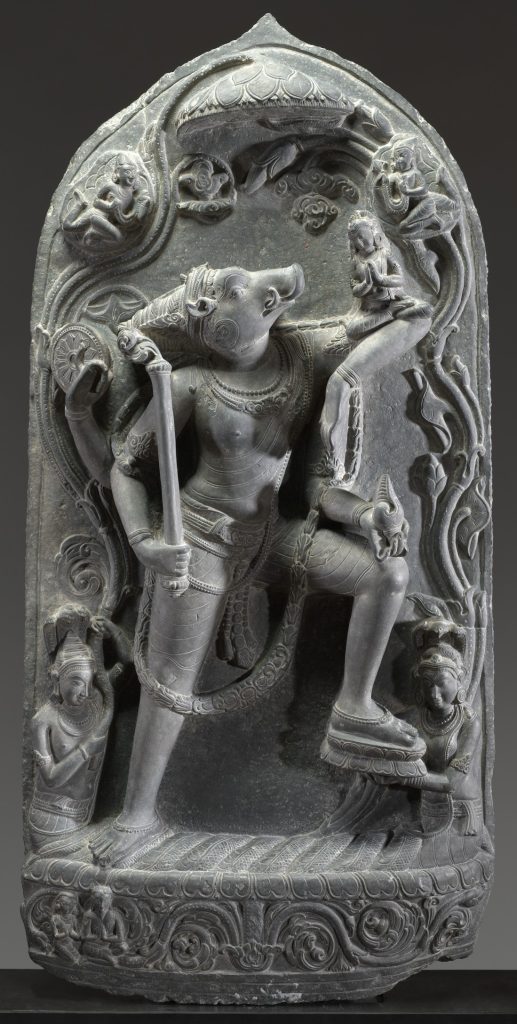
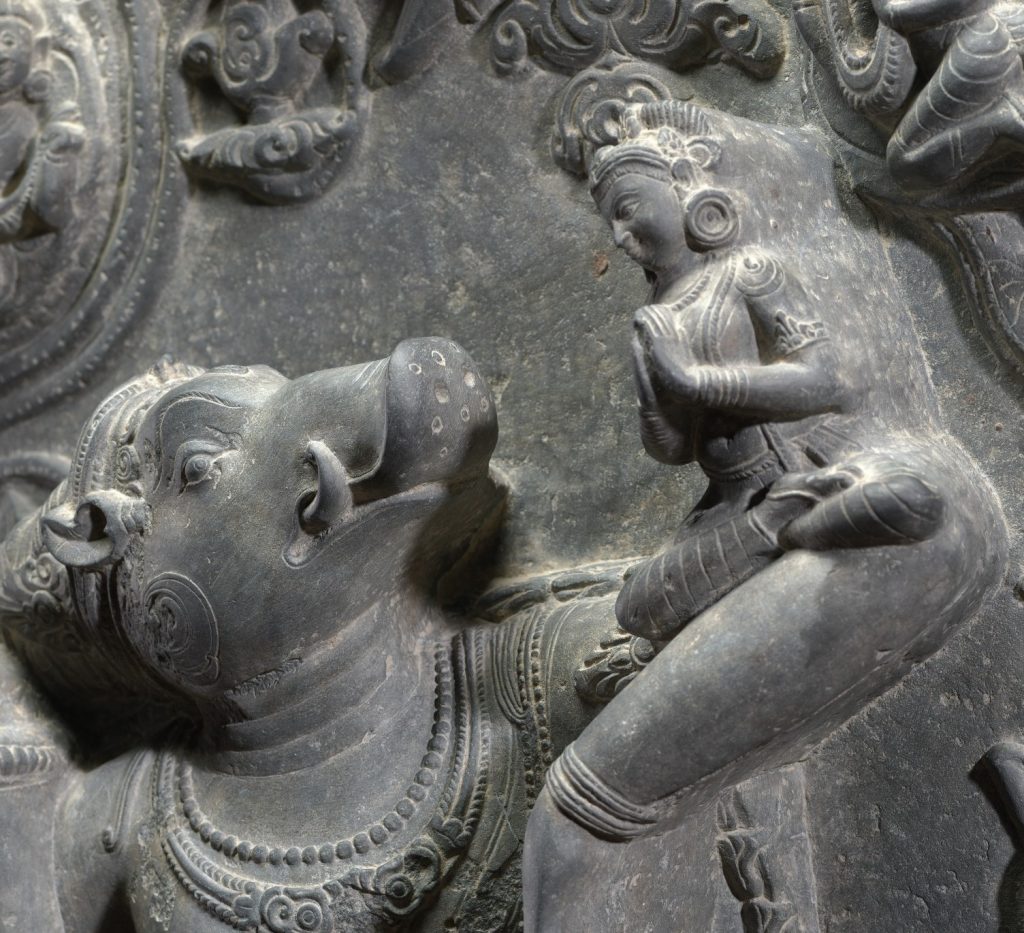
Unknown Artist, Vishnu as the Boar Avatar (Varaha),
10th century (Full sculpture above, detail below).
V I S H N U V A R A H A
How serenely she sits
Perched upon the rise of his elbow
Gazing at him with wonder and relief
And more than a little fear.
Her body, trembling perhaps, barely bigger than his nose
His snout mere inches from her mouth, her breasts, her hands joined
In awe and supplication;
Her eyes dazzled by the shock, perhaps
Of his breath, the twin tunnels of his nostrils
The slow, vast slope of the brow
The tusk protruding so gracefully
From either corner of his mouth;
The fearsome power of each pointed curve
At rest, at least for now. . .
His eyes reflecting, perhaps, the wonder in her own
As they bathe her in a gaze of triumphant affection
Ever mindful of the curves of her perfectly-formed, tiny body.
His great head thrust back, he grins at her
As only a wild boar can.
His right leg stretched behind him, left leg bent
He leans in toward her
The other of his two left hands resting on his knee.
He holds there a conch shell
Memento, perhaps, of his mission of moments ago—
Moments, whole eons, in pre-human time—
When he plunged beneath the sea and slew
The demon who would have her dead
Cracked its head with the mace he now grips proudly
In one of his two right hands, the other holding a chakra;
Swept her up with the tip of his tusk
Off the floor of the primordial ocean,
A task that took one thousand primordial years.
Who is she? Sweet Earth
Without whom our kind would be
Scarcely a floater in lord Vishnu’s eye.
And he? Third avatar of Vishnu himself—
Varaha the Boar—
Poised beneath a lotus the size of a hemisphere
Star of an ancient story captured here
By an artist working in eastern India
Perhaps a thousand years ago, our time—
A sculptor who rescued a piece of black stone
From silence and oblivion
Even as Vishnu the Boar rescued Earth
From where she lay bruised and battered
In the dark trough of the sea—
Hurled there by the demon Hiranyaksha
Golden-eyed bully of the world
Who wished to be its only king.
O, how that one deprived himself
To prove his devotion to Brahma, lord of the gods.
And lo, did Brahma grant him, in gratitude
For all this sacrifice, the boon of dominion
Over every animal he might care to name.
But we all know how it is with lists:
We forget. Something always gets left out.
Thus in his haste did the demon Hiranyaksha
Forget to name the wild boar. Yes,
Our badboy of the golden eyes
Forgot to remember, if he was aware,
That Vishnu the Creator moves in many forms.
That all must be counted, none can be ignored:
All of them must be accounted for.
And so our would-be hero Hiranyaksha
Quashed all the world’s creatures—or thought he did—
Seized all the scriptures
Snatched up the Earth
And dashed her to the bottom of the sea.
Enter Vishnu Varaha, true to his vow
Come to smash the demon
And salvage her.
One version of the story says
That when lord Vishnu bore our tattered Earth
Back to—where? the air?—he soothed her soul
And groomed her for ‘human use’
By ‘moulding her mountains and continents’—
All four of his hands, we can assume,
All sixteen fingers and four of his thumbs
Roamed eagerly over her body for millions
Of years. Kneaded her into the Eden
Our ancestors found
And pondered how to plunder
As they sat under bodhi-trees
And carved hand-axes of stone. . .
Even as, myriads of generations down,
The sculptor of this exquisite piece
Created it—
For us, though he couldn’t know this—
Plundered nothing more or less
Than his own imagination
His eye for detail and composition
The texture of the stone beneath his restless
Fingers, the feel of it in his hands—
And his love
For the magnificent body of lore
Spread endlessly, voluptuously
Before him.
8 June 2008
* * *
Editor’s Note: The Rubin Museum of Art will have a farewell weekend Oct. 4-6, 2024,
with an event on Friday the 4th (6-10 pm). Click here to find out more.
Return to Issue 6 Table of Contents